Editorial dossier / Logistics
Logistics App Planning Guide: Orders, Dispatch, Tracking and Proof of Delivery
Plan a logistics platform across service promises, orders, capacity, dispatch, driver workflows, tracking, proof of delivery, exceptions, billing and support.
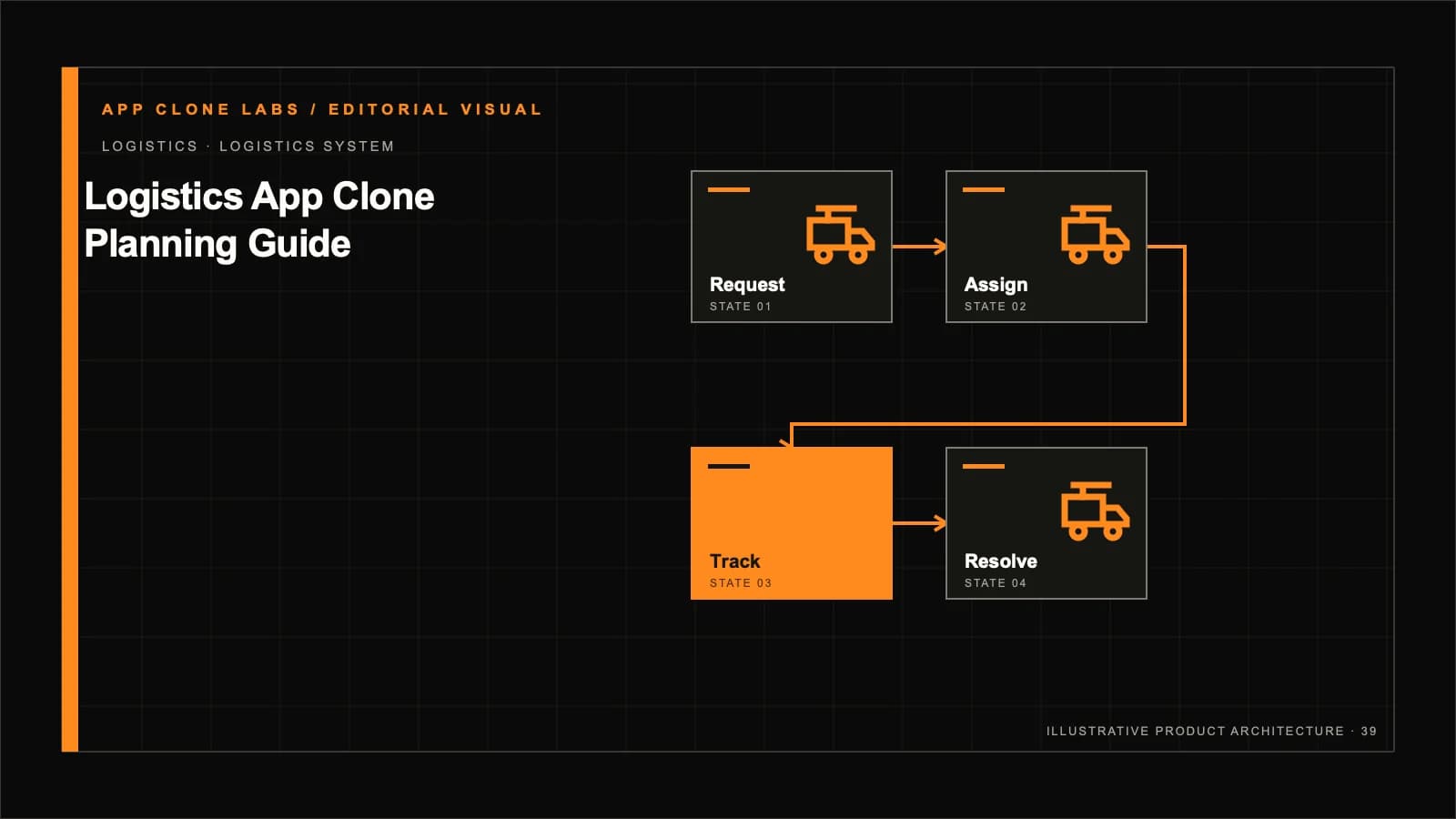
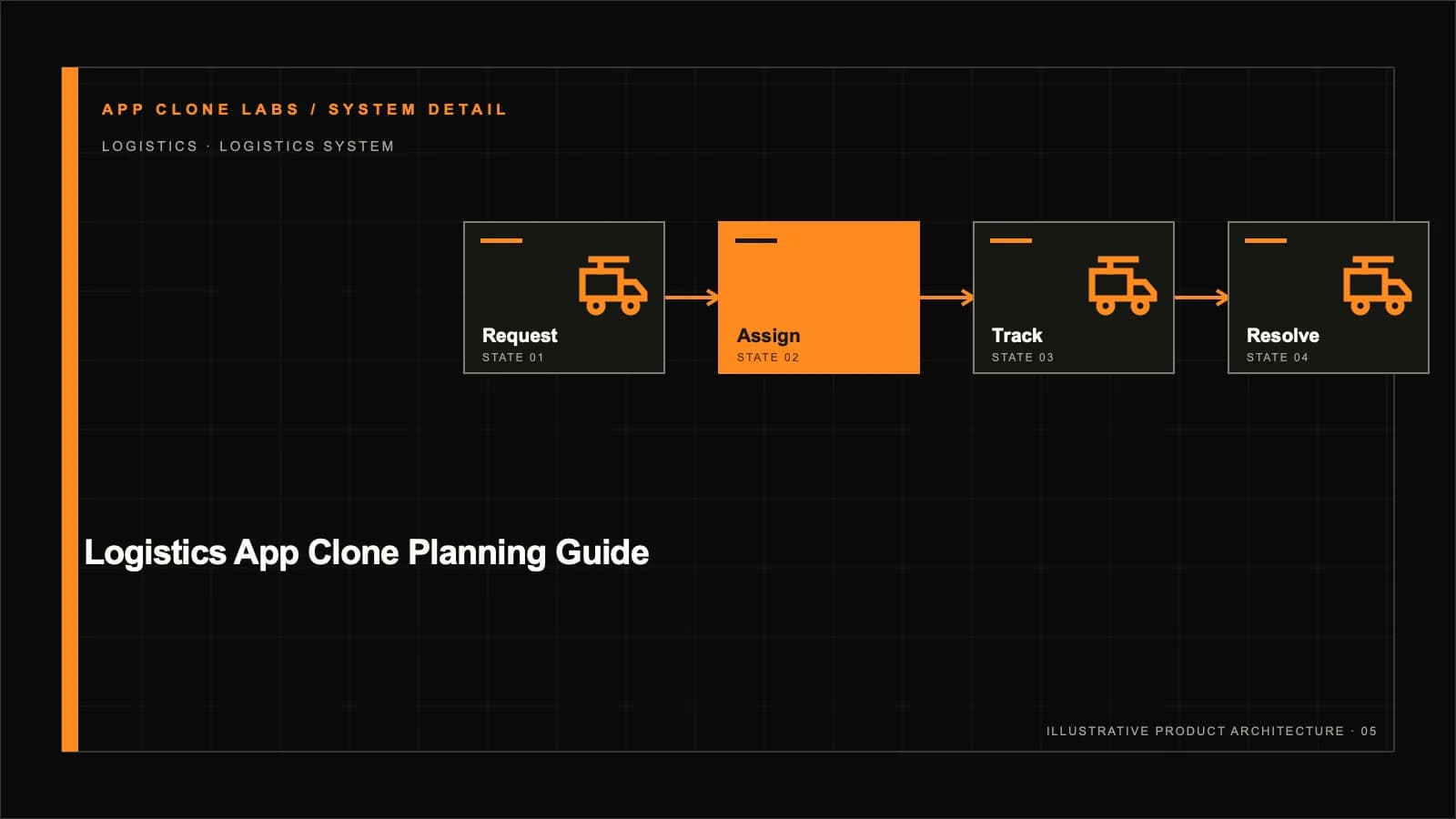
A driver can be shown as three minutes away while travelling in the opposite direction. A package can be marked delivered without evidence. A dispatcher can reassign a job after the original driver has already collected it. These are not map-screen defects; they are failures in state, authority and operational reconciliation.
A logistics platform coordinates a service promise across customer demand, physical capacity, people, locations and evidence. The application must remain useful when GPS is noisy, networks disappear, addresses are wrong and humans take actions at the same time.
This guide starts with the shipment lifecycle and exception ownership, then works outward to dispatch, tracking, proof, finance and scale.
Define the service promise
Same-day parcel, scheduled courier, freight and multi-stop distribution require different operations.
The failure mode is concrete: marketing offers speed and coverage that capacity rules cannot enforce. This is not solved by adding another screen or background job. The product has to define ownership, permitted transitions, and the evidence retained when the transition occurs.
For the first release, publish a versioned service definition for the initial geography. Write that decision as an enforceable server-side rule, not guidance that depends on a client, operator, or AI model remembering the intended boundary.
Implementation should include service area, item limits, pickup window, delivery target, exclusions, price basis, cancellation and support. Keep the public response smaller than the internal record: users need a clear outcome and recovery path, while authorized operators need correlation IDs, policy versions, timestamps, and the before-and-after state.
Validate it with boundary address, oversized item and missed window. Test the ordinary path, then repeat under timeout, duplicate delivery, stale state, partial failure, revoked authority, and concurrent requests. A feature is not ready when only the demonstration succeeds.
- Owner: product operations lead
- Release evidence: service blueprint
- Stop condition: dispatch cannot determine whether an order is serviceable
Model shipments as state machines
Booked, assigned, accepted, collected, in transit, attempted and delivered have distinct evidence.
The failure mode is concrete: one status field accepts arbitrary jumps. This is not solved by adding another screen or background job. The product has to define ownership, permitted transitions, and the evidence retained when the transition occurs.
For the first release, define permitted transitions, actors and prerequisites. Write that decision as an enforceable server-side rule, not guidance that depends on a client, operator, or AI model remembering the intended boundary.
Implementation should include shipment ID, state, version, actor, time, location, evidence and reason. Keep the public response smaller than the internal record: users need a clear outcome and recovery path, while authorized operators need correlation IDs, policy versions, timestamps, and the before-and-after state.
Validate it with duplicate command, stale client and concurrent reassignment. Test the ordinary path, then repeat under timeout, duplicate delivery, stale state, partial failure, revoked authority, and concurrent requests. A feature is not ready when only the demonstration succeeds.
- Owner: domain architect
- Release evidence: transition matrix
- Stop condition: a shipment reaches delivered without collection evidence
Separate stops from shipments
One route may carry several shipments and one shipment may require several stops.
The failure mode is concrete: route, order and stop are treated as the same record. This is not solved by adding another screen or background job. The product has to define ownership, permitted transitions, and the evidence retained when the transition occurs.
For the first release, model pickup and delivery obligations independently from route plans. Write that decision as an enforceable server-side rule, not guidance that depends on a client, operator, or AI model remembering the intended boundary.
Implementation should include shipment, stop, sequence, type, address version, window, contact, status and evidence. Keep the public response smaller than the internal record: users need a clear outcome and recovery path, while authorized operators need correlation IDs, policy versions, timestamps, and the before-and-after state.
Validate it with multi-drop route, return stop and split shipment. Test the ordinary path, then repeat under timeout, duplicate delivery, stale state, partial failure, revoked authority, and concurrent requests. A feature is not ready when only the demonstration succeeds.
- Owner: logistics architect
- Release evidence: relationship invariants
- Stop condition: changing a route rewrites completed stop history
Validate addresses without pretending certainty
Geocoding can return plausible but operationally wrong results.
The failure mode is concrete: the first autocomplete result becomes unquestioned truth. This is not solved by adding another screen or background job. The product has to define ownership, permitted transitions, and the evidence retained when the transition occurs.
For the first release, retain entered, normalized and confirmed location data separately. Write that decision as an enforceable server-side rule, not guidance that depends on a client, operator, or AI model remembering the intended boundary.
Implementation should include raw address, place reference, coordinates, precision, landmark, access note and verifier. Keep the public response smaller than the internal record: users need a clear outcome and recovery path, while authorized operators need correlation IDs, policy versions, timestamps, and the before-and-after state.
Validate it with apartment entrance, rural pin and corrected address. Test the ordinary path, then repeat under timeout, duplicate delivery, stale state, partial failure, revoked authority, and concurrent requests. A feature is not ready when only the demonstration succeeds.
- Owner: address quality owner
- Release evidence: failed-address sample
- Stop condition: drivers cannot report or resolve location ambiguity
Checkpoint 4: reconcile the product promise with the recorded state. Support, finance, security, and delivery teams should be able to reach the same conclusion from the same identifiers without reconstructing events from chat messages or screenshots.
Represent capacity explicitly
Vehicles and drivers have weight, volume, time, skill and service constraints.
The failure mode is concrete: available means every job can be assigned. This is not solved by adding another screen or background job. The product has to define ownership, permitted transitions, and the evidence retained when the transition occurs.
For the first release, compute eligibility from current capacity and obligation context. Write that decision as an enforceable server-side rule, not guidance that depends on a client, operator, or AI model remembering the intended boundary.
Implementation should include vehicle, driver, shift, zone, load, dimensions, equipment, certifications and remaining time. Keep the public response smaller than the internal record: users need a clear outcome and recovery path, while authorized operators need correlation IDs, policy versions, timestamps, and the before-and-after state.
Validate it with oversized parcel, shift end and overlapping job. Test the ordinary path, then repeat under timeout, duplicate delivery, stale state, partial failure, revoked authority, and concurrent requests. A feature is not ready when only the demonstration succeeds.
- Owner: fleet operations
- Release evidence: capacity rejection tests
- Stop condition: dispatch creates physically impossible work
Make assignment a reservation
Automated and manual dispatch may compete for the same driver.
The failure mode is concrete: two workers assign one driver simultaneously. This is not solved by adding another screen or background job. The product has to define ownership, permitted transitions, and the evidence retained when the transition occurs.
For the first release, reserve, offer, accept or expire assignments with idempotent transitions. Write that decision as an enforceable server-side rule, not guidance that depends on a client, operator, or AI model remembering the intended boundary.
Implementation should include candidate set, score explanation, offer ID, expiry, acceptance, rejection and release. Keep the public response smaller than the internal record: users need a clear outcome and recovery path, while authorized operators need correlation IDs, policy versions, timestamps, and the before-and-after state.
Validate it with double offer, offline driver and dispatcher override. Test the ordinary path, then repeat under timeout, duplicate delivery, stale state, partial failure, revoked authority, and concurrent requests. A feature is not ready when only the demonstration succeeds.
- Owner: dispatch lead
- Release evidence: concurrency invariant
- Stop condition: one driver owns conflicting active jobs
Design driver workflow for interruption
Drivers operate with glare, movement, low battery and unstable networks.
The failure mode is concrete: the app assumes continuous connectivity and careful typing. This is not solved by adding another screen or background job. The product has to define ownership, permitted transitions, and the evidence retained when the transition occurs.
For the first release, use large, bounded tasks with offline-safe command queues. Write that decision as an enforceable server-side rule, not guidance that depends on a client, operator, or AI model remembering the intended boundary.
Implementation should include current stop, required action, local timestamp, evidence, sync state, retry and conflict. Keep the public response smaller than the internal record: users need a clear outcome and recovery path, while authorized operators need correlation IDs, policy versions, timestamps, and the before-and-after state.
Validate it with network loss at pickup, app restart and stale route. Test the ordinary path, then repeat under timeout, duplicate delivery, stale state, partial failure, revoked authority, and concurrent requests. A feature is not ready when only the demonstration succeeds.
- Owner: driver product owner
- Release evidence: field interruption test
- Stop condition: a completed action disappears after reconnection
Treat location as a sampled signal
GPS points contain error, gaps and privacy consequences.
The failure mode is concrete: every coordinate is shown as precise truth. This is not solved by adding another screen or background job. The product has to define ownership, permitted transitions, and the evidence retained when the transition occurs.
For the first release, store accuracy and freshness and derive customer-safe status. Write that decision as an enforceable server-side rule, not guidance that depends on a client, operator, or AI model remembering the intended boundary.
Implementation should include subject, latitude, longitude, accuracy, captured time, received time, motion and consent state. Keep the public response smaller than the internal record: users need a clear outcome and recovery path, while authorized operators need correlation IDs, policy versions, timestamps, and the before-and-after state.
Validate it with urban canyon, spoofed point and long silence. Test the ordinary path, then repeat under timeout, duplicate delivery, stale state, partial failure, revoked authority, and concurrent requests. A feature is not ready when only the demonstration succeeds.
- Owner: tracking lead
- Release evidence: trace quality suite
- Stop condition: the interface shows stale position as live
Checkpoint 8: reconcile the product promise with the recorded state. Support, finance, security, and delivery teams should be able to reach the same conclusion from the same identifiers without reconstructing events from chat messages or screenshots.
Calculate ETA as a range and version
Traffic, service time and route changes make arrival uncertain.
The failure mode is concrete: one exact minute is promised and continuously oscillates. This is not solved by adding another screen or background job. The product has to define ownership, permitted transitions, and the evidence retained when the transition occurs.
For the first release, retain prediction versions and communicate useful windows. Write that decision as an enforceable server-side rule, not guidance that depends on a client, operator, or AI model remembering the intended boundary.
Implementation should include model or provider, input route, generated time, lower and upper bound, confidence and reason. Keep the public response smaller than the internal record: users need a clear outcome and recovery path, while authorized operators need correlation IDs, policy versions, timestamps, and the before-and-after state.
Validate it with new stop, traffic incident and missing location. Test the ordinary path, then repeat under timeout, duplicate delivery, stale state, partial failure, revoked authority, and concurrent requests. A feature is not ready when only the demonstration succeeds.
- Owner: routing owner
- Release evidence: ETA calibration report
- Stop condition: predictions are judged only by attractive demos
Require collection and delivery evidence
Evidence supports customer trust, billing and dispute resolution.
The failure mode is concrete: a single button creates proof. This is not solved by adding another screen or background job. The product has to define ownership, permitted transitions, and the evidence retained when the transition occurs.
For the first release, define proof requirements by service and exception type. Write that decision as an enforceable server-side rule, not guidance that depends on a client, operator, or AI model remembering the intended boundary.
Implementation should include actor, stop, timestamp, location, signature or photo, recipient, consent and tamper metadata. Keep the public response smaller than the internal record: users need a clear outcome and recovery path, while authorized operators need correlation IDs, policy versions, timestamps, and the before-and-after state.
Validate it with contactless delivery, refused signature and failed upload. Test the ordinary path, then repeat under timeout, duplicate delivery, stale state, partial failure, revoked authority, and concurrent requests. A feature is not ready when only the demonstration succeeds.
- Owner: quality owner
- Release evidence: proof completeness audit
- Stop condition: delivery is finalized without required evidence
Build exception workflows first
Address failures, absent recipients, damage and vehicle breakdown are ordinary logistics.
The failure mode is concrete: drivers call dispatch and state is reconstructed later. This is not solved by adding another screen or background job. The product has to define ownership, permitted transitions, and the evidence retained when the transition occurs.
For the first release, create typed exceptions with permitted actions and ownership. Write that decision as an enforceable server-side rule, not guidance that depends on a client, operator, or AI model remembering the intended boundary.
Implementation should include type, severity, shipment, evidence, driver safety, owner, customer impact, next action and deadline. Keep the public response smaller than the internal record: users need a clear outcome and recovery path, while authorized operators need correlation IDs, policy versions, timestamps, and the before-and-after state.
Validate it with unsafe location, damaged parcel and failed attempt. Test the ordinary path, then repeat under timeout, duplicate delivery, stale state, partial failure, revoked authority, and concurrent requests. A feature is not ready when only the demonstration succeeds.
- Owner: exception operations
- Release evidence: scenario rehearsal
- Stop condition: a driver cannot proceed safely without improvisation
Coordinate customer communication
Notifications should reflect verified operational transitions.
The failure mode is concrete: messages are emitted from client screens and duplicated on retry. This is not solved by adding another screen or background job. The product has to define ownership, permitted transitions, and the evidence retained when the transition occurs.
For the first release, publish idempotent communication events from server state. Write that decision as an enforceable server-side rule, not guidance that depends on a client, operator, or AI model remembering the intended boundary.
Implementation should include event ID, audience, channel, template version, locale, send status and preference. Keep the public response smaller than the internal record: users need a clear outcome and recovery path, while authorized operators need correlation IDs, policy versions, timestamps, and the before-and-after state.
Validate it with reassignment, ETA change and cancelled shipment. Test the ordinary path, then repeat under timeout, duplicate delivery, stale state, partial failure, revoked authority, and concurrent requests. A feature is not ready when only the demonstration succeeds.
- Owner: communications owner
- Release evidence: notification timeline
- Stop condition: customers receive contradictory shipment states
Checkpoint 12: reconcile the product promise with the recorded state. Support, finance, security, and delivery teams should be able to reach the same conclusion from the same identifiers without reconstructing events from chat messages or screenshots.
Calculate charges from auditable inputs
Distance, time, zones, surcharges and exceptions can change final price.
The failure mode is concrete: the customer quote and final invoice use unrelated logic. This is not solved by adding another screen or background job. The product has to define ownership, permitted transitions, and the evidence retained when the transition occurs.
For the first release, version rating rules and retain the inputs for every calculation. Write that decision as an enforceable server-side rule, not guidance that depends on a client, operator, or AI model remembering the intended boundary.
Implementation should include service, distance source, duration, zone, weight, surcharge, discount, tax, currency and rule version. Keep the public response smaller than the internal record: users need a clear outcome and recovery path, while authorized operators need correlation IDs, policy versions, timestamps, and the before-and-after state.
Validate it with reroute, waiting time and cancelled pickup. Test the ordinary path, then repeat under timeout, duplicate delivery, stale state, partial failure, revoked authority, and concurrent requests. A feature is not ready when only the demonstration succeeds.
- Owner: billing owner
- Release evidence: quote-to-invoice reconciliation
- Stop condition: support cannot explain a charge
Give dispatch a control tower
Operators need prioritized exceptions and current capacity, not a decorative map.
The failure mode is concrete: the dashboard displays vehicles but hides failing obligations. This is not solved by adding another screen or background job. The product has to define ownership, permitted transitions, and the evidence retained when the transition occurs.
For the first release, organize around unassigned work, SLA risk and owned exceptions. Write that decision as an enforceable server-side rule, not guidance that depends on a client, operator, or AI model remembering the intended boundary.
Implementation should include queue, severity, shipment, promised window, latest evidence, owner, recommended action and audit. Keep the public response smaller than the internal record: users need a clear outcome and recovery path, while authorized operators need correlation IDs, policy versions, timestamps, and the before-and-after state.
Validate it with location outage, assignment backlog and regional incident. Test the ordinary path, then repeat under timeout, duplicate delivery, stale state, partial failure, revoked authority, and concurrent requests. A feature is not ready when only the demonstration succeeds.
- Owner: control-tower lead
- Release evidence: shift simulation
- Stop condition: operators cannot identify the next consequential decision
Rehearse regional failure and recovery
Maps, notifications, payments and tracking are external or distributed dependencies.
The failure mode is concrete: the service has no degraded operating mode. This is not solved by adding another screen or background job. The product has to define ownership, permitted transitions, and the evidence retained when the transition occurs.
For the first release, define fallbacks, reconciliation and staged restoration per dependency. Write that decision as an enforceable server-side rule, not guidance that depends on a client, operator, or AI model remembering the intended boundary.
Implementation should include health signal, circuit state, queued commands, manual procedure, communication, rollback and recovery evidence. Keep the public response smaller than the internal record: users need a clear outcome and recovery path, while authorized operators need correlation IDs, policy versions, timestamps, and the before-and-after state.
Validate it with map outage, delayed events and database failover. Test the ordinary path, then repeat under timeout, duplicate delivery, stale state, partial failure, revoked authority, and concurrent requests. A feature is not ready when only the demonstration succeeds.
- Owner: operations lead
- Release evidence: incident exercise
- Stop condition: physical work continues while digital state becomes unrecoverable
Implementation references
Use GS1 logistics standards and record the version used for the release.
Validate implementation against W3C Geolocation API specification and record the version used for the release.
Review OWASP API Security Top 10 and record the version used for the release.
Compare with Google Maps Routes API documentation and record the version used for the release.
Continue with Logistics Industry when translating the operating model into delivery scope.
Frequently asked questions
What is the smallest credible logistics MVP?
Serviceability, shipment and stop lifecycles, driver onboarding, capacity-aware assignment, driver tasks, tracking freshness, proof of delivery, exception handling, notifications and dispatch support.
Should GPS be treated as exact?
No. Store accuracy and timestamps, detect stale or implausible points and communicate derived status rather than false precision.
How should dispatch prevent double assignment?
Use reservation or offer states with version checks, expiry and idempotent acceptance.
What proof of delivery is required?
It depends on the service: timestamp and actor at minimum, with location, recipient, signature or photo where policy and consent allow.
How should offline driver actions work?
Queue stable command IDs locally, preserve occurrence time, retry safely and resolve conflicts against server versions.
What belongs on a dispatch dashboard?
Unassigned jobs, capacity constraints, promised-window risks, stale tracking, active exceptions and owned recovery actions.
How should ETA be displayed?
As a useful time window with freshness, recalculated after material route changes and evaluated for calibration.
What should be tested before launch?
Concurrent assignment, offline pickup, bad address, missing recipient, proof upload failure, pricing reconciliation, regional dependency outage and recovery.
Turn the model into release evidence
A credible release connects its public promise to durable states, scoped authority and recoverable operations. The team should be able to explain ordinary journeys and important exceptions without reconstructing truth from screenshots or chat.
Keep the initial scope narrow enough to rehearse. Expand only after access, money, evidence and support outcomes remain consistent under retries, stale data, partial failures and human mistakes.
- 01
- 02
- 03
- 04
- 05
- 06
Reviewed by the App Clone Labs product strategy team
This guide is written for founders and operators planning clone-inspired platforms, SaaS products, marketplaces, and mobile apps. It is reviewed against App Clone Labs delivery patterns, product scoping standards, and current implementation realities before being published.
Review the editorial team structureRelated product paths
Continue with the services, solutions, guides, and articles that connect this topic to a real software build.
Services, solutions, and guides
Read next