Case record / Healthcare operations
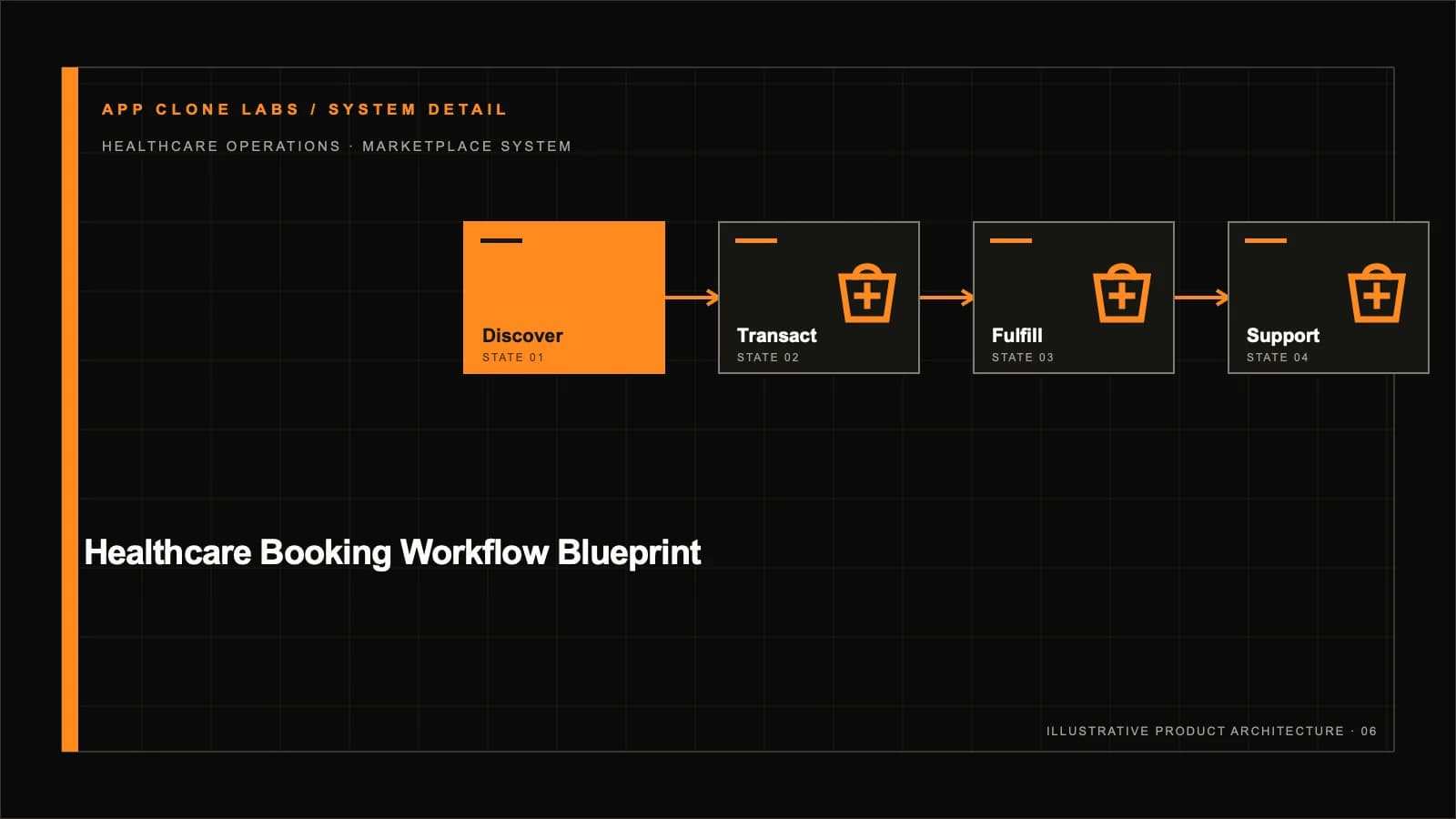
Healthcare Booking Workflow Blueprint
A conceptual delivery blueprint pending verification of project provenance, permissions, implementation status, and outcomes.
Published outcome claim / not independently verified here
Conceptual reference only; no client result is claimed.
Request a similar build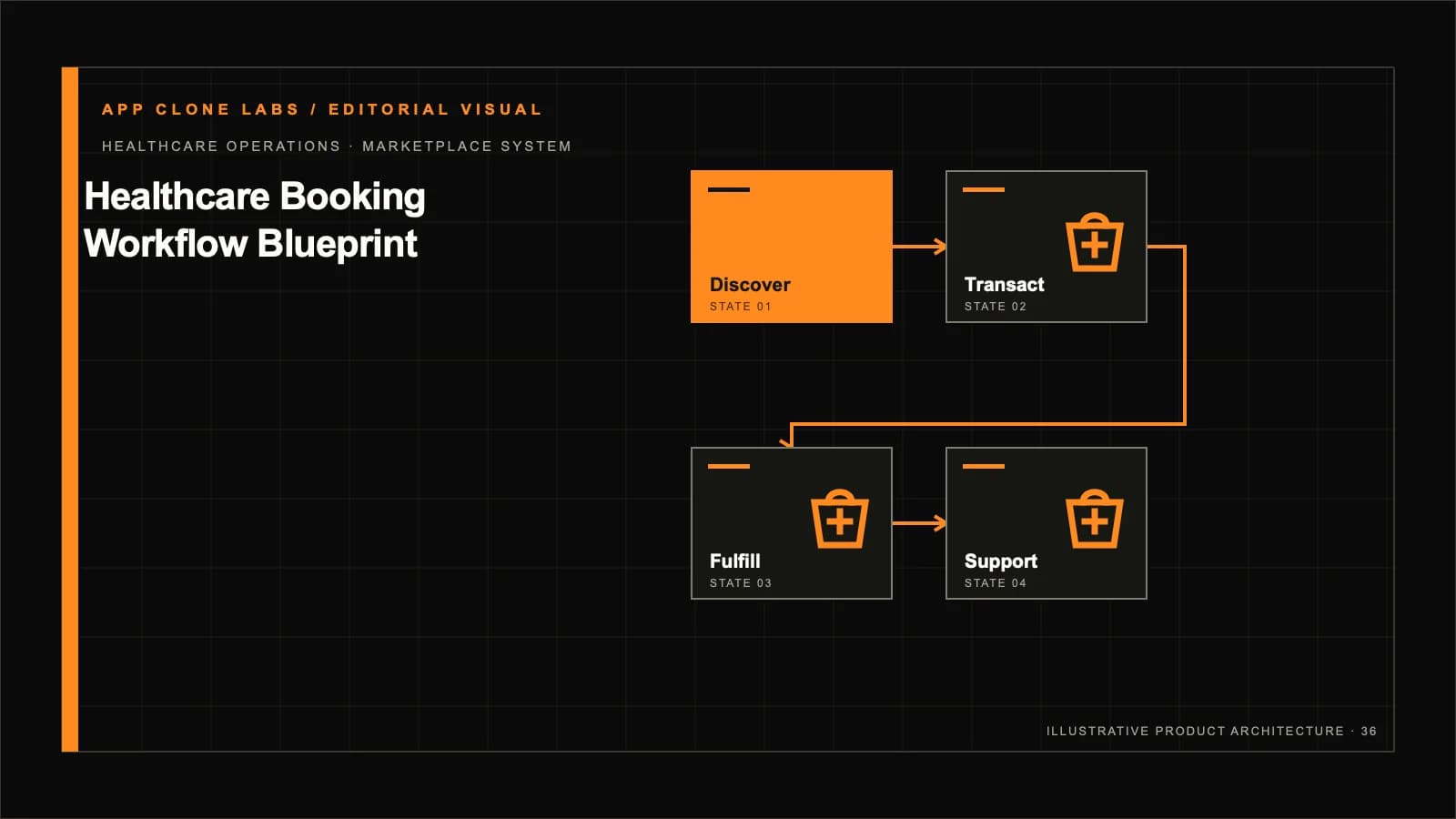
Proof status / evidence boundary
What this record can and cannot establish
Recorded project context
The industry, summary, service list, stack, narrative, and body are fields supplied by the case-study record.
Architecture and workflow
The workflow and technology labels describe the published delivery scope. They are not presented here as a new contractual commitment.
Outcome evidence boundary
Public outcome evidence is not attached to this record.
Evidence status: Blueprint / Last reviewed: Not recorded
Context / delivery read
A similar product needs workflow clarity before interface polish.
The fastest path is to map the commercial loop, user roles, admin controls, integrations, reporting, and launch handoff before design and engineering scale up.
Recorded services
Workflow and deliverables
Role-specific user journeys before interface design
Admin, support, reporting, and operations controls
Payment, notification, map, media, or AI integrations scoped early
Launch documentation, cloud context, and ownership handoff
The healthcare founder needed a booking product that could support patient search, doctor availability, appointment states, clinic-side review, prescriptions, and post-visit support without becoming a full hospital system in version one.
The work focused on workflow boundaries: what patients could change, what clinics could approve, which records were visible, how support would resolve missed appointments, and what admin reports were needed after launch.
The outcome was an anonymized healthcare launch plan with role permissions, appointment-state logic, support workflows, record handling notes, and cloud-readiness guidance for a focused MVP.
Technical architecture and system design
CareQueue was architected as a React Native patient app paired with a Node.js service layer and PostgreSQL on AWS, with role separation across patient, clinic, doctor, support, and admin surfaces enforced through JWT-scoped tokens rather than route-level guards alone. Appointment state was modeled as an explicit state machine—requested, clinic-approved, confirmed, checked-in, completed, cancelled, no-show—so every transition could be audited and replayed for support disputes, with illegal transitions rejected at the service layer before any database write. Doctor availability was stored as a calendar primitive with conflict-checked booking windows backed by a Postgres exclusion constraint on the (doctor_id, slot_start, slot_end) range, ensuring double bookings were impossible at the database level even under concurrent patient requests hitting the same slot. Patient records handoff was treated as a controlled disclosure flow rather than an open file store, with access logged for compliance review and each disclosure scoped to a specific appointment so support agents could never retrieve records outside the visit they were resolving. The clinic-side calendar management surface allowed clinic admins to define recurring availability templates per doctor, block specific slots for leave, and set booking lead times so patients could not book same-day appointments for clinics that required 24-hour notice, and these rules were enforced server-side so a patient app could not bypass them by crafting a direct API call.
API design separated the patient booking journey from the clinic management journey, with prescription flow and post-visit support modeled as discrete services rather than embedded in the booking endpoint, so a spike in prescription volume could not degrade the booking path. Real-time requirements were modest, but appointment status updates used a lightweight event channel backed by a Postgres LISTEN/NOTIFY fan-out so patients and clinics saw consistent state without polling, with a fallback long-poll fallback for devices behind restrictive networks. The architecture deferred full EHR integration, insurance claims, and telemedicine to later phases so the first release could prove the booking and clinic-review loop under real patient load, and each deferred module was documented as a service boundary so later teams could slot it in without refactoring the booking core. Cloud security controls were applied at the data layer with AES-256 encryption at rest, TLS 1.3 in transit, and field-level access policies for sensitive records enforced through row-level security so a misconfigured client could never read PHI it was not entitled to.
Development methodology and sprint breakdown
The build ran in two-week sprints, opening with a discovery sprint that locked the 11 patient and clinic workflows, role permissions, and appointment-state logic before any UI work, with each workflow signed off as a one-page spec so scope changes had to be negotiated rather than silently absorbed. Sprint one delivered patient search and booking against stubbed clinic calendars, while sprint two introduced clinic-side approval, prescription flow, and post-visit support, with the state machine tests written before the handlers so illegal transitions failed the build immediately. QA covered the full appointment lifecycle on each build, with particular attention to missed-appointment handling and record access edge cases, including negative tests that verified a patient token could not read another patient appointment. Each sprint closed with a demoable release reviewed by the healthcare founder, and release sequencing kept admin reporting in the same sprint as the clinic feature it governed so no feature shipped without its operational visibility.
A hardening sprint before launch stress-tested record access permissions, missed-appointment resolution, and support queue routing, since these were the workflows most likely to generate compliance and operational load, and each was load-tested against a synthetic patient population to surface concurrency bugs. Automated regression checks validated that no patient could access records outside their visit history and that appointment transitions followed the legal state path, with a property-based test suite that generated random transition sequences and asserted only legal ones persisted. The final release checklist included cloud handoff, monitoring for access-policy violations with alerting wired to the on-call channel, and a support runbook for missed-appointment disputes that mapped each dispute type to the exact state-machine transition the agent should look up. This sequencing kept the healthcare MVP focused on booking and clinic review while leaving a documented backlog for EHR and insurance, each item annotated with the estimated compliance effort so the founder could prioritize the next phase realistically.
Operational challenges and resolutions
The dominant operational challenge was appointment no-show handling, where missed visits created billing ambiguity and wasted clinic capacity that could not be backfilled on short notice. The resolution was a no-show state with configurable patient-side soft limits—three no-shows in a rolling 90-day window triggered a temporary booking hold—and a clinic-side override for documented medical emergencies, tracked in the admin console for repeat cases so operators could spot patterns before they escalated. Doctor availability drift, where clinics forgot to block calendars for leave or holidays, was handled with a periodic revalidation job that pruned stale slots older than the configured freshness threshold and alerted clinic admins via in-app and email notifications. Prescription flow ambiguity, where post-visit scripts were unclear to patients because free-text instructions varied by doctor, was resolved by structuring prescriptions as discrete records linked to the appointment with standardized dosage, frequency, and duration fields validated against a medication reference table.
Record access compliance surfaced when support agents needed context for a ticket but should not see full clinical history; the team introduced a scoped disclosure flow that exposed only the appointment record relevant to the ticket, with every access logged to an append-only audit table that compliance reviewers could query by agent, patient, or date range. Patient search quality, where irrelevant doctors dominated results because the initial implementation matched on a generic text index, was improved by indexing on specialty, location, and availability using a composite GIN index so results prioritized doctors with open slots near the patient before falling back to broader matches. Each resolution was captured as a runbook so the clinic operations team could manage the platform independently after handoff, with each runbook linked from the admin console so operators did not have to hunt through a separate documentation site. These operational fixes directly supported the 11 workflows clarified before build, and the audit trail they produced became the evidence the founder used when negotiating data-processing agreements with larger clinic networks.
Admin and operator tooling
The admin console covered clinic onboarding, doctor verification, appointment dispute resolution, no-show review, and healthcare reporting, with each surface built as a tab rather than a separate page so operators could switch context without losing their filter state. Operators could view clinic onboarding status, appointment completion rates, and no-show trends on a single dashboard, with drill-downs into individual records that preserved the audit context so every click was traceable. Support tooling linked each ticket to the underlying appointment with scoped record access, giving agents context without exposing full clinical history, and the ticket view rendered the relevant state-machine transitions inline so agents did not have to open a separate timeline view. Reporting dashboards exposed booking volume, completion rate, no-show rate, and clinic utilization, refreshed on a near-real-time pipeline backed by a materialized view that recomputed every five minutes so the numbers were never more than a few minutes stale.
Operational controls included configurable no-show policies with per-clinic thresholds, a patient block list for abuse that prevented new bookings while allowing existing ones to complete, a doctor verification workflow with document upload and admin sign-off, and a release-control surface for toggling features per clinic so a risky change could be enabled for a pilot clinic without affecting the rest. The admin dashboard provided audit logs for every record access and appointment override so post-incident reviews had a clear compliance trail, and the logs were exportable in a regulator-friendly format that mapped each action to the user, timestamp, and affected record. This tooling layer was what made the healthcare product operable at launch, not just bookable, and it directly enabled the 11 workflows clarified before build. Clinic teams could manage calendars and review appointments without engineering involvement, keeping the clinical cadence independent of the deploy cycle, which mattered because clinic staff turnover meant the tooling had to be learnable in a single onboarding session rather than requiring engineering hand-holding.
Launch outcomes and lessons
The MVP launched with a curated set of verified clinics and a documented expansion playbook, proving the booking and clinic-review loop before any EHR or insurance modules were added, and the curated launch kept the support surface area small enough that the two-person operations team could handle every ticket personally during the first month. What worked well was the explicit appointment-state machine, which made no-show disputes resolvable in minutes because the agent could see the exact transition history, and the scoped record access flow, which kept support context-rich without compromising compliance because every disclosure was logged and justified. What did not work was underestimating doctor availability drift, which required the revalidation job after the first week when three clinics had stale slots that patients booked and then arrived to find the doctor absent. The lesson was that clinic calendars must be revalidated on a schedule, not trusted to stay accurate, because clinic staff treat a booking platform as a lower priority than patient care in the room. A third lesson, surfaced only after the second clinic onboarded, was that the no-show soft-limit threshold needed to be per-clinic configurable rather than platform-wide, because a busy urban clinic with high patient turnover tolerated a different no-show rate than a specialist clinic with weeks-long wait lists, and a single threshold would have penalized clinics whose patient demographics made no-shows structurally more likely.
A second lesson was that record access must be scoped per ticket from day one, since retroactive access controls would have created a compliance liability the moment the first support agent saw a full clinical history without a documented reason. Founders evaluating a similar healthcare booking build should resist launching EHR integration or insurance claims early, because their compliance complexity dwarfs the booking MVP and the integration effort can consume a quarter of engineering time before a single patient is served. The anonymized launch plan captured these lessons as a checklist for the next clinic rollout, with each item tied to the specific incident or near-miss that produced it so the next team understood the reasoning rather than just the rule. Overall, the launch validated that clone-inspired healthcare products succeed when the operating layer is engineered as carefully as the patient app, and that the boring parts—state machines, audit logs, and revalidation jobs—are what keep a healthcare product defensible once competitors notice the model.
Scalability and post-launch evolution
The architecture was designed to scale by keeping transactional data in PostgreSQL with indexed doctor availability and conflict-checked booking windows, with a documented sharding plan keyed by clinic region so the booking table could be partitioned once a single region exceeded a million monthly appointments. The Node.js service layer was deployed with autoscaling on AWS behind an application load balancer, and the appointment-status event channel was built to fan out across instances for concurrent patient-clinic updates using a shared Redis pub-sub layer so a patient on one instance and a clinic admin on another saw the same transition within seconds. Record access was governed by field-level policies enforced at the data layer through Postgres row-level security so compliance did not bottleneck on application logic, and the policies were unit-tested against synthetic tokens representing each role to catch regressions before deploy. Deferred to later phases were full EHR integration, insurance claims, telemedicine, and a patient health timeline, each scoped as a separate service to avoid entangling the booking loop and each given an interface contract so the booking core could call them without knowing their internals.
Post-launch evolution followed the documented backlog: new clinics were onboarded by replicating the verification flow with clinic-specific calendar rules, validated through per-clinic feature toggles so a misconfigured clinic could be paused without affecting the rest of the network. Reporting was upgraded from near-real-time to a streaming pipeline once booking volume justified the investment, with the materialized views replaced by a Kafka-backed stream that fed a ClickHouse warehouse so the founder could run cohort analysis across months of appointments without loading the transactional database. The prescription flow later absorbed a pharmacy integration that sent structured prescriptions to partner pharmacies via a queued outbound API, but only after the MVP proved that discrete prescription records were sufficient for launch and after enough volume existed to negotiate pharmacy partnerships. This phased evolution kept the healthcare platform stable under growth while preserving the original clone-inspired speed of the first release, and the discipline of deferring each module until its predecessor was proven meant the team never carried more than one major integration in flight at a time.
Related case records