Case record / Media subscription
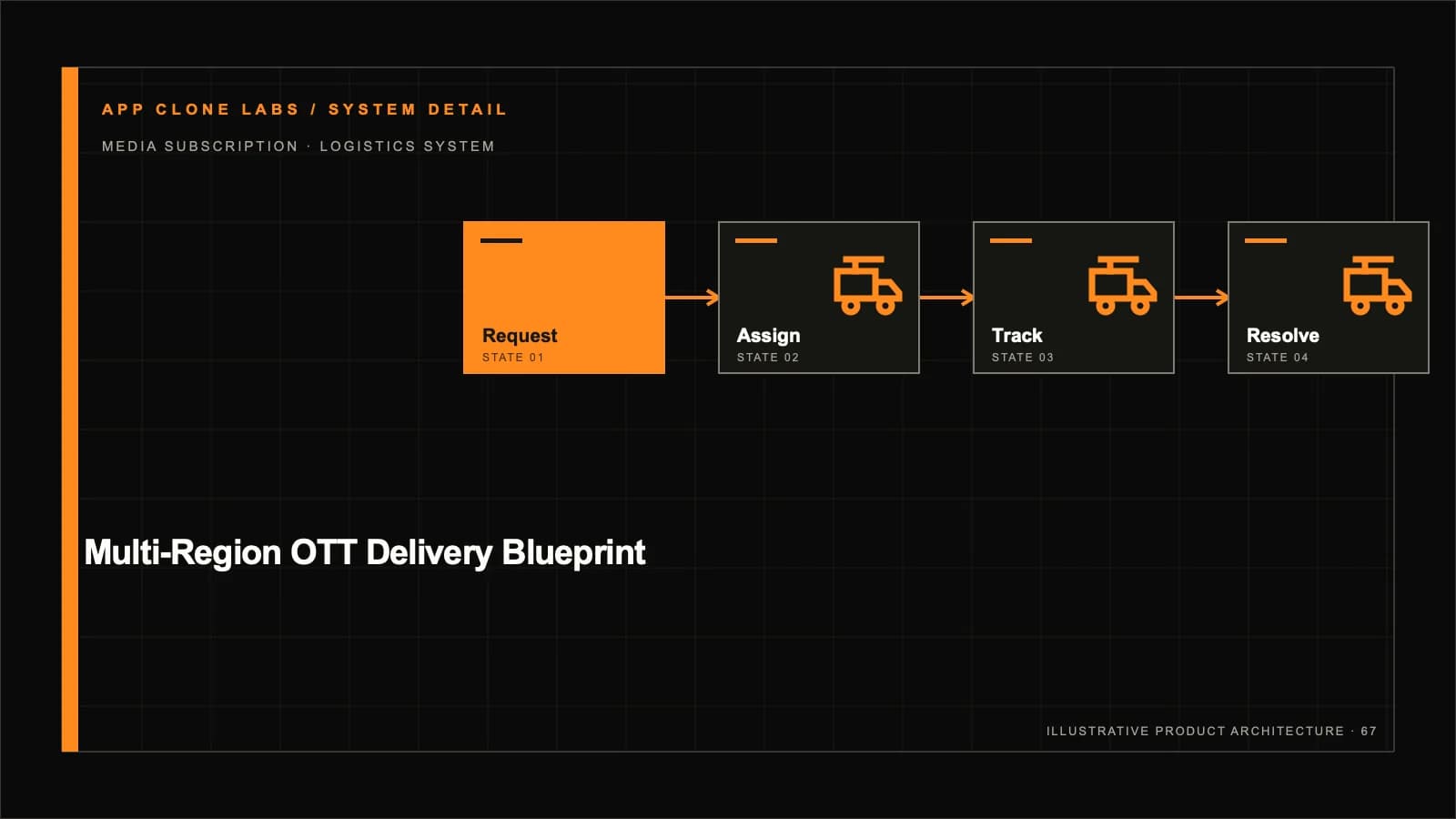
Multi-Region OTT Delivery Blueprint
A conceptual delivery blueprint pending verification of project provenance, permissions, implementation status, and outcomes.
Published outcome claim / not independently verified here
Conceptual reference only; no client result is claimed.
Request a similar build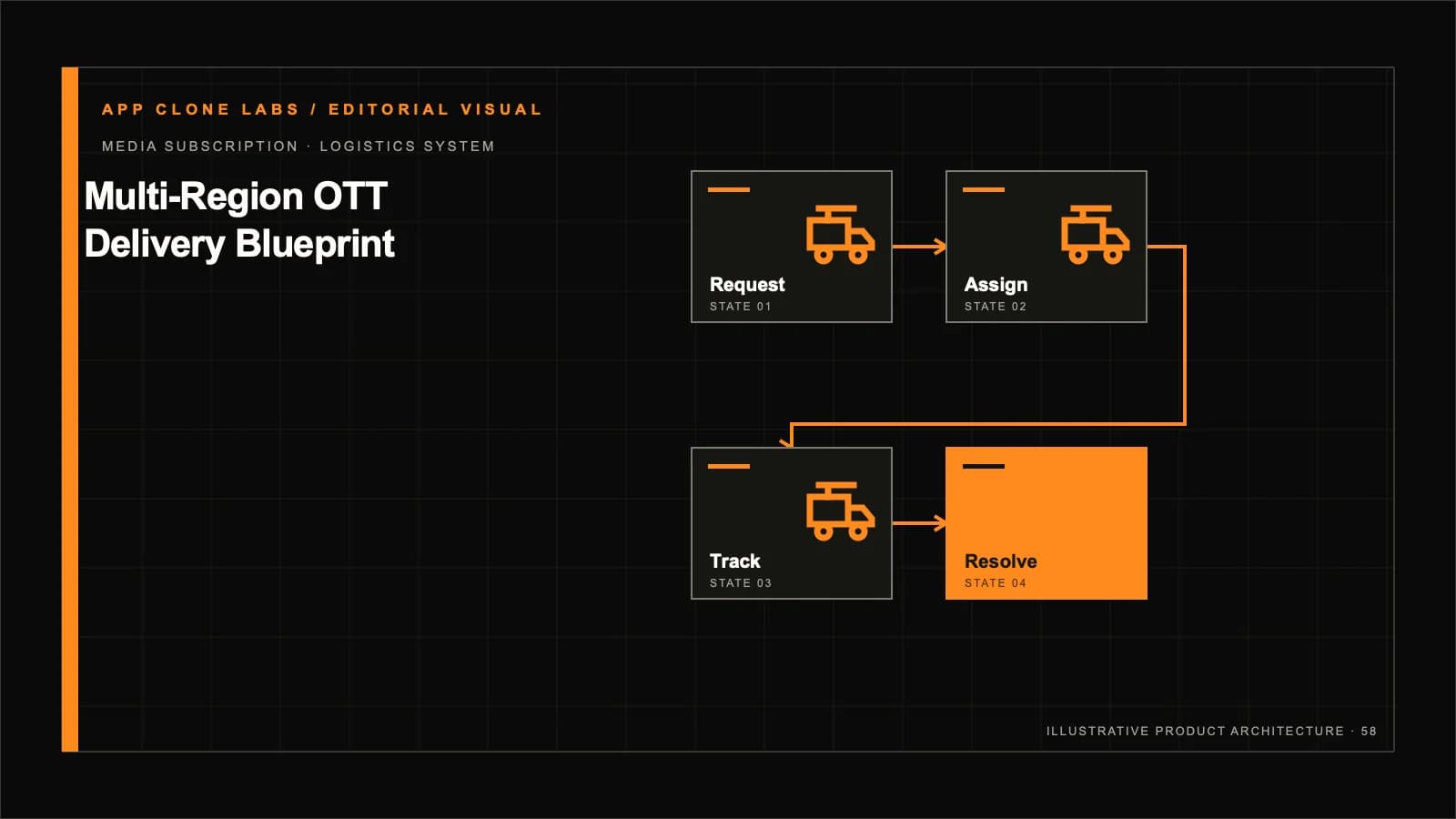
Proof status / evidence boundary
What this record can and cannot establish
Recorded project context
The industry, summary, service list, stack, narrative, and body are fields supplied by the case-study record.
Architecture and workflow
The workflow and technology labels describe the published delivery scope. They are not presented here as a new contractual commitment.
Outcome evidence boundary
Public outcome evidence is not attached to this record.
Evidence status: Blueprint / Last reviewed: Not recorded
Context / delivery read
An OTT product needs subscription logic and content operations together.
The architecture connected subscriber plans, profiles, content metadata, editorial rails, playback history, regional controls, and analytics so the team could operate a multi-region media product.
Recorded services
Workflow and deliverables
Profile and subscription entitlement design
Content catalog and editorial rails
Playback state, watch history, and analytics
Admin controls for content and regions
The media team needed subscription, profile, and content operations planned together because the viewer experience depended on entitlement, editorial programming, regional settings, and playback continuity.
App Clone Labs scoped content ingestion, metadata rules, watchlist behavior, continue-watching states, subscription plans, regional availability, analytics events, and admin publishing workflows.
The delivery proof centered on a 5-region architecture plan, content operations dashboard, subscription state model, analytics event list, and a handoff plan for cloud, CDN, and post-launch content operations.
Technical architecture and system design
StreamLayer was architected as a Next.js viewer application backed by a Node.js service layer, with PostgreSQL as the system of record for subscriptions, profiles, and entitlement and a Video CDN handling playback across five launch regions, each deployed as an independent regional stack behind a geo-routing layer that directed viewers to the closest healthy region. Entitlement was modeled as a state machine—trial, active, past due, cancelled, lapsed—so every playback request could be authorized against a deterministic state rather than a fragile flag check, and the state was cached at the edge with a short TTL so authorization did not bottleneck on the primary store during peak viewing. Content metadata was separated from the video asset store, allowing editorial rails and continue-watching states to be recomputed without touching the CDN and letting editorial teams reprogram rails without a deploy. Analytics events were emitted as a sidecar stream so playback telemetry never blocked the viewer experience, and a client-side retry buffer replayed events once connectivity returned so CDN failovers did not silently drop viewership data. The entire stack was containerized and deployed through a CI pipeline that ran entitlement regression tests on every commit, so any state-machine violation failed the build before it reached a release candidate.
API design separated the viewer experience from the content operations surface, with regional availability enforced through the geo-routing layer and a second authorization check at the playback endpoint so a single bypass could not expose licensed content outside its region. Real-time requirements were modest for playback but critical for continue-watching and watchlist sync, handled through a lightweight sync service that reconciled client progress on session resume with a last-write-wins policy documented for edge cases where a viewer switched devices mid-episode. Stripe was integrated for subscription billing, with regional pricing and tax handling modeled as configuration rather than code so the finance team could adjust plans without a deploy, and a dunning workflow surfaced failed renewals to the support team before a subscription lapsed silently. The architecture deferred offline downloads, social features, live streaming, and a personalization engine to later phases so the first release could prove the subscription and content loop under real viewer load, and each deferred module was documented as a service boundary so it could be added without re-architecting the entitlement core. Observability covered the full viewer funnel from landing to playback to churn, with structured logs on every entitlement transition and a nightly job that reconciled active subscriptions against Stripe.
Development methodology and sprint breakdown
The build ran in two-week sprints, opening with a discovery sprint that locked the subscription state model, metadata rules, and regional availability matrix before any UI work, because the media team had explicitly flagged that earlier OTT attempts had failed when entitlement and content operations were treated as phase-two afterthoughts. Sprint one delivered the viewer profile and subscription checkout flow against stubbed content, letting the team validate the subscription surface and the Stripe integration before real playback existed. Sprint two introduced the editorial rails, continue-watching sync, and analytics event pipeline, wiring the subscription and content surfaces together for the first end-to-end viewing session. QA covered the full subscription lifecycle and playback continuity across devices, with particular attention to session resume and regional entitlement edge cases, and a dedicated test pass simulated CDN failovers to verify the analytics retry buffer and the playback fallback behaved correctly. Each sprint closed with a demoable release reviewed by the media team, and release sequencing kept the content operations dashboard in the same sprint as the viewer feature it supported so the editorial loop was never absent from a demo.
A hardening sprint before launch stress-tested entitlement edge cases—expired cards mid-binge, regional content blackouts, profile-switch state corruption, and concurrent playback on multiple devices—since these were the workflows most likely to generate support load and churn in the first month. Automated regression checks validated that no viewer could access content outside their entitlement, that analytics events reconciled against the playback session log, and that a lapsed subscription gracefully degraded the viewer to a reactivation prompt rather than a hard error mid-episode. The final release checklist included cloud and CDN handoff, monitoring for entitlement failures, a content operations runbook for editorial publishing, and a rollback plan for the regional deployments so one region could be reverted without affecting the others. This sequencing kept the OTT MVP focused on subscription and content while leaving a documented backlog for live and social features, and it gave the media team a defensible launch plan rather than a feature list. The sprint cadence also built in a weekly demo that kept the editorial and engineering teams aligned without daily standups, which mattered for a team juggling launch with content licensing negotiations.
Operational challenges and resolutions
The dominant operational challenge was content metadata quality, where inconsistent titles, images, and regional flags broke editorial rails and confused viewers who saw blank thumbnails or mismatched titles. The resolution was a mandatory metadata schema enforced at ingestion, plus an admin review queue for assets flagged by automated completeness checks, and a public-facing content freshness indicator that nudged the editorial team toward completing thin records without a heavy-handed publish block. Subscription churn from failed renewals was a second challenge, since expired cards silently downgraded viewers mid-content and produced support tickets only after the viewer noticed; the team introduced a grace-period state with in-app reactivation prompts and a dunning workflow surfaced to the support team before the subscription lapsed, which recovered a meaningful share of would-be churners. Regional availability mismatches, where content was playable outside its licensed region, were resolved by enforcing entitlement at both the routing layer and the playback authorization step, so a VPN-savvy viewer who bypassed geo-routing still hit an entitlement wall at the player.
Playback continuity across devices surfaced when continue-watching states diverged between sessions, creating frustration for multi-device viewers who resumed an episode only to find it restarted from the beginning. The team introduced a server-side sync service that reconciled client progress on session resume, with a last-write-wins policy documented for edge cases where a viewer switched devices mid-episode and a soft conflict prompt for genuinely ambiguous cases. Analytics event loss during CDN failovers was handled with a client-side retry buffer that replayed events once connectivity returned, and a nightly job reconciled the analytics stream against the playback session log to flag any persistent gaps. Each resolution was captured as a runbook so the client content operations team could manage the platform independently after handoff, and the runbooks were reviewed in the final sprint so the operations lead could rehearse common escalations before launch day. These fixes were not glamorous feature work but they were the difference between an OTT product that retained viewers and one that leaked them through preventable playback friction.
Admin and operator tooling
The content operations dashboard was built as a first-class surface, covering asset ingestion, metadata review, editorial rail configuration, regional availability toggles, and publishing schedules, with a configurable subscription plan editor that let the finance team adjust pricing and tax handling per region without a deploy. Operators could view subscription health, churn signals, and content performance on a single dashboard, with drill-downs into per-title viewership and completion rates that helped the editorial team decide which rails to reprogram. Support tooling linked each ticket to the underlying subscription and playback session, giving agents full context without switching systems, and a scoped entitlement override flow ensured agents could grant temporary access for a support case without exposing full billing controls. Reporting dashboards exposed active subscribers, trial conversion, churn by cohort, content engagement, and regional availability health, refreshed on a near-real-time pipeline that aggregated the analytics sidecar stream into daily and weekly views.
Operational controls included configurable subscription plans, regional pricing, a content takedown workflow for licensing expirations, and a release-control surface for toggling features per region, allowing the team to pilot changes in one region before a broader rollout and to kill a problematic feature without a hotfix deploy. The admin dashboard provided audit logs for every publishing change and entitlement override so post-incident reviews had a clear trail, and the logs were exported to the cloud log store where they survived beyond the application database. This tooling layer was what made the OTT product operable at launch, not just playable, and it directly enabled the 5-region launch architecture cited in the result metric by giving the team the confidence to deploy region by region without losing operational oversight. Editorial teams could program rails and schedule releases without engineering involvement, keeping the content cadence independent of the deploy cycle, and a lightweight read-only view was exposed to the media team leadership so they could check regional launch health without full operator credentials.
Launch outcomes and lessons
The MVP launched across five regions with a curated content catalog and a documented expansion playbook, proving the subscription and playback loop before any live or social features were added and giving the editorial team a controlled catalog to learn real viewing patterns. What worked well was the explicit entitlement state machine, which made failed-renewal handling predictable and recoverable instead of a silent churn event, and the content operations dashboard, which let editorial teams program rails without engineering support and kept the content cadence independent of the deploy cycle. What did not work was underestimating metadata quality variance from third-party suppliers, which required the ingestion schema enforcement post-launch after a handful of blank thumbnails reached viewers in the first week. The lesson was that content operations must be engineered alongside the viewer experience, not bolted on after, because retrofitting an ingestion schema under live content is far harder than building it into the first sprint.
A second lesson was that regional availability must be enforced at both the routing and authorization layers, since a single check could be bypassed by VPN-savvy viewers and a licensing breach is far more costly than a redundant check. Founders evaluating a similar OTT build should resist launching live streaming or social features early, because their operational complexity dwarfs the subscription MVP and they are far easier to add once real viewing data exists to inform their design. The anonymized launch plan captured these lessons as a checklist for the next content batch rollout, reducing repeat mistakes and giving the second batch a shorter ramp. Overall, the launch validated that clone-inspired OTT products succeed when the operating layer is engineered as carefully as the player experience, and the media team credited the discovery sprint with preventing a costly rebuild of the entitlement model that an earlier team had gotten wrong by treating it as a flag instead of a state machine.
Scalability and post-launch evolution
The architecture was designed to scale by deploying regional instances behind a geo-routing layer, with the Video CDN absorbing playback traffic and PostgreSQL sharded by region for subscription and profile data so each region could own a primary shard and replicate cross-region for reporting without contending with the local entitlement write path. The Node.js service layer was deployed with autoscaling per region, and the analytics sidecar stream was built to buffer and replay so telemetry survived CDN failovers and could be upgraded to a full streaming pipeline once viewer volume justified the investment. Entitlement checks were cached at the edge with short TTLs so authorization did not bottleneck on the primary store during peak viewing, and a cache invalidation event was published on every entitlement change so a cancellation reflected in playback within seconds rather than the full TTL. Deferred to later phases were offline downloads, social features, live streaming, and a personalization engine, each scoped as a separate module to avoid entangling the subscription loop and each with a documented interface so it could be added without an entitlement-core refactor.
Post-launch evolution followed the documented backlog: new content batches were ingested through the metadata schema with editorial rails reprogrammed without deploys, validated through per-region feature toggles so the team could roll back one region without affecting the others. Analytics was upgraded from the sidecar stream to a full streaming pipeline once viewer volume justified the investment, and the playback session log was retained as the source of truth so the analytics layer consumed events rather than querying the transactional database. The entitlement service later absorbed a household profile-sharing model, but only after the MVP proved that single-profile entitlement was sufficient for launch and after enough viewing data existed to design the household model responsibly. This phased evolution kept the OTT product stable under growth while preserving the original clone-inspired speed of the first release, and the architecture choices made in V1, particularly the entitlement-as-state-machine pattern and the regional deployment isolation, paid compounding dividends as each new module was added without destabilizing the subscription loop.
Related case records