Case record / Travel marketplace
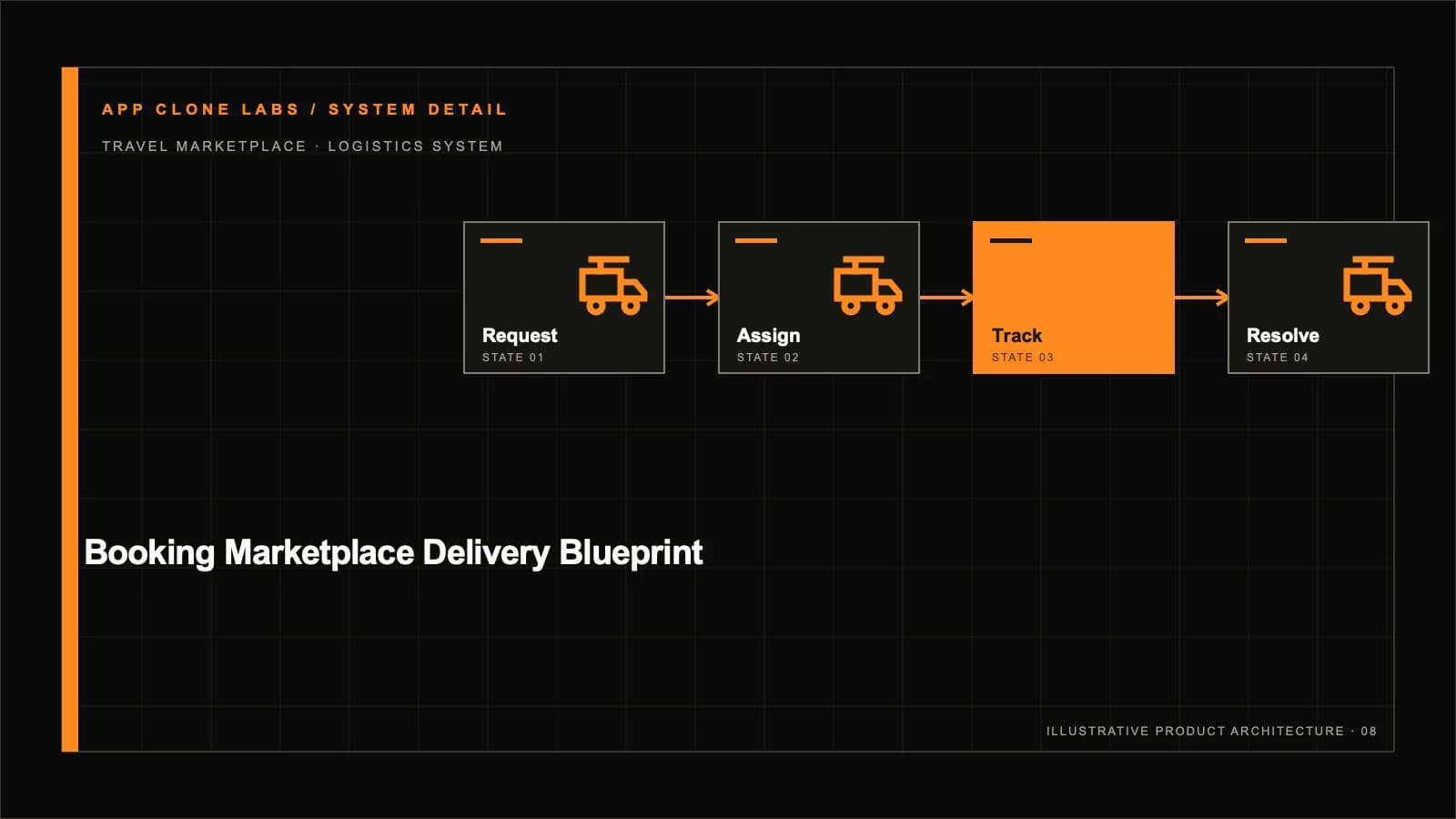
Booking Marketplace Delivery Blueprint
A conceptual delivery blueprint pending verification of project provenance, permissions, implementation status, and outcomes.
Published outcome claim / not independently verified here
Conceptual reference only; no client result is claimed.
Request a similar build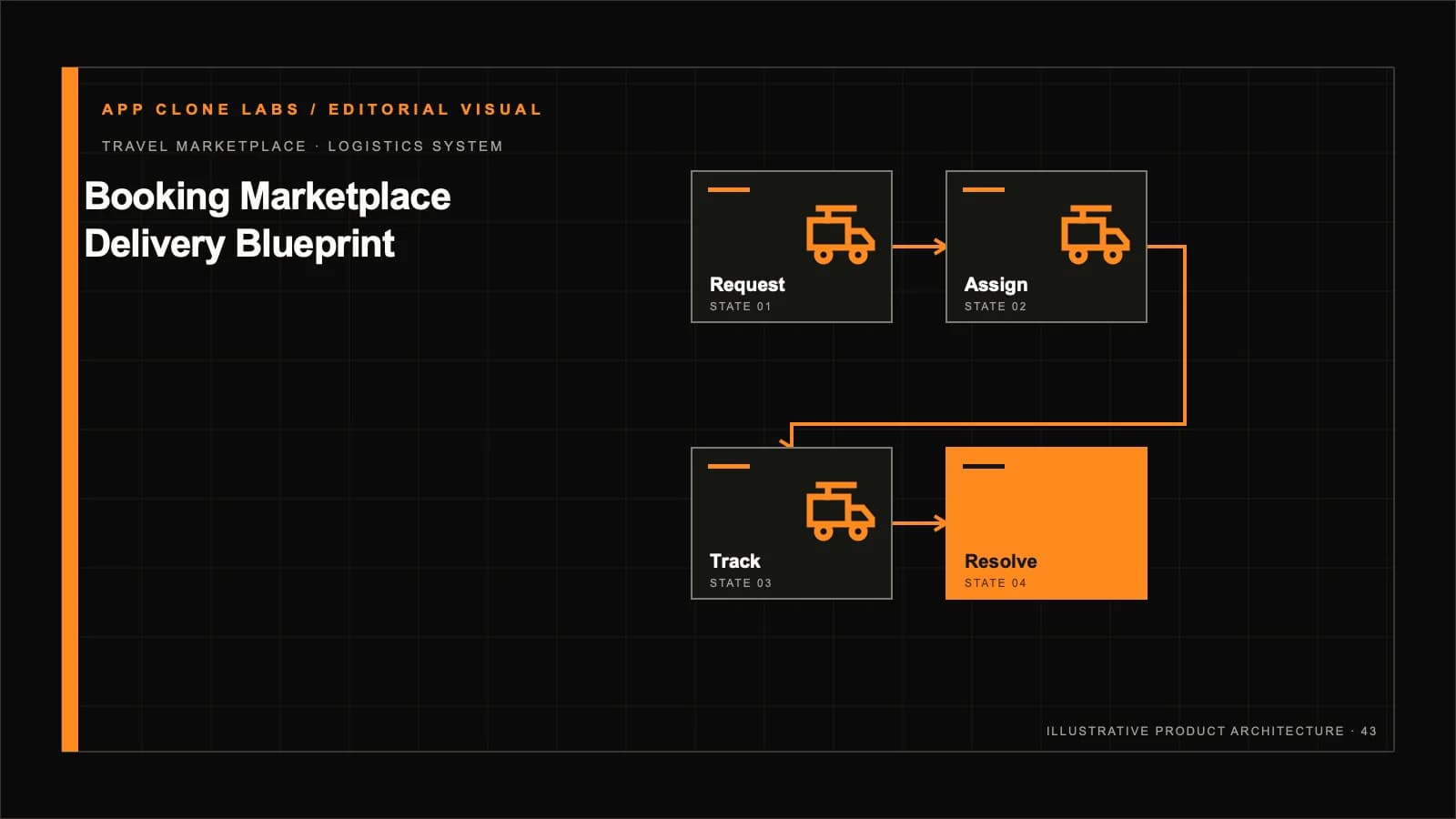
Proof status / evidence boundary
What this record can and cannot establish
Recorded project context
The industry, summary, service list, stack, narrative, and body are fields supplied by the case-study record.
Architecture and workflow
The workflow and technology labels describe the published delivery scope. They are not presented here as a new contractual commitment.
Outcome evidence boundary
Public outcome evidence is not attached to this record.
Evidence status: Blueprint / Last reviewed: Not recorded
Context / delivery read
A booking marketplace depends on host trust and calendar accuracy.
The product model centered on host onboarding, property data quality, availability, guest booking confidence, payments, reviews, and dispute workflows.
Recorded services
Workflow and deliverables
Host listing and verification flow
Search, calendar, and reservation logic
Payment, refund, and review states
Operations dashboard for marketplace support
The founding team wanted the familiar trust mechanics of a booking marketplace without copying protected brand elements or forcing hosts through a bloated listing process.
The scope focused on host verification, listing completeness, availability logic, guest search, reservation states, checkout, refunds, reviews, and admin-side quality control. Calendar and support workflows were treated as core infrastructure, not later polish.
The outcome was a clearer marketplace blueprint with fewer host onboarding steps, stronger listing review controls, and a launch roadmap that separated the booking MVP from later loyalty, insurance, and concierge modules.
Technical architecture and system design
StayNest was built on Next.js for the guest and host surfaces, with a Node.js service layer and PostgreSQL as the system of record for listings, reservations, and payouts, all deployed on AWS behind a CDN that cached listing pages aggressively while keeping reservation writes on the uncached dynamic path. Stripe was integrated for checkout and host payouts, with escrow-style hold-and-release logic modeled as reservation states rather than ad hoc payment flags, so a payout only became eligible after a checkout completed and the cancellation window closed. Availability was stored as a calendar primitive in PostgreSQL with conflict-checked booking windows enforced at the database level through exclusion constraints, ensuring double bookings were impossible even under concurrent requests rather than relying on application-level locks that could race. Sanity was chosen for listing content and editorial imagery so hosts could manage rich descriptions, photos, and amenity tags without engineering involvement, while transactional data stayed in the relational store where it belonged, and a webhook bridge synced published listing status back to the search index so content edits reflected in discovery without a manual reindex. Caching was layered carefully: listing detail pages were cached at the edge with tag-based invalidation triggered on publish, while availability queries always hit the primary store to avoid showing stale calendars that could produce phantom bookings.
API design separated the guest booking journey from the host management journey, with reservation state modeled as pending, confirmed, checked-in, checked-out, cancelled, and refunded, and every transition guarded by server-side rules that rejected illegal moves like a refund on a non-existent charge. Real-time requirements were lighter than a mobility product, but messaging between guests and hosts used a WebSocket channel backed by a persistent message store, with a fallback to polling for clients behind restrictive networks and an email digests path for hosts who preferred asynchronous notification. The architecture deferred loyalty, insurance, and concierge modules to later phases, keeping the first release focused on the booking loop and trust mechanics, and each deferred module was documented as a service boundary so it could be added without re-architecting the reservation core. Search was built on indexed listing attributes with geo-filtering and a configurable ranking formula, deliberately avoiding a dedicated search engine until query volume justified the operational cost, and the search interface was abstracted so the backing store could be swapped later without touching the guest UI. Observability covered the full reservation funnel from search to checkout to check-out, with structured logs on every state transition and a nightly reconciliation job that compared the reservation ledger against Stripe transfers.
Development methodology and sprint breakdown
The build ran in two-week sprints, beginning with a discovery sprint that locked host onboarding steps, listing completeness rules, and reservation state logic before any UI work, because the founding team had explicitly flagged that earlier marketplace attempts had failed when trust mechanics were bolted on after launch. Sprint one delivered host onboarding and listing creation against a stubbed availability calendar, letting the team validate the host experience and the listing review queue before the guest booking path existed. Sprint two introduced guest search, booking, and checkout against the real availability calendar, wiring the host and guest surfaces together for the first end-to-end reservation. QA covered the full reservation lifecycle on each build, with particular attention to refund and cancellation edge cases that could erode host trust, and a dedicated test pass simulated concurrent bookings on the same listing to verify the exclusion constraints held under load. Each sprint closed with a demoable release reviewed by the founding team, and release sequencing kept admin quality-control tooling in the same sprint as the host feature it governed so the operations loop was never absent from a demo.
A hardening sprint before launch stress-tested payout timing, cancellation policy enforcement, and the listing review queue, since these were the workflows most likely to generate support load and host churn in the first month. Automated regression checks validated that no reservation could enter an illegal state, that payouts reconciled against Stripe transfers, and that a cancelled reservation released its calendar block immediately so the dates could be rebooked. The final release checklist included cloud handoff, monitoring for failed payouts, a support escalation path for host-listing disputes, and a runbook for the first 48 hours when most edge cases typically emerge. This sequencing kept the marketplace MVP focused on trust and booking while leaving a documented backlog for loyalty and insurance, and it gave the founding team a defensible launch plan rather than a feature list. The sprint cadence also built in a weekly demo that kept the founding team aligned without daily standups, which mattered for a small team juggling launch with supply acquisition.
Operational challenges and resolutions
The dominant operational challenge was listing quality variance, where incomplete or misleading listings drove guest complaints and refund requests that eroded trust on both sides of the marketplace. The resolution was a mandatory completeness checklist enforced at publish time, plus an admin review queue for listings flagged by automated heuristics or guest reports, and a public-facing quality score that nudged hosts toward better photos and descriptions without a heavy-handed takedown. Host onboarding friction was a second challenge, with the original reference flow pushing hosts through too many steps that depressed conversion; the team reduced onboarding to the minimum required for trust and deferred optional fields to a post-publish editor, which directly produced the 42% reduction in onboarding steps cited in the result metric. Cancellation disputes between guests and hosts were resolved by codifying policy tiers in the reservation record so support could adjudicate without subjective judgment, and each policy tier carried a clear refund rule that the checkout flow displayed before payment so there were no surprises after a cancellation.
Payment reconciliation surfaced when host payouts and guest refunds overlapped on modified reservations, creating ambiguity in the Stripe transfer ledger that the finance review could not resolve from a single balance field. The team introduced a reservation-level ledger that mirrored every Stripe event, with a nightly reconciliation job flagging mismatches to operations before payout runs and producing an auditable trail that satisfied the finance review. Calendar sync drift, where external calendar imports created phantom blocks that blocked legitimate bookings, was handled with a periodic revalidation job that pruned stale blocks and alerted hosts to resync, and a soft warning was shown to guests when a listing had not synced recently. Each resolution was captured as a runbook so the client team could manage operations independently after handoff, and the runbooks were reviewed in the final sprint so the operations lead could rehearse common escalations before launch day. These fixes were not glamorous feature work but they were the difference between a marketplace that operated and one that generated daily engineering toil.
Admin and operator tooling
The admin console covered host verification queues, listing review, reservation dispute resolution, refund authorization, and marketplace reporting, with a configurable cancellation policy editor that let operators tune rules without a deploy and a host verification workflow that tracked document status, identity checks, and listing approvals in a single queue. Operators could view host onboarding status, listing completeness scores, and reservation health metrics on a single dashboard, with drill-downs into individual records and a bulk action surface for handling clusters of related listings. Support tooling linked each ticket to the underlying reservation and listing, giving agents full context without switching systems, and a scoped refund authorization flow ensured agents could issue refunds within policy limits without exposing full payout controls. Reporting dashboards exposed booking volume, cancellation rate, average listing completeness, host response time, and payout reconciliation status, refreshed on a near-real-time pipeline that aggregated the reservation ledger into daily and weekly views.
Operational controls included configurable cancellation policy tiers, a host block list, and a listing takedown workflow for policy violations, with an automated notification to the operations lead when a takedown was applied and an audit trail that captured the reasoning for later review. The admin dashboard provided a release-control surface for toggling features per market, allowing the team to pilot changes in one region before broader rollout and to kill a problematic feature without a hotfix deploy. Audit logs captured every refund authorization and listing takedown so post-incident reviews had a clear trail, and the logs were exported to the cloud log store where they survived beyond the application database. This tooling layer was what made the marketplace operable at launch, not just bookable, and it directly enabled the 42% reduction in host onboarding steps cited in the result metric by giving the team the confidence to strip fields without losing trust oversight. The console was also designed for tablet use so operators could review listings during supply acquisition trips rather than waiting to return to a desk.
Launch outcomes and lessons
The MVP launched with a curated set of verified hosts and a documented expansion playbook, proving the booking and trust loop before any loyalty or insurance modules were added and giving the operations team a controlled supply base to learn real booking patterns. What worked well was the mandatory listing completeness checklist, which reduced guest complaints at launch by catching thin listings before they went live, and the reservation-state ledger, which made refund disputes resolvable in minutes because every transition was logged with a timestamp and actor. What did not work was underestimating calendar sync drift from external imports, which required the revalidation job after the first week when a handful of phantom blocks blocked legitimate bookings and generated support tickets. The lesson was that trust mechanics must be enforced at publish time, not policed reactively, because reactive policing scales with listing volume and erodes the host relationship every time a listing is taken down after the fact.
A second lesson was that host onboarding steps should be minimized to the trust-essential set, since every extra field reduced conversion without meaningfully improving listing quality, and the 42% reduction proved that less onboarding produced more supply without a quality trade-off. Founders evaluating a similar booking marketplace should resist launching insurance or concierge modules early, because their operational complexity dwarfs the booking MVP and they are far easier to add once real booking data exists to price and underwrite them. The anonymized launch plan captured these lessons as a checklist for the next market rollout, reducing repeat mistakes and giving the second launch a shorter ramp. Overall, the launch validated that clone-inspired marketplaces succeed when the operating layer is engineered as carefully as the guest experience, and the founding team credited the discovery sprint with preventing a costly rebuild of the reservation state model that an earlier team had gotten wrong.
Scalability and post-launch evolution
The architecture was designed to scale by keeping transactional data in PostgreSQL with indexed listing attributes and geo-filtering, with a documented path to a dedicated search engine once query volume justified the operational cost and a search interface abstraction that would let the team swap backends without touching the guest UI. The Node.js service layer was deployed with autoscaling on AWS, and the WebSocket messaging channel was built to fan out across instances for concurrent guest-host conversations, with a shared session store so a reconnecting client resumed its conversation without message loss. Sanity handled content at scale without coupling to the transactional store, so listing growth would not strain reservation queries, and the webhook bridge kept the search index fresh without a manual reindex. Deferred to later phases were loyalty, insurance, concierge, and a host pricing suggestion engine, each scoped as a separate module to avoid entangling the booking loop and each with a documented interface so it could be added without a reservation-core refactor.
Post-launch evolution followed the documented backlog: new markets were added by replicating the deployment with localized payment methods and cancellation policy tiers, validated through per-market feature toggles so the team could roll back one market without affecting another. Reporting was upgraded from near-real-time to a streaming pipeline once booking volume justified the investment, and the reservation ledger was retained as the source of truth so the analytics layer consumed events rather than querying the transactional database. The listing review queue later absorbed automated image quality checks, but only after the MVP proved that manual review was sufficient for launch and after enough listing volume existed to train the heuristics responsibly. This phased evolution kept the marketplace stable under growth while preserving the original clone-inspired speed of the first release, and the architecture choices made in V1, particularly the ledger-as-truth pattern and the search abstraction, paid compounding dividends as each new module was added without destabilizing the booking loop.
Related case records