Case record / Fintech platform
Fintech Operations Reference Architecture
A conceptual delivery blueprint pending verification of project provenance, permissions, implementation status, and outcomes.
Published outcome claim / not independently verified here
Conceptual reference only; no client result is claimed.
Request a similar build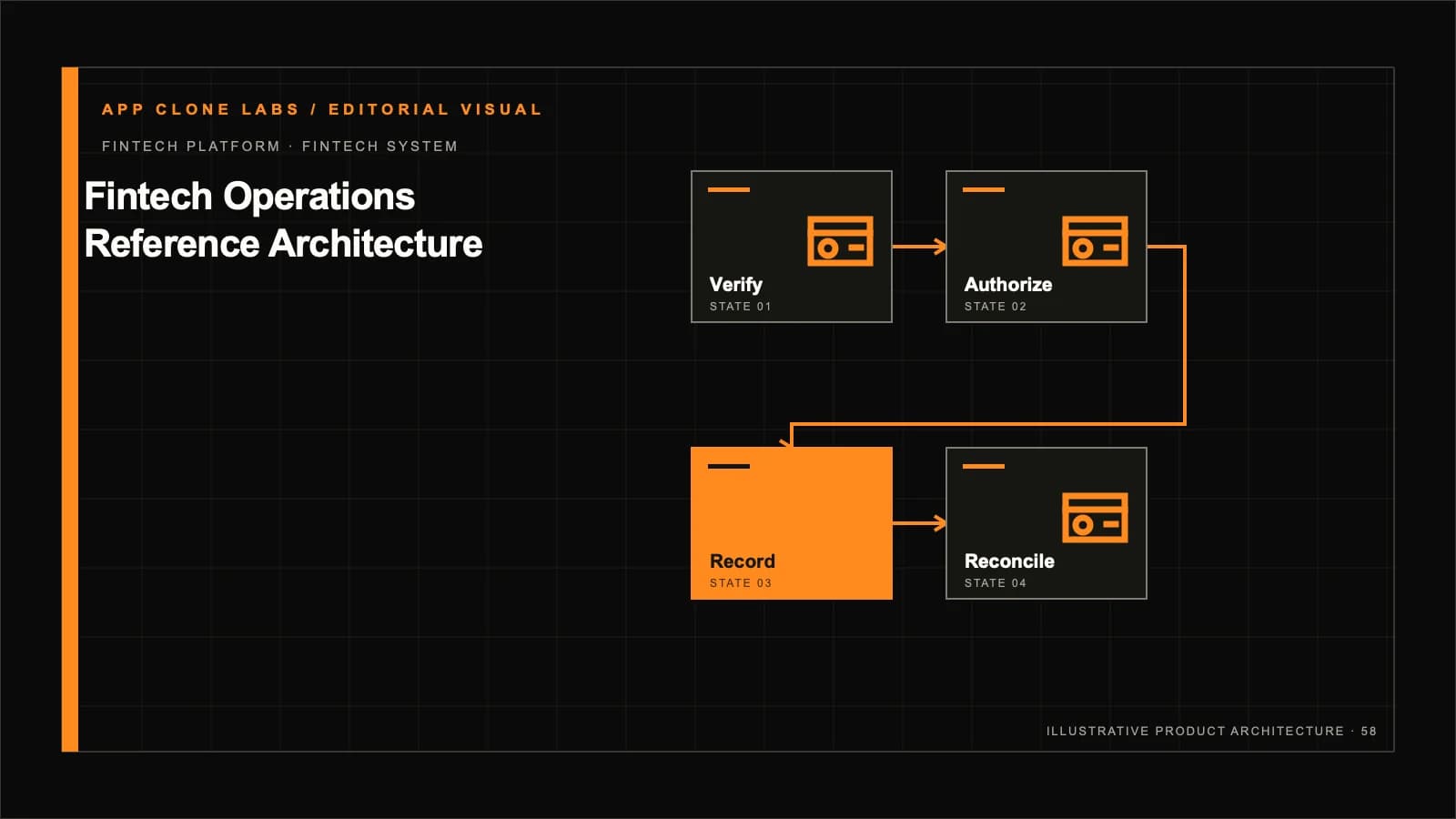
Proof status / evidence boundary
What this record can and cannot establish
Recorded project context
The industry, summary, service list, stack, narrative, and body are fields supplied by the case-study record.
Architecture and workflow
The workflow and technology labels describe the published delivery scope. They are not presented here as a new contractual commitment.
Outcome evidence boundary
Public outcome evidence is not attached to this record.
Evidence status: Blueprint / Last reviewed: Not recorded
Context / delivery read
A similar product needs workflow clarity before interface polish.
The fastest path is to map the commercial loop, user roles, admin controls, integrations, reporting, and launch handoff before design and engineering scale up.
Recorded services
Workflow and deliverables
Role-specific user journeys before interface design
Admin, support, reporting, and operations controls
Payment, notification, map, media, or AI integrations scoped early
Launch documentation, cloud context, and ownership handoff
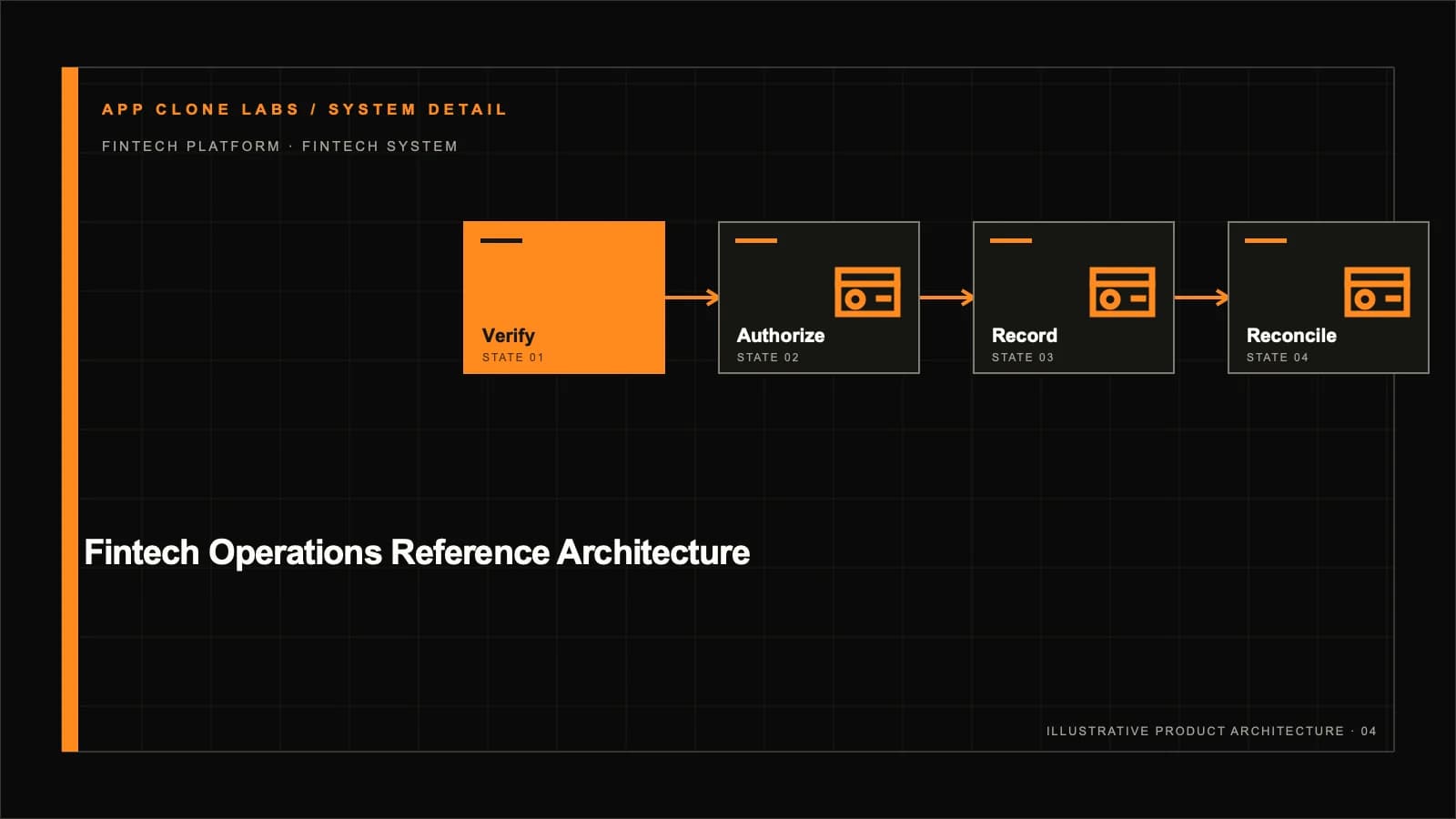
The fintech founder needed clarity on wallet behavior, transfer states, KYC review, failed transactions, reconciliation, limits, support, and audit trails before interface design.
App Clone Labs separated user-facing wallet experience from the operating model behind it: ledger entries, admin review, risk states, support queues, reporting, and release controls.
The anonymized output included a wallet-state map, review queue model, reconciliation checklist, audit-log requirements, and a staged roadmap for compliance-heavy expansion.
Technical architecture and system design
WalletCore was architected as a Next.js user wallet application backed by a Node.js service layer and PostgreSQL on AWS, with an immutable audit logging subsystem capturing every ledger entry and admin action to an append-only table that application code could write but never update or delete. The wallet was modeled as a double-entry ledger rather than a mutable balance, so every transfer, top-up, and fee was represented as paired debit and credit entries that could be reconciled deterministically, and the balance was always a computed sum of entries rather than a stored field that could drift. Transfer state was modeled as an explicit state machine—initiated, KYC-pending, risk-reviewed, settled, failed, reversed—so every transaction could be audited and replayed for support disputes, with each transition timestamped and attributed to the actor that triggered it. KYC review was isolated as its own service so identity verification could evolve independently of the wallet experience, and the two communicated through an async queue so a slow KYC provider could not block the wallet API.
API design separated the user-facing wallet experience from the operating model behind it, with limits, reconciliation, and admin review enforced server-side rather than trusted from the client, so a compromised client could not bypass a transfer limit by manipulating a request payload. Real-time requirements were modest, but transfer-status updates used a lightweight event channel backed by a Postgres LISTEN/NOTIFY fan-out so users and support saw consistent state without polling, with a fallback long-poll for browsers that dropped the notification socket. The architecture deferred lending, investment products, and cross-border remittance to later phases so the first release could prove the wallet and transfer loop under real transaction load, and each deferred module was documented with the regulatory trigger that would justify building it. Cloud security controls were applied at the data layer with AES-256 encryption at rest, TLS 1.3 in transit, field-level access policies for sensitive records enforced through Postgres row-level security, and append-only audit logs that could not be mutated by application code because the database role used by the service layer had INSERT-only privileges on the audit table.
Development methodology and sprint breakdown
The build ran in two-week sprints, opening with a discovery sprint that locked the wallet-state map, review queue model, and reconciliation checklist before any UI work, with each artifact signed off by the fintech founder so scope changes were negotiated rather than silently absorbed. Sprint one delivered wallet top-up and balance display against stubbed KYC, while sprint two introduced transfers, KYC review, and the admin review queue against the ledger, with the double-entry ledger tests written before the handlers so any unbalanced entry failed the build immediately. QA covered the full transfer lifecycle on each build, with particular attention to failed-transaction and reconciliation edge cases that could erode user trust, including negative tests that verified a reversal always produced a balanced ledger and that a partial settlement could not leave the wallet in an inconsistent state. Each sprint closed with a demoable release reviewed by the fintech founder, and release sequencing kept admin reporting in the same sprint as the wallet feature it governed so no transfer capability shipped without the operational visibility to reconcile it.
A hardening sprint before launch stress-tested reconciliation accuracy, failed-transaction reversal, and audit-log integrity, since these were the workflows most likely to generate compliance and operational load, and each was tested against a synthetic user base of five hundred accounts running concurrent transfers to surface race conditions in the ledger write path. Automated regression checks validated that the ledger always balanced, that no transfer could enter an illegal state, and that audit logs captured every state transition, with a property-based test suite that generated random transfer sequences and asserted only legal ones persisted and that the ledger sum across all accounts was always zero. The final release checklist included cloud handoff, monitoring for reconciliation mismatches with alerting wired to the on-call channel, and a support runbook for failed-transaction disputes that walked agents through reading the ledger entries and the corresponding audit log. This sequencing kept the fintech MVP focused on wallet and transfer operations while leaving a documented backlog for compliance-heavy expansion, each item annotated with the regulatory trigger that would justify building it.
Operational challenges and resolutions
The dominant operational challenge was reconciliation accuracy, where failed transactions and partial settlements created ledger ambiguity that could not be resolved by a single balance check because the balance was a sum that hid the individual entry mismatches. The resolution was the double-entry ledger with a nightly reconciliation job that flagged any imbalance to operations before user-facing payouts, and the job produced a diff report that listed the exact entries that did not reconcile so the operations team could investigate rather than staring at a single failing number. KYC review throughput was a second bottleneck, since document verification could block transfers for days and frustrated users would abandon the wallet; the team introduced a staged review path that allowed low-risk transfers below a configurable threshold to proceed while enhanced due diligence completed, with the threshold adjustable per compliance regime. Failed-transaction reversal, where user funds were debited but never settled downstream, was handled by an automated reversal entry paired with the original debit, surfaced to the support queue for confirmation so an agent could verify the reversal was correct before it was finalized.
Risk-state handling, where suspicious transfers needed manual review, was resolved by a risk-reviewed state that paused settlement until an admin cleared the transfer, with every decision logged to the append-only audit table with the admin identity, timestamp, and reasoning so regulators could reconstruct the decision chain. Support for failed transactions was streamlined by linking each ticket to the underlying ledger entries, giving agents full context without switching systems, and the ticket view rendered the ledger entries inline so agents could see the original debit, the failed settlement, and the reversal in a single timeline. Each resolution was captured as a runbook so the fintech operations team could manage the platform independently after handoff, with each runbook including the exact admin-console path and the expected resolution time so new operations hires could be onboarded in days rather than weeks. These operational fixes directly supported the ledger and review model separated before UI, and the reconciliation diff reports became the evidence the founder used when negotiating with banking partners who required proof of ledger integrity.
Admin and operator tooling
The admin console covered KYC review queues, transfer dispute resolution, risk-state review, reconciliation monitoring, limit configuration, and fintech reporting, with each surface built as a tab rather than a separate page so operators could switch context without losing their filter state. Operators could view KYC backlog, transfer volume, and reconciliation status on a single dashboard, with drill-downs into individual ledger records that showed the paired debit and credit entries side by side so an operator could verify balance at a glance. Support tooling linked each ticket to the underlying transfer and ledger entries, giving agents full context without switching systems, and the ticket view rendered the transfer state timeline inline so agents could see every transition and the audit entry that produced it. Reporting dashboards exposed transfer volume, failure rate, reconciliation mismatches, and KYC throughput, refreshed on a near-real-time pipeline backed by a materialized view that recomputed every five minutes so the numbers were never more than a few minutes stale.
Operational controls included configurable transfer limits with per-regime thresholds, a user block list for risk that prevented new transfers while letting pending ones settle, a reversal workflow that required two-agent confirmation for amounts above a configurable threshold, and a release-control surface for toggling features per compliance regime so a new capability could be piloted in one jurisdiction before a broader rollout. The admin dashboard provided immutable audit logs for every review decision, limit change, and reversal so post-incident reviews had a clear compliance trail, and the logs were exportable in a regulator-friendly format that mapped each action to the admin identity, timestamp, and affected ledger entries. This tooling layer was what made the fintech platform operable at launch, not just transactable, and it directly enabled the ledger and review model separated before UI. Operations teams could manage KYC and review transfers without engineering involvement, keeping the compliance cadence independent of the deploy cycle, which mattered because regulatory deadlines did not wait for engineering sprints and a delayed limit change could mean a compliance breach.
Launch outcomes and lessons
The MVP launched with a capped user base and a documented compliance playbook, proving the wallet and transfer loop before any lending or remittance modules were added, and the capped base kept the reconciliation surface area small enough that the two-person operations team could personally verify every failed transaction during the first month. What worked well was the double-entry ledger, which made reconciliation resolvable in minutes instead of hours because the diff report pointed directly at the mismatched entries, and the staged KYC path, which kept low-risk transfers moving while enhanced checks completed so users were not blocked by a verification queue they had no visibility into. What did not work was underestimating KYC backlog, which required the throughput dashboard after the first week when document verification piled up and users started opening support tickets asking why their transfers were pending. The lesson was that the ledger and review model must be separated before UI, not bolted on after, because retrofitting a double-entry ledger onto a mutable-balance system requires a data migration that no fintech team wants to run under live traffic.
A second lesson was that audit logs must be append-only from day one, since mutable logs would have created a compliance liability the moment a regulator asked for an immutable record and the team could not prove the logs had not been edited. Founders evaluating a similar fintech build should resist launching lending or cross-border remittance early, because their compliance complexity dwarfs the wallet MVP and a lending module alone can consume a compliance team for months before a single loan is disbursed. The anonymized launch plan captured these lessons as a checklist for the next compliance regime rollout, with each item tied to the specific incident or near-miss that produced it so the next team understood the reasoning rather than just the rule. Overall, the launch validated that clone-inspired fintech products succeed when the operating layer is engineered as carefully as the wallet experience, and that the unglamorous parts—double-entry ledgers, append-only audit logs, and reconciliation diff reports—are what keep a fintech platform defensible once regulators and banking partners start asking hard questions.
Scalability and post-launch evolution
The architecture was designed to scale by keeping the ledger in PostgreSQL with partitioning by user cohort, ensuring reconciliation jobs could run in parallel as the user base grew, with each partition scanned independently so a reconciliation run on a large cohort did not block a small one. The Node.js service layer was deployed with autoscaling on AWS behind an application load balancer, and the transfer-status event channel was built to fan out across instances using a shared Redis pub-sub layer so a user on one instance and a support agent on another saw the same transfer state within seconds. KYC review was isolated as a service so identity verification could scale or swap providers without touching the wallet experience, and the service exposed a provider-agnostic interface so swapping from one KYC vendor to another required only an adapter implementation rather than a wallet-layer refactor. Deferred to later phases were lending, investment products, cross-border remittance, and a fraud detection module, each scoped as a separate service to avoid entangling the wallet loop and each given an interface contract so the wallet core could call them without coupling to their internals.
Post-launch evolution followed the documented backlog: new compliance regimes were added by replicating the limit and review configuration, validated through per-regime feature toggles so a new jurisdiction could be enabled without affecting existing users. Reporting was upgraded from near-real-time to a streaming pipeline once transfer volume justified the investment, with the materialized views replaced by a Kafka-backed stream that fed a ClickHouse warehouse so the founder could run transfer-volume analysis across months of ledger entries without loading the transactional database. The ledger service later absorbed a fraud detection module that flagged anomalous transfer patterns using a rules engine fed by the ledger event stream, but only after the MVP proved that manual risk review was sufficient for launch and after enough transfer history existed to calibrate the rules without generating excessive false positives. This phased evolution kept the fintech platform stable under growth while preserving the original clone-inspired speed of the first release, and the discipline of deferring each module until its predecessor was proven meant the team never carried more than one major compliance initiative in flight at a time.
Related case records