Digital-asset exchange

Configurable Peer Exchange Platform — Custom-Built for Your Market

Configurable peer offer, escrow-orchestration, evidence, and dispute management system. Planned for authorized operators launching jurisdiction-limited peer asset marketplaces with role-specific workflows, operator controls, integrations, and a handover boundary defined for the selected market.

From $2,799 one-time for the Professional plan. Enterprise customization is quoted on scope.

See product screens and demo access

Custom workflows

Brand-safe product strategy

Admin and operations tooling

Reference walkthrough by arrangement

Workflow

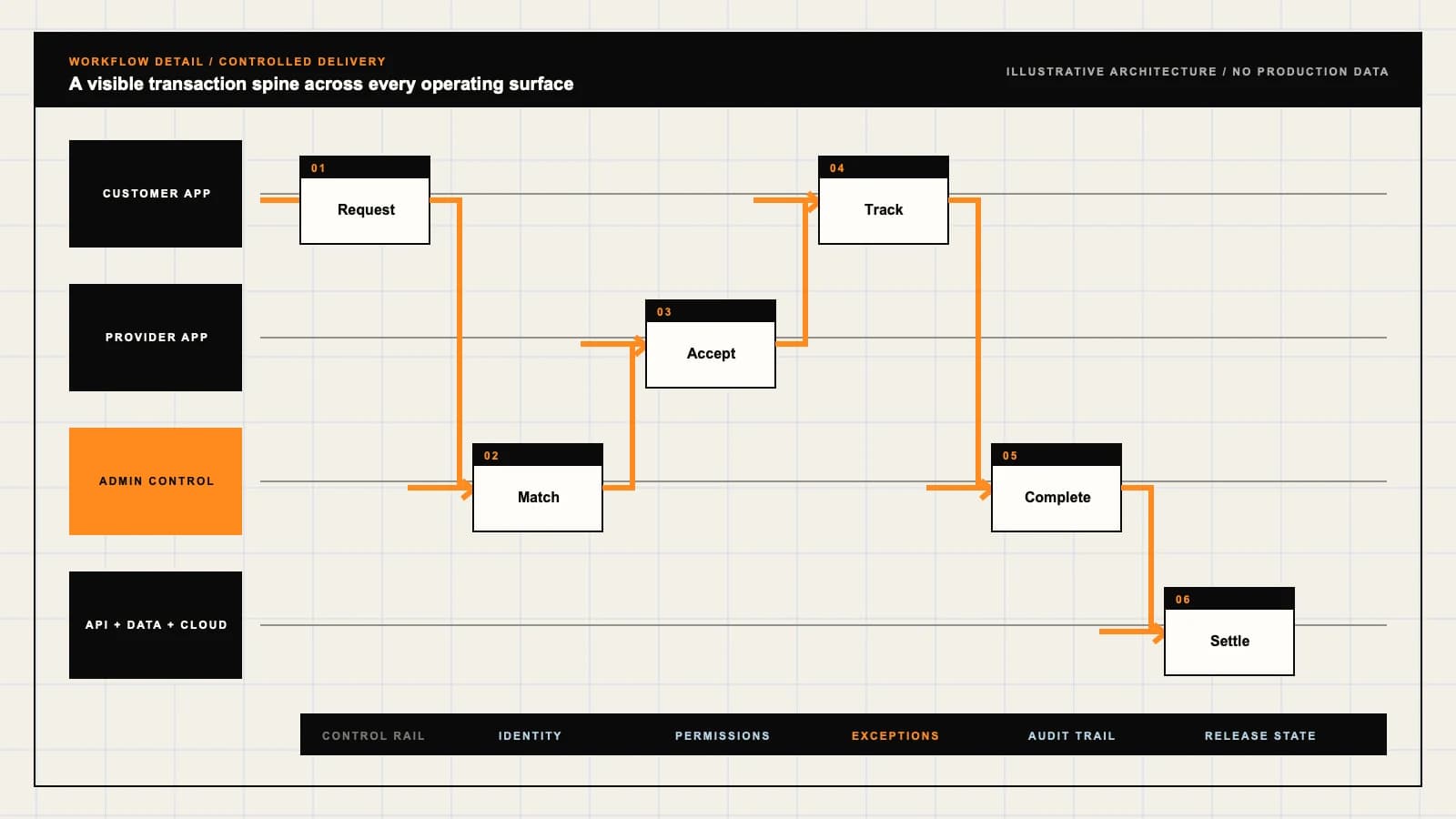
Configurable Peer Exchange Platform workflow stages.

Each workflow stage is mapped to a role, screen, API, notification, admin control, and measurable launch outcome.

01Publish and accept

Validate eligibility and available inventory

Apply current ad limits, payment methods and exact quantities. Preserve accepted terms and reserve the eligible asset through the selected custody arrangement before requesting payment.

02Pay and substantiate

Track external settlement evidence

Record payment claims separately from recipient confirmation. Match the amount, currency, account and reference through permitted evidence channels without equating uploaded receipts with final settlement.

03Resolve and reconcile

Close only supported obligations

Route disagreement to an attributable case, authorize the permitted release or return and reconcile custody confirmation. Retain uncertainty when a provider response or payment result is unresolved.

Deployable Product Architecture

Workflow / system register

Revision EPlanning surface

Product delivery loop

Configurable Peer Exchange Platform workflow stages.

A focused release proves one complete workflow

Product delivery loop: Configurable Peer Exchange Platform workflow stages.A focused release proves one complete workflow. Scope the customer action and the operator response as one system.
01

Validate eligibility and available inventory

02

Track external settlement evidence

03

Close only supported obligations

Control note

Scope the customer action and the operator response as one system.

Illustrative architecture register; validate against the accepted scope.

Operator controls

Configurable Peer Exchange Platform admin and operator controls.

The control center is scoped as a first-class product surface, not an afterthought.

01Advertisement and acceptance limits

Prevent conflicting inventory commitments

Enforce quantity bounds, account limits and current eligibility at acceptance. Serialize reservations so concurrent takers cannot acquire the same available seller quantity.

02Evidence and dispute authority

Preserve accountable investigation

Restrict sensitive receipts and case records, retain revisions and separate reviewer decisions from release approval. Chat instructions cannot bypass the agreed payment destination.

03Escrow state and accounting

Reconcile each external movement

Bind orders to custody reservations and provider references. Handle duplicated callbacks, uncertain releases and network confirmation changes without creating a second asset movement.

Integrations

Configurable Peer Exchange Platform integration surface.

External systems that determine launch readiness, data flow, and operational continuity.

01Integration

Identity and sanctions services

Permitted identity, sanctions and fraud services with reviewed eligibility decisions, account restrictions and operator-specific policy versions

02Integration

Custody and escrow services

Contracted custody, escrow and network-monitoring services with reservation references, separate signing authority and reconciled release or return outcomes

03Integration

Payment evidence and case management

Authorized payment evidence, protected communication and case-management systems with restricted documents, delivery tracking and attributable review decisions

Scope drivers

Configurable Peer Exchange Platform scope drivers.

The variables that most influence build effort, cost, and launch readiness.

01Operator policy variation

Count rule sets and their exceptions

Define eligible regions, assets, payment methods, ad limits and account permissions. Each additional operator policy requires isolated configuration and acceptance evidence.

02Settlement and custody boundaries

Establish authoritative evidence

Specify which payment observations and custody confirmations are available. Manual verification and provider outages need explicit ownership, staffing and recovery paths.

03Dispute and reconciliation load

Scope unresolved work alongside trades

Measure concurrent reservations, evidence volumes, case queues and outstanding instructions. Add capacity only with tested accounting and accountable exception handling.

Deployable Product Architecture

Scope drivers / system register

Revision DPlanning surface

Product delivery loop

Configurable Peer Exchange Platform scope drivers.

A focused release proves one complete workflow

Product delivery loop: Configurable Peer Exchange Platform scope drivers.A focused release proves one complete workflow. Scope the customer action and the operator response as one system.
01

Count rule sets and their exceptions

02

Establish authoritative evidence

03

Scope unresolved work alongside trades

Control note

Scope the customer action and the operator response as one system.

Illustrative architecture register; validate against the accepted scope.

V1 scope

Configurable Peer Exchange Platform V1 foundation.

Launch the smallest complete operating loop first, then scale the product with confidence.

01Bounded rule configuration

Prove selected marketplace policies

Support one reviewed operating policy, selected assets and a limited payment method set. Demonstrate ineligible accounts, conflicting ad limits and simultaneous takers.

02Traceable escrow orchestration

Separate orders from external custody

Record reservation requests, confirmed holds, release approvals and observed outcomes. Rehearse failed reservations, missing callbacks and duplicate release attempts using synthetic records.

03Evidence-led case closure

Resolve exceptions without losing history

Provide protected evidence, reviewer decisions, separate approvals and reconciliation reports. Test a reused receipt, partial payment and uncertain asset movement before closing the order.

Later phases

Configurable Peer Exchange Platform post-launch expansion.

Capabilities that should usually wait until real usage proves the core loop.

01Additional approved operator policies

Expand through reviewed configuration

Add regions, methods and account categories after establishing permissions, evidence availability and staffed support. Avoid copying eligibility decisions from unrelated markets.

02Richer payment reconciliation

Reduce manual investigation where supported

Add authorized status adapters and risk signals with explicit freshness and coverage. Provider observations support investigation without proving irreversible payment in every method.

03Custody recovery and reporting breadth

Extend demonstrated operational coverage

Add contracted provider redundancy and reviewed exports after proving reservation, release and accounting consistency. New custody models require separate authority and failure analysis.

Deployable Product Architecture

Later phases / system register

Revision APlanning surface

Product delivery loop

Configurable Peer Exchange Platform post-launch expansion.

A focused release proves one complete workflow

Product delivery loop: Configurable Peer Exchange Platform post-launch expansion.A focused release proves one complete workflow. Scope the customer action and the operator response as one system.
01

Expand through reviewed configuration

02

Reduce manual investigation where supported

03

Extend demonstrated operational coverage

Control note

Scope the customer action and the operator response as one system.

Illustrative architecture register; validate against the accepted scope.

Regulatory review

Configurable Peer Exchange Platform regulatory and compliance flags.

Each flag must be reviewed by qualified counsel for your target market before build or launch.

Confirm licensing and market-specific authorization before enabling regulated activity

Define whether assets or funds are held by the operator, a qualified custodian, or not held at all

Apply security review, strong authentication, encryption, audit logging, recovery, and incident response

Present educational product information only and prohibit personalized financial, legal, tax, or wagering advice

Apply customer verification, sanctions screening, blockchain monitoring, asset-listing review, and travel-rule processes where required

Prevent deployment in a market until operator permissions, custody contracts, and financial-crime procedures are documented

Reference walkthrough

Request a Configurable Peer Exchange Platform reference walkthrough.

Ask us to confirm which reference surfaces are currently available for this product model. Rather than publishing shared demo credentials, we schedule a private guided walkthrough for qualified buyers.

01Reference surface

Eligible offer makers and takers: Agree versioned trade terms

Request a role-specific demonstration and confirm which capabilities are currently available. Review the proposed responsibility: Publish bounded advertisements and accept available quantities under approved asset, payment and account rules. A payment-sent report remains a claim until reviewed receipt evidence supports the next action.

02Reference surface

Marketplace rule administrators: Configure permitted operator policies

Request a role-specific demonstration and confirm which capabilities are currently available. Review the proposed responsibility: Own eligibility, ad limits, deadlines and fee versions. Policy access does not confer custody signing permissions or authority to resolve every disputed transfer.

03Reference surface

Case reviewers and custody approvers: Resolve evidence through separate authority

Request a role-specific demonstration and confirm which capabilities are currently available. Review the proposed responsibility: Investigate conflicting payment reports and record reasons for decisions. Execute permitted custody instructions through independently authorized approvers and reconcile their actual outcomes.

04Next step

Book a walkthrough

Request a live, private walkthrough of the reference implementation. We will confirm scope and discuss configured deployment versus custom build for your market.

Open register

Deployable Product Architecture

Reference walkthrough / system register

Revision FPlanning surface

Product delivery loop

Request a Configurable Peer Exchange Platform reference walkthrough.

A focused release proves one complete workflow

Product delivery loop: Request a Configurable Peer Exchange Platform reference walkthrough.A focused release proves one complete workflow. Scope the customer action and the operator response as one system.
01

Eligible offer makers and takers: Agree versioned trade terms

02

Marketplace rule administrators: Configure permitted operator policies

03

Case reviewers and custody approvers: Resolve evidence through separate authority

04

Book a walkthrough

Control note

Scope the customer action and the operator response as one system.

Illustrative architecture register; validate against the accepted scope.

User roles

Configurable Peer Exchange Platform roles and workflows.

Clone-inspired platforms usually need several coordinated interfaces, not just a customer app.

01Eligible offer makers and takers

Agree versioned trade terms

Publish bounded advertisements and accept available quantities under approved asset, payment and account rules. A payment-sent report remains a claim until reviewed receipt evidence supports the next action.

02Marketplace rule administrators

Configure permitted operator policies

Own eligibility, ad limits, deadlines and fee versions. Policy access does not confer custody signing permissions or authority to resolve every disputed transfer.

03Case reviewers and custody approvers

Resolve evidence through separate authority

Investigate conflicting payment reports and record reasons for decisions. Execute permitted custody instructions through independently authorized approvers and reconcile their actual outcomes.

Review order states, payment evidence and release authority for peer trades.

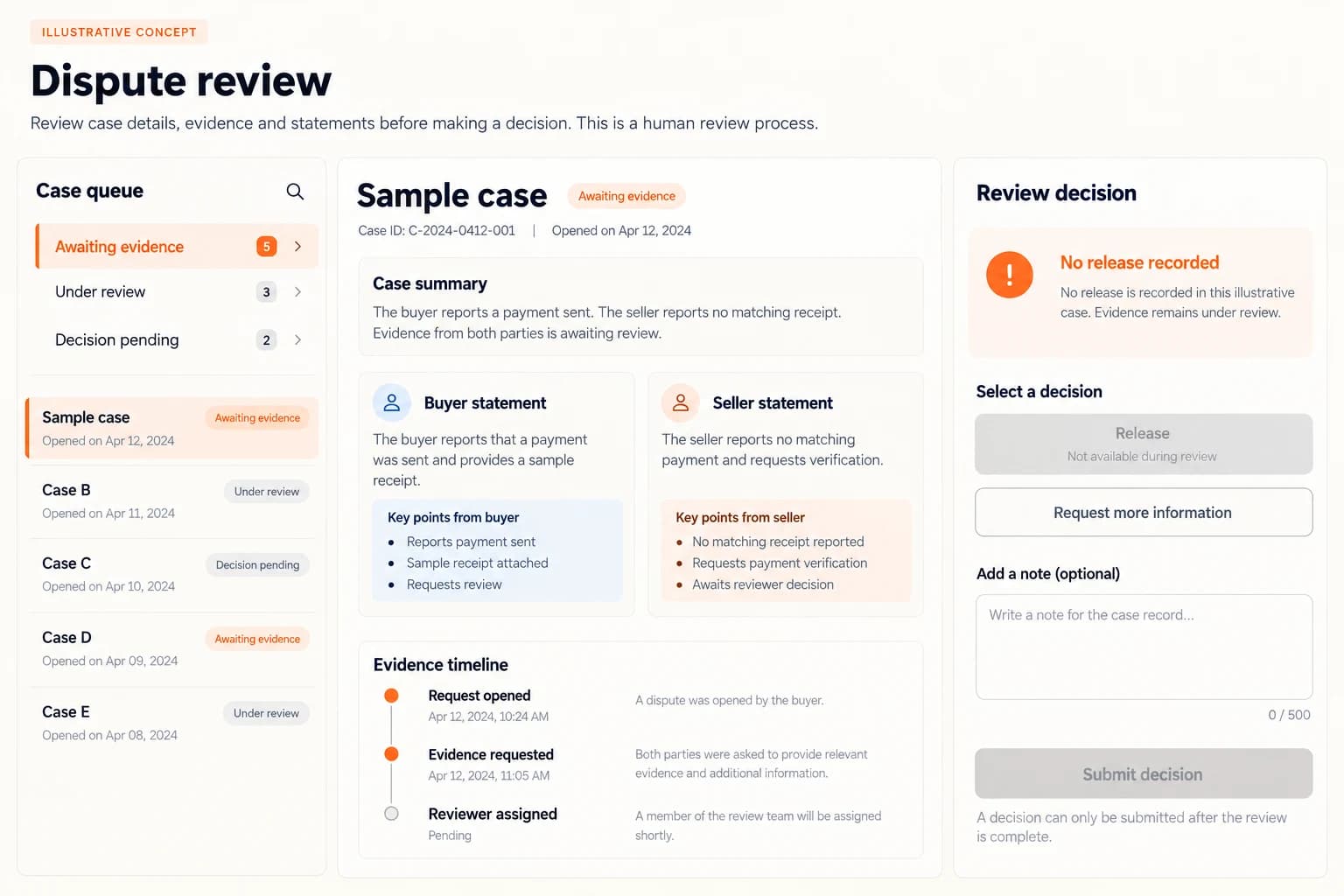
Use this original payment-dispute concept to scope a peer exchange workflow. The buyer reports payment sent and supplies a sample receipt; the seller reports no matching receipt. Evidence awaits review and release remains disabled. Ask for a working demonstration of the proposed order rules, payment verification and custody-provider responsibilities before accepting the scope.

Peer-payment dispute concept with buyer and seller reports awaiting review

Peer-payment dispute concept with buyer and seller reports awaiting review

Original App Clone Labs payment-dispute concept at 1536×1024. The conflicting payment claims, sample receipt, pending evidence review and disabled release are illustrative workflow states. This is concept artwork, not an actual custody or payment interface, a brand UI, a working escrow demonstration or proof of payment, asset reservation, release or operator authorization. No release is recorded in the concept.

What to check in the walkthrough

  • Order states: Can the proposed demo trace offer acceptance, payment deadline, buyer payment-sent claim, seller disagreement and evidence review without treating a claim as settled payment? Ask to attempt cancellation after the claim, expiry during review and duplicate updates, then inspect the allowed transitions and order history.
  • Off-platform payment verification: What evidence establishes receipt when payment happens outside the marketplace? Ask to compare a redacted sample receipt with the recipient account, amount, currency and authoritative payment reference, then replay a reused receipt or unmatched payment. Identify which verification steps depend on the payment partner or a human reviewer.
  • Release authority: Which contracted custody provider holds any reserved assets, and who may authorize release after a dispute? Ask to inspect separate reviewer and release permissions, approval records and provider confirmation; demonstrate that missing evidence or an unavailable provider leaves release blocked and cannot produce a completed-release state.
Open full-size reference

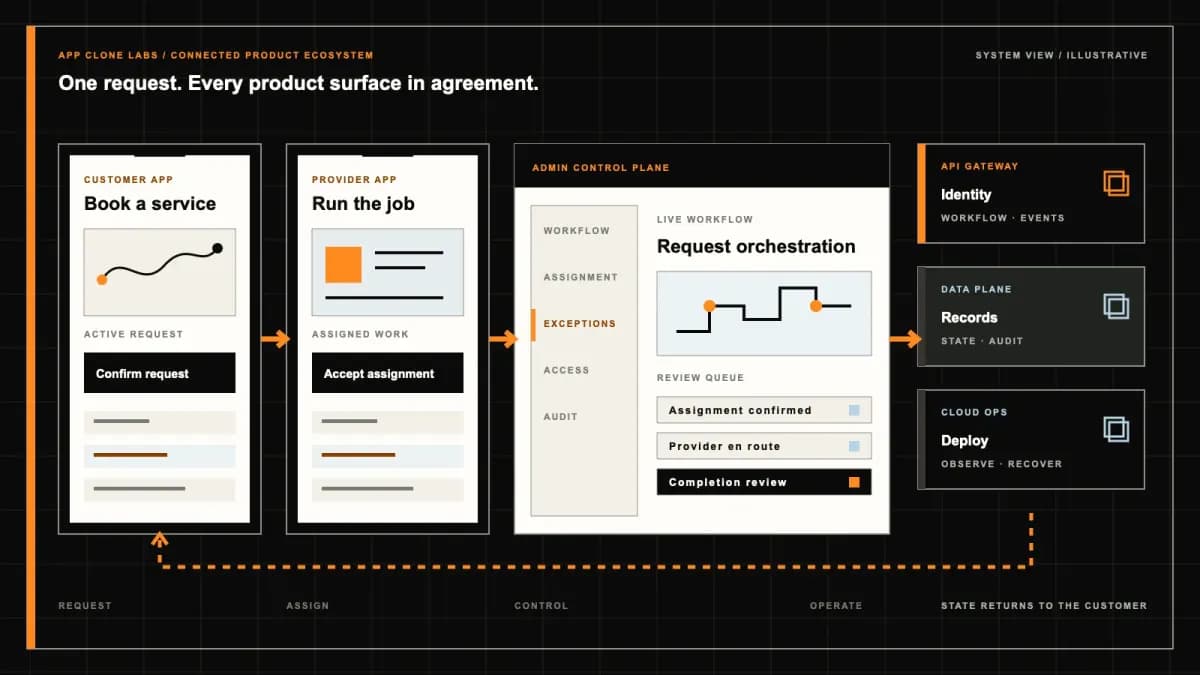
Product flow

Role-workflow flow diagram.

A visual map of how each role interacts with each workflow stage, with operator controls and integration boundaries.

Deployable product architecture

Configurable Peer Exchange Platform

Workflow

  1. 01Validate eligibility and available inventory
  2. 02Track external settlement evidence
  3. 03Close only supported obligations

Roles in the loop

  • Eligible offer makers and takersAgree versioned trade terms
  • Marketplace rule administratorsConfigure permitted operator policies
  • Case reviewers and custody approversResolve evidence through separate authority

Operator controls

  • Prevent conflicting inventory commitments
  • Preserve accountable investigation
  • Reconcile each external movement

Integrations underneath

  • Identity and sanctions services
  • Custody and escrow services
  • Payment evidence and case management
Illustrative validation artifact — role-workflow flow diagram; final surfaces, boundaries, and integration topology are confirmed during discovery.

Monetization

Configurable Peer Exchange Platform monetization models.

We model monetization early so payments, admin controls, and reporting support the business.

Price the agreed operating footprint

Define supported operators, rules and environments in the contract. Software delivery does not include operating permissions, counterparties or guaranteed trading returns.

Apply disclosed completion rules

Version maker or taker charges and specify cancellation, return and unresolved-case treatment. Reconcile fees to supported outcomes rather than charging from a payment claim alone.

Scope accountable service capacity

Price contracted evidence, investigation and reporting capabilities with clear access limits. Paid service levels must not determine dispute outcomes or remove eligibility checks.

A peer exchange must reconcile two different settlement stories

A fictional buyer accepts an advertisement for 12 units of NOVA, a fictional asset, payable in fictional LOCAL currency. The seller’s asset reservation is confirmed, the buyer uploads a payment receipt and the seller reports no matching incoming transfer. The operator now has three records: an accepted trade, a custody hold and a disputed external payment. Completing the order because one screen says paid would collapse those records into an unsupported conclusion.

App Clone Labs scopes a configurable P2P exchange script around these operating boundaries. This is an independently branded software scope, without implied affiliation with an existing exchange. Establish operating permissions, payment access and custody contracts separately. No trading returns are guaranteed. The buying decision should establish who owns each rule, which evidence supports each transition and what remains unresolved when one provider or counterparty stops responding.

Configure an operator policy before publishing the first ad

Specify eligible accounts, permitted assets, supported payment methods and the jurisdictions in which the operator may offer the service. Record a reviewed policy version rather than exposing an unrestricted settings panel. A technically available currency or custody route does not establish permission to use it. Account verification, market eligibility and payment-account acceptance need distinct decisions under the actual operating arrangement.

Define who can approve changes and when they take effect. A new limit should govern later acceptances without rewriting the agreement for an existing trade. Demonstrate an account becoming restricted while its accepted order remains under investigation. The system should prevent new activity as required while preserving records and an authorized route for resolving outstanding obligations. Configuration isolation matters when several operators share software: their eligibility decisions, payment destinations and case records must not leak across boundaries.

An advertisement needs an exact asset identity, available quantity, price rule, minimum and maximum trade size, permitted payment method and effective period. Show enough terms for a taker to understand the proposed exchange before acceptance. An indicative rate requires a freshness policy and a defined point at which the quote becomes binding. Do not silently substitute a new price after the customer has agreed.

Validate ad limits again when creating the order. Two takers can select the final available quantity at the same time, so the reservation decision must prevent conflicting commitments. Test simultaneous acceptance, a maker reducing inventory during checkout and a stale screen submitting an expired quote. Retain an accepted snapshot of the terms, including fees and payment instructions. A later advertisement edit should never change the recipient account shown in an existing trade.

Escrow orchestration requires a confirmed reservation

Identify the contracted custody arrangement and the evidence that an asset amount is actually reserved for a specific order. A marketplace database flag cannot prove control of external funds. Keep reservation requested, reservation confirmed and reservation failed distinct. Request external payment only after the required hold is confirmed under the chosen design, with supported next steps if the reservation remains uncertain.

Bind the hold to the order, asset, network, quantity and provider reference. Separate marketplace administration from signing authority; a support agent editing an advertisement should not gain the ability to move reserved assets. Rehearse the provider accepting a reservation while its response is lost. Check the existing instruction before retrying, and prevent a second hold against the same trade. Custodial and multisignature designs have different authority boundaries; select one explicitly rather than presenting an escrow label as a complete security model.

Payment sent and payment received are separate facts

Bisq’s published trading rules and dispute documentation distinguish buyer payment actions, seller receipt checks and dispute review. They also describe payment-detail matching. This is a reference for evidence boundaries, not a proposal to copy Bisq’s protocol, dispute timelines or custody design into a different operator’s marketplace.

For the selected payment method, define how the recipient account, sender identity where required, amount, currency and reference are checked. A receipt can support a claim without proving that the recipient received usable funds. A pending or reversed transfer needs its own state. Rehearse an underpayment, a correct amount sent to the wrong destination and a reused receipt attached to two orders. Authorized partner data may assist verification, but unavailable or incomplete coverage must remain visible to the reviewer and customer.

Deadlines must preserve a payment claim under review

Define payment windows, evidence deadlines and escalation ownership as separate rules. An untouched order reaching expiry can follow a different path from an order where the buyer reported payment just before the deadline. Automatically returning reserved assets while the payment claim is unresolved can create an obligation the customer interface no longer acknowledges. Choose supported transitions for cancellation and expiry at every relevant stage.

Test a payment report racing the expiry worker, an appeal arriving after a case deadline and a customer reconnecting with an old cancellation button. The authoritative order state should decide the permitted action and preserve both events. Display the next required step and responsible team without promising that every bank or custody provider follows the marketplace clock. Notifications need delivery records and account-visible status; sending a reminder alone does not establish that a customer had an opportunity to respond.

Dispute evidence needs restricted access and an accountable decision

Create a case tied to the accepted terms, custody reference, payment claims and protected conversation. Request only the evidence needed for the dispute and limit access to legitimate reviewers. Preserve uploads and revisions with their timestamps; replacing a receipt should not erase the earlier document. Malware screening, file limits and access expiry belong in the evidence boundary, especially where documents reveal private financial information.

Record what the reviewer concluded, what remains uncertain and which supported remedy is proposed. A customer’s statement and a provider observation need identifiable origins. Rehearse contradictory documents, an unavailable reviewer and an appeal with new evidence. Do not allow the first agent to close the case by overwriting the payment status. Define escalation and review authority independently from custody approval so a dispute decision does not itself impersonate a confirmed transfer or remove the need for permitted signing.

A release request is not an observed asset delivery

The Bitcoin developer guide’s payment-processing chapter explains transaction confirmation and double-spend considerations. It supports treating broadcast and confirmed payment as different observations. An independent marketplace must establish its own chain-specific monitoring, custody confirmations and recovery policy; Bitcoin guidance does not specify finality for every supported asset.

Track approved release, provider acceptance, broadcast where applicable and the required settlement evidence separately. Reconcile exact quantities, fees, destination and network to the order. Test a lost callback after provider acceptance, a delayed transaction and a changed confirmation observation. Use the existing provider reference to investigate an uncertain outcome before issuing another instruction. Customers and support should see that release is being reconciled rather than receiving a completed badge that the underlying evidence cannot support.

Reconciliation must include returns and outstanding obligations

An operator needs a view joining each order to its reservation, payment evidence, case decision, release or return instruction and observed outcome. Compare marketplace liabilities with custody records at defined checkpoints. A canceled order can still have an outstanding return; a closed dispute can still have an uncertain release. Report those differences as work owned by a named operational role.

Rehearse duplicate callbacks, an unmatched custody movement and a fee posted before completion. Corrections need attributable records rather than silent balance edits. Define how payment reversals discovered after asset release become investigation cases, including the limits of available remedies. Software cannot guarantee recovery of an external payment or blockchain transfer. Buyer acceptance should inspect the exception report and the supporting history, not merely a dashboard total that balances after someone manually changes it.

Define the daily handover for unresolved items. A replacement analyst should see the last verified observation, the missing evidence, the responsible provider and the next permitted action without reading private documents unrelated to the case. Test a shift change while NOVA release remains uncertain and an external payment inquiry is still open. Keep the two investigations connected by order identity while recording their different owners. Closing one inquiry must not remove the other from the queue or imply that both settlement obligations have been discharged.

Commercial scope should follow the work the operator can staff

Price operator licensing, transaction administration and contracted case tooling against an explicit footprint. Establish which completion event triggers a fee, which party pays it and how cancellation or returns affect charges. Keep transaction fees separate from network charges and external payment costs. Publishing more advertisements does not supply willing counterparties, favorable pricing or usable liquidity.

Start with a reviewed asset set and limited settlement methods whose evidence can actually be investigated. The main scope drivers are policy variations, custody interfaces, concurrent reservations and dispute workload. Expand only after support and reconciliation can absorb the additional cases. High-risk or weakly evidenced methods need their own decision, not an automatic toggle inherited from a generic feature list. Any promised performance, support capacity or provider coverage requires evidence specific to the proposed implementation and contracted services.

Choose the peer architecture that matches the buying problem

Compare the Paxful-style peer marketplace scope when the central question is settlement-method choice and offer discovery. This configurable platform brief emphasizes operator policy versions, advertisement limits and consistency across external payment, escrow instructions and reconciliation records.

Use the Remitano-style localized peer exchange scope when regional settlement operations and local support are the primary constraints. Here, specify a generic operator architecture first, then add the permitted regional adapters. Establish source-code terms, evidence ownership and custody responsibilities without assuming that any reference service supplies access or operational approval.

Accept the scope through a synthetic disputed trade

Use a synthetic sandbox with fictional NOVA and LOCAL records, fictional participants and controlled custody responses. Buyer acceptance should publish an ad, race two takers, confirm one reservation and introduce a receipt that the seller disputes. Try cancellation during review, expire a deadline and replay a provider event. Require an attributable decision and separately authorized release, then withhold its callback to demonstrate an unresolved reconciliation case. Illustrative screens are not working escrow or payment proof.

Bring one operator policy and payment exception to a peer exchange scope discussion to identify evidence gaps, release authority and staffed case ownership.

Use the delivery process to agree the acceptance records and provider dependencies before committing to additional methods or markets.

FAQ

Questions to resolve before the build.

01What is the core purpose of this P2P exchange script?

It provides configurable operator rules, advertisement limits, escrow orchestration, payment evidence, disputes and reconciliation, with explicit ownership across external payment and asset movement boundaries.

02Does the software provide authority to operate an exchange?

No. The operator must establish lawful permissions, permitted markets, payment relationships and custody contracts separately. Technical configuration does not confer authorization or guarantee trading returns.

03How are advertisement limits enforced?

Validate exact quantities, minimums, maximums, eligibility and available inventory at acceptance. Preserve agreed terms and prevent simultaneous takers from reserving the same seller quantity.

04Does an escrow badge prove an asset is reserved?

No. Bind the order to confirmed evidence from the contracted custody arrangement. A requested reservation or marketplace status alone does not prove external funds are held.

05Can an uploaded receipt trigger automatic release?

A receipt supports a payment claim but may be reused, incomplete or inconsistent. Define authoritative receipt checks, dispute handling and separate custody approval before permitting release.

06What happens when a deadline expires after payment is reported?

Apply the agreed transition rules and preserve the reported payment for investigation. Do not silently return reserved assets while an unresolved payment claim requires review.

07Who can see sensitive payment evidence?

Restrict documents to legitimate case participants and reviewers under the agreed policy. Preserve revisions, limit access duration and retain attributable evidence handling records.

08Can a dispute reviewer move the reserved assets?

Review decisions and custody authority should be distinct. A proposed remedy requires permitted approval and observed provider outcomes before the marketplace describes the asset movement as complete.

09How should a missing release callback be handled?

Investigate the existing provider reference and reconcile its actual outcome. Keep the order visibly unresolved rather than retrying blindly and risking a duplicate asset movement.

10What belongs in the reconciliation report?

Join orders, reservations, payment evidence, decisions, fees and release or return outcomes. Expose unmatched movements and outstanding obligations with accountable operational ownership and supporting history.

11How does this differ from the Paxful and Remitano scopes?

This page centers on generic operator architecture and rule consistency. The related scopes emphasize settlement-method marketplace choices and localized regional payment and support operations respectively.

12What should a buyer inspect in a demonstration?

Use fictional records to test simultaneous acceptance, disputed receipts, deadline races, separate approvals and uncertain releases. Inspect the reconciliation history rather than treating illustrative screens as payment proof.

Solution reference register

01 / Regulatory caveat

Confirm licensing and market-specific authorization before enabling regulated activity · Define whether assets or funds are held by the operator, a qualified custodian, or not held at all · Apply security review, strong authentication, encryption, audit logging, recovery, and incident response · Present educational product information only and prohibit personalized financial, legal, tax, or wagering advice · Apply customer verification, sanctions screening, blockchain monitoring, asset-listing review, and travel-rule processes where required · Prevent deployment in a market until operator permissions, custody contracts, and financial-crime procedures are documented

Primary sources

References behind this page

Dated official documentation, standards, and research that support the factual claims on this page.

  1. 01
  2. 02

How to read this page

Scope, cost and timeline figures are planning guidance until confirmed in a written proposal. Diagrams and screens are illustrations, not client deliverables, and source-code rights and handover follow the signed agreement. See the delivery process and the full disclaimer.

Next decision

Turn the brief into an accepted product scope.

Define outcomes, constraints, evidence, rights and handover before delivery begins.

Commercial rights, repositories, environments, documentation, acceptance and handover remain contract-defined.