
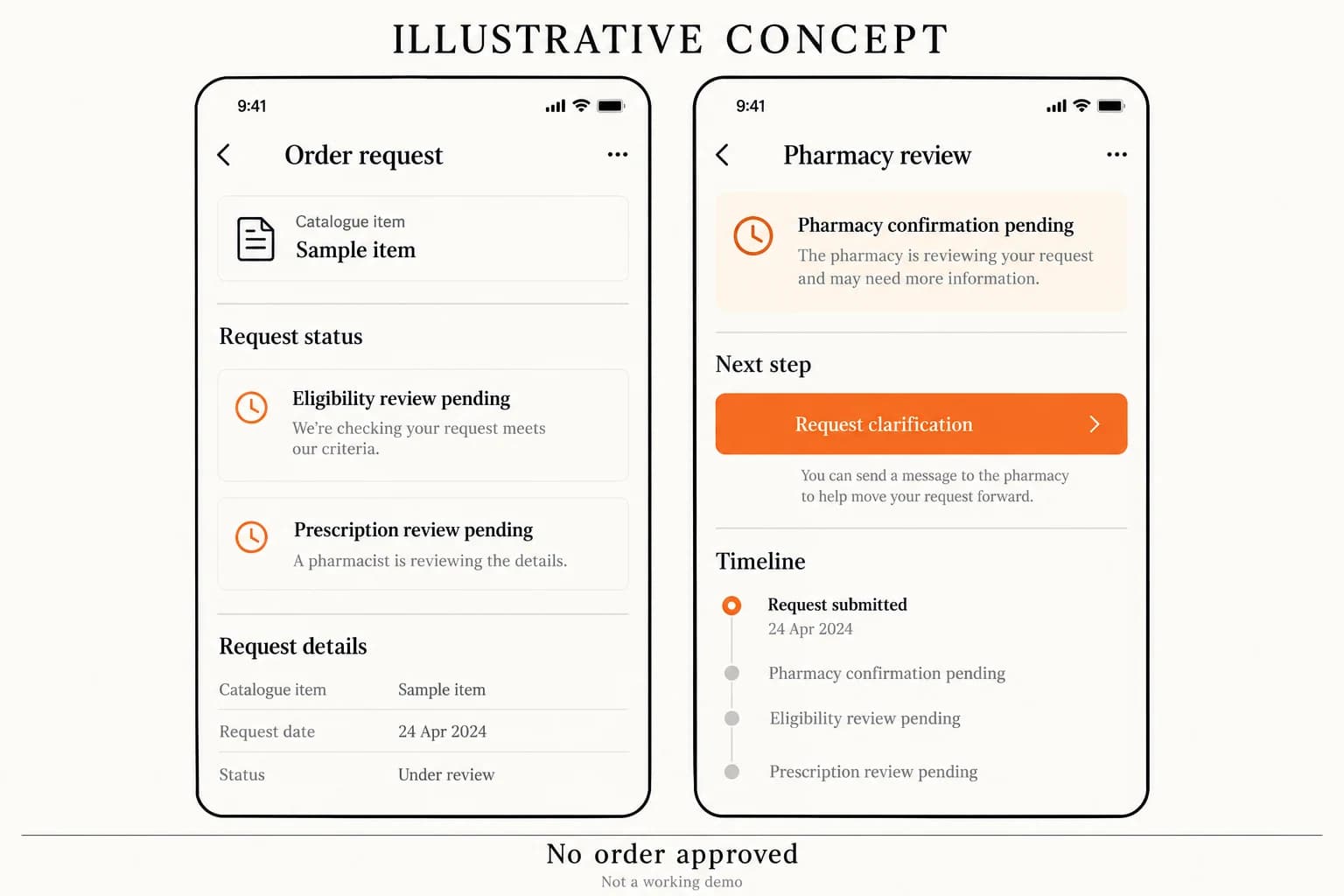
A customer uploads a prescription and sees a green order-confirmed badge before a pharmacist has reviewed it. The checkout works, the payment succeeds and the courier is available. The workflow is still wrong if the badge implies approval that nobody authorized. Pharmacy delivery software needs to explain what has been requested, what has been reviewed and what can lawfully happen next.
The essential feature checklist starts with a licensed pharmacy operation and qualified professional oversight, not a shopping template with medicine photographs. Product eligibility, prescription requirements, dispensing, storage and delivery rules depend on the jurisdiction and the actual product. Identity checks, encryption and a payment integration do not make a sale lawful or a platform universally compliant.
This guide helps pharmacy chains and authorized operators prepare a software brief. It is not medical, dispensing or legal advice. A qualified pharmacist and appropriate regional legal advisers should review the intended operation and approve applicable policies before implementation and launch. The examples are fictional workflow scenarios; they are not instructions to prescribe, substitute or dispense medicines.
Establish the lawful service boundary before the catalogue
Write down the entity providing pharmacy services, its operating locations and the areas it intends to serve. Identify the licences and professional responsibilities that apply, then obtain specialist confirmation of the proposed online and delivery model. A software company cannot determine those permissions from a reference application. Keep unresolved product classes and locations unavailable until the authorized reviewers approve the boundary.
The FDA's consumer guidance for the United States describes warning signs of unsafe online pharmacies and points consumers toward licensed pharmacies and pharmacist access. That guidance is useful context, not a global operating licence. Requirements elsewhere differ. The procurement brief should identify which authority's rules apply to the operator and where the team will obtain ongoing regulatory updates.
Translate the approved boundary into controls the system can enforce. A service area might differ by pharmacy, product class or delivery capability. A catalogue item can be visible for information while unavailable for online ordering. Explain those states plainly to customers. Do not advertise a product as immediately available merely because it exists in the central catalogue or was sold previously.
Model a request separately from a dispensing decision
The customer-facing lifecycle should distinguish submission, information review, pharmacist review, fulfilment preparation and delivery. The exact terms need professional approval, but the principle is simple: an uploaded document and a collected payment are not proof of authorized dispensing. Keep the required decisions explicit and attribute them to the staff member or approved process responsible.
Consider a fictional request with an unreadable document. The safe software outcome is a request for clarification or another authorized resolution, not an automated approval based on the presence of an attachment. Show the customer what action is needed without exposing unnecessary clinical details. Support staff should know whether they can help with a technical problem or must refer the matter to the pharmacist.
Retain a history of state changes and reasons for controlled interventions. If someone corrects the delivery address after professional review, establish whether the change affects eligibility or requires another check. Do not let a generic administrator edit every field without consequence. The system should preserve the relationship between the request reviewed and the product ultimately prepared for handover.
Build prescription intake around reviewable evidence
Where the approved operation accepts prescription-related documents, specify supported file types, size limits, secure storage and authorized access. Treat every upload as untrusted input. Scan or otherwise validate files according to the security design, avoid public object links and prevent document contents from leaking into analytics or error logs. Use synthetic documents during development and demonstrations.
The pharmacist's workspace should display the information necessary for the authorized review, the document version and the history of clarification. Record the outcome and its provenance without turning the interface into an automated clinical decision-maker. Any proposed automation must have an explicitly approved role and validation plan. Optical character recognition may assist transcription, but recognized text is not a substitute for professional verification.
Define how duplicate submissions, expired requests and altered attachments are handled under the approved policy. If the customer replaces a document, retain sufficient history and invalidate any decision that can no longer be safely relied upon. The technical specification should ask who may make that judgement. It should not invent clinical validity rules or imply that all prescriptions can be processed through the same workflow.
Give pharmacists a queue with appropriate authority
A pharmacist needs more than a list of orders sorted by commercial value. The workspace should identify requests awaiting review, clarification, stock confirmation or another authorized action. Show age and ownership so that cases do not disappear between shifts. Design the escalation process with the pharmacy team rather than relying on developers to decide which situations are clinically urgent.
Separate administrative convenience from professional authority. A customer-support operator may correct a notification preference but should not inherit the ability to approve dispensing. Require distinct roles, scoped access and appropriate authentication for sensitive actions. Keep a reviewable record of who accessed or changed a request. Shared staff accounts make accountability difficult and should not become the default shortcut during a busy launch.
Plan handover between shifts and locations. A request transferred to another authorized pharmacy may need different eligibility, stock or review checks. Do not assume the original approval travels unchanged. The operation's qualified reviewers must define what may transfer and what must be reviewed again. Software should enforce that documented policy and make the current accountable team visible.
Make the product catalogue operationally precise
Catalogue records need identifiers that staff can reconcile with the actual product and pack being handled. Similar names, different strengths and different pack sizes must not collapse into an interchangeable listing. Have the pharmacy approve the relevant catalogue structure and display conventions. The editorial team should not invent therapeutic claims, directions or equivalence statements to make product pages look fuller.
Separate descriptive content from transaction eligibility. A pharmacy may decide that an item requires a particular review or cannot be offered through the delivery channel. Those controls belong in structured rules, not a disclaimer at the bottom of a page. Keep publication changes reviewable and define who can update clinical or product information versus ordinary marketing content.
Search should help customers find the intended item without encouraging unsafe selection. Handle ambiguous queries with appropriate clarification and approved information rather than asserting a match. Test the catalogue with fictional records designed to expose confusion. Include look-alike names and multiple pack configurations, but have the pharmacy define the acceptance criteria. The goal is a dependable identification process, not an automated recommendation engine.
Track stock, batches, expiry and quarantine states
Inventory is more than a count of available units. The operation may need batch or lot references, expiry information, supplier records and restrictions on stock that cannot be sold. WHO's guidance on good storage and distribution practices describes risks throughout the medical-product supply chain. It supports treating storage and movement as controlled activities rather than ordinary parcel handling.
Define how stock becomes available for a request and how it is reserved while review is pending. A reserved item should not be promised to another customer without the agreed release rule. Equally, a long-abandoned request should not hold stock indefinitely. The pharmacist and operations team must approve the allocation and expiry policies; the software should make those policies observable and auditable.
Include quarantine and recall-related states that prevent affected stock from entering fulfilment. Staff should be able to identify which requests and handovers relate to a relevant batch when required. FDA supply-chain integrity resources describe the United States tracing and suspect-product context; applicability and current obligations require specialist review. Do not present a barcode field as complete compliance with a supply-chain law.
Keep substitution behind a qualified decision
A customer choosing a preferred delivery time is not the same as authorizing a medicine substitution. Never copy grocery substitution logic into pharmacy fulfilment without professional and legal review. The allowed process depends on the product, prescription and jurisdiction. The system must not infer permission from a generic checkbox that accepts all replacements or from the customer's willingness to pay a difference.
Provide a controlled clarification path when the requested product cannot be supplied. Record the authorized decision, the communication required and any further review necessary. Keep commercial repricing distinct from professional approval. A staff member should not be able to change the product behind an already approved request merely because the replacement has the same catalogue category.
Test that an unapproved change cannot proceed to packing or dispatch. Use fictional products and have the pharmacy define the expected outcome. The acceptance test concerns enforcement of the approved workflow, not whether the development team can judge therapeutic equivalence. Avoid public copy promising instant substitutions or automatic approvals when the operation depends on human professional decisions.
Treat temperature-sensitive delivery as a validated operation
A cold-chain checkbox does not establish suitable storage or transport. Product-specific requirements, qualified packaging, monitoring and handling procedures need review by the responsible specialists. WHO guidance is a useful reference for storage and distribution practices, but it is not a substitute for validating the actual route, equipment and procedure. Do not apply a single invented temperature range to every medicine.
Where monitoring is required, define the relationship between the package, sensor record and delivery event. Staff need to know whether evidence is complete and what happens if a reading is missing or outside the approved conditions. A courier should not be able to close the issue by typing a reassuring note. The authorized team must determine disposition under the documented policy.
Build an exception workflow for delayed delivery, equipment failure and uncertain handling history. That may require quarantine, escalation or another professionally approved resolution. The software should preserve the evidence and prevent unsupported release; it should not decide that a product remains suitable because the delivery was only slightly late. Keep operational notifications factual and avoid giving customers clinical instructions through automated status messages.
Minimize patient information in delivery tools
A courier generally needs an authorized delivery address, contact method and relevant handover instructions, not unrestricted access to prescription documents. Determine the permitted data for each role with the operator's privacy and legal advisers. In applicable United States contexts, HHS explains the HIPAA minimum-necessary principle and its exceptions. Its precise legal application depends on the relationship and purpose, not merely the presence of a healthcare label.
Use privacy-preserving notification text and review lock-screen exposure. A message that names a medicine can reveal more than a generic request update. Avoid putting sensitive values into URLs, third-party analytics, crash reports or ordinary support exports. Approve the contents of each message template and the vendors that receive it. Encryption does not undo an unnecessary disclosure to an inappropriate recipient.
Plan device loss and staff departure. Revoke access, limit session lifetime where appropriate and keep local data to the agreed minimum. Review whether couriers use managed devices or personal phones and what the operation can actually enforce. The software contract should state the boundary clearly. Do not claim comprehensive privacy protection while leaving screenshots, shared accounts and unrestricted exports outside any operating procedure.
Design payment timing around the approved workflow
Decide when the customer receives a price, when a payment authorization is requested and when capture occurs. The pharmacy's review and stock confirmation may change the amount or prevent fulfilment entirely. Provider capabilities, authorization windows and contractual eligibility need verification. A development team should not promise that every payment method supports the same delayed-capture or refund behaviour.
Keep request, payment and fulfilment states separate. If a request is declined, the interface should distinguish a cancelled authorization from a completed refund and explain the actual next step. Reconcile provider records with internal records so support does not mark money returned before the processor confirms it. Use neutral, accurate wording rather than promising immediate bank settlement outside the operator's control.
Do not describe platform-held funds as escrow or a regulated wallet without the appropriate approved structure. Agree financial responsibilities between pharmacies, the platform and delivery partners. Include tax, reimbursement or insurance integrations only if they are explicitly in scope and validated with the relevant parties. Complex settlement and eligibility workflows should not be implied by a standard checkout demonstration.
Specify handover, failed delivery and returns carefully
The handover policy needs to identify who may receive the package and which evidence is appropriate. Applicable rules differ by product and location. Identity or age verification may be one control, but it does not establish that the overall sale or delivery is lawful. The operator's qualified advisers must approve the exact procedure and the software must support it without encouraging workarounds.
Define what happens when the recipient is unavailable, the address changes or the package cannot be handed over. Do not automatically reroute sensitive products or leave them unattended under a generic parcel policy. Keep the original request and relevant chain-of-custody events connected. Customer support needs a clear escalation path instead of discretionary controls that bypass the approved conditions.
Returns are not automatically restockable inventory. The pharmacy must define what can be accepted, how returned products are segregated and who decides their disposition. The software should prevent a refund from silently increasing sellable stock. These are separate events. A financially resolved case can still require physical quarantine, disposal or documentation under the operation's approved procedures.
Procure security and audit evidence, not badges
Ask the implementation partner for a data-flow diagram, role model and inventory of vendors handling sensitive information. Determine who can access production, how approvals are recorded and how credentials are revoked. Contracts and applicable business-associate arrangements require appropriate review. A vendor displaying a cloud-provider certification does not prove that the application's configuration or the operator's practices meet every obligation.
Require tests for unauthorized document access, cross-pharmacy records, predictable download links and excessive exports. Use synthetic patients and controlled test accounts. Logs should record useful access and intervention evidence without copying full documents or clinical details into a second uncontrolled database. Agree retention, review responsibility and incident escalation before collecting sensitive production data.
Ask for restoration and incident exercises as deliverables. A backup is useful only if authorized staff can restore the relevant system and preserve the required records. Rehearse in an isolated environment and control access to restored data. The scope should include the pharmacy's ability to continue safely or suspend affected operations while an incident is investigated, not only the time needed to restart the web application.
Turn the checklist into a bounded pilot
Select an explicitly approved product and service boundary for the first pilot. Exclude any class the operator is not ready or permitted to handle. Use the pharmacy's procedures to define review, preparation and delivery acceptance cases. Start with fictional data and move to real operations only when the responsible teams authorize the transition and the safeguards are in place.
The pilot should include an unreadable document, a stock discrepancy, a clarification request, a payment failure and an unsuccessful handover. Where temperature-sensitive handling is in scope, include a simulated missing monitoring record and verify escalation without using actual compromised products. Each scenario needs a named decision owner and a recorded outcome. The measure of success is controlled handling, not the percentage of requests automatically approved.
Review staff workload alongside technical results. A queue that depends on one individual remembering to refresh a browser is not dependable. Notifications, shift handover and escalation need to work in ordinary conditions. Agree thresholds and response commitments with the people delivering the service. Avoid publishing customer-facing delivery promises until the operating team has evidence that the complete approved process can support them.
Validate integrations without surrendering the source of truth
An existing dispensing or inventory system may remain authoritative even when a new customer application is introduced. Map the identifiers, statuses and update permissions on both sides. Decide whether the application can request a reservation or merely display an availability indication. An integration that copies yesterday's stock count should not be presented as a guarantee that the requested product can be supplied today.
Document how the teams reconcile disagreement. If an external system accepts an update but the application times out, retrying blindly may create a duplicate request. Keep stable request identifiers and an investigation path. A delayed cancellation also needs an explicit outcome: the software must not tell the customer a request is cancelled while the pharmacy continues preparing it without receiving the change.
Migration deserves its own acceptance plan. Count catalogue records, active requests, attachments and authorized history separately. Confirm which records can be transferred, which must remain in the original system and how staff will access the archive. Do not move sensitive data simply because a bulk export is technically possible. The operator's privacy, legal and professional reviewers should approve purpose, access and retention.
Rehearse with synthetic records before changing production connections. Test rejected updates, duplicated events and an unavailable partner system. Establish a controlled way to suspend new requests while preserving access to existing work if synchronization becomes unreliable. The support desk needs factual wording for that situation, not a generic error page or a promise that the pharmacist has received information that is still queued.
Ask for a proposal that preserves professional control
Send prospective partners the approved service boundary, role model, data map and exception scenarios. Ask them to distinguish existing software, new engineering, third-party services and pharmacy-owned procedures. Request evidence for each claimed capability and explicit exclusions for unsupported integrations. A screenshot can illustrate a review queue; it cannot prove professional oversight, lawful dispensing or validated cold-chain handling.
Budget discovery, security review, integration validation, staff training and ongoing maintenance separately. Do not compare suppliers only by the customer-app price. The pharmacy's existing stock and dispensing systems may require substantial mapping and reconciliation work. Obtain named integration documentation and test access before assuming an off-the-shelf connector will preserve every required field and decision history.
App Clone Labs can help scope pharmacy-delivery software around an authorized operation and agreed engineering responsibilities. The pharmacy and its qualified advisers retain the clinical, dispensing and jurisdictional decisions. A good implementation makes those decisions explicit, protects sensitive information and gives staff reliable ways to stop, investigate and resolve exceptions. Build that control before optimizing checkout speed or adding more products.
FDA: buying medicines safely from an online pharmacy
WHO: good storage and distribution practices for medical products
HHS: HIPAA minimum-necessary requirement and exceptions
FDA: drug supply-chain integrity resources
Pharmacy delivery software scope
Comparison register
Pharmacy-delivery procurement evidence checklist
Engineering review framework, not a clinical protocol, legal determination or complete regulatory checklist. The authorized operator and qualified advisers must approve applicable requirements.
| Control area | Evidence to request | Unsafe shortcut to reject |
|---|---|---|
| Service eligibility | Approved entities, locations and product boundaries | Treating identity verification as permission to sell |
| Professional review | Scoped pharmacist queue and attributable decisions | Approving on document upload alone |
| Stock and traceability | Relevant identifiers, expiry and quarantine controls | Restocking returned products after a refund automatically |
| Sensitive documents | Authorized access, safe storage and reviewed vendor flows | Public attachment links or prescription data in analytics |
| Temperature-sensitive handling | Validated applicable procedure and exception evidence | A generic cold-chain checkbox |
| Delivery exceptions | Approved handover and failed-delivery process | Unreviewed rerouting or unattended delivery |
| Financial reconciliation | Separate request, payment and refund records | Claiming a refund before provider confirmation |
- 01
- 02
- 03
- 04
Reviewed by Aditya Bhimrajka
This guide is written for founders and operators planning clone-inspired platforms, SaaS products, marketplaces, and mobile apps. It is reviewed against App Clone Labs delivery patterns, product scoping standards, and current implementation realities before being published.
Review the editorial team structureRelated product paths
Continue with the services, solutions, guides, and articles that connect this topic to a real software build.