Editorial dossier / Regulated Products
Regulated Product Launch Readiness Checklist
A practical, evidence-led launch gate for regulated software covering product claims, privacy, security, payments, AI, app stores, operations, recovery, and monitoring.
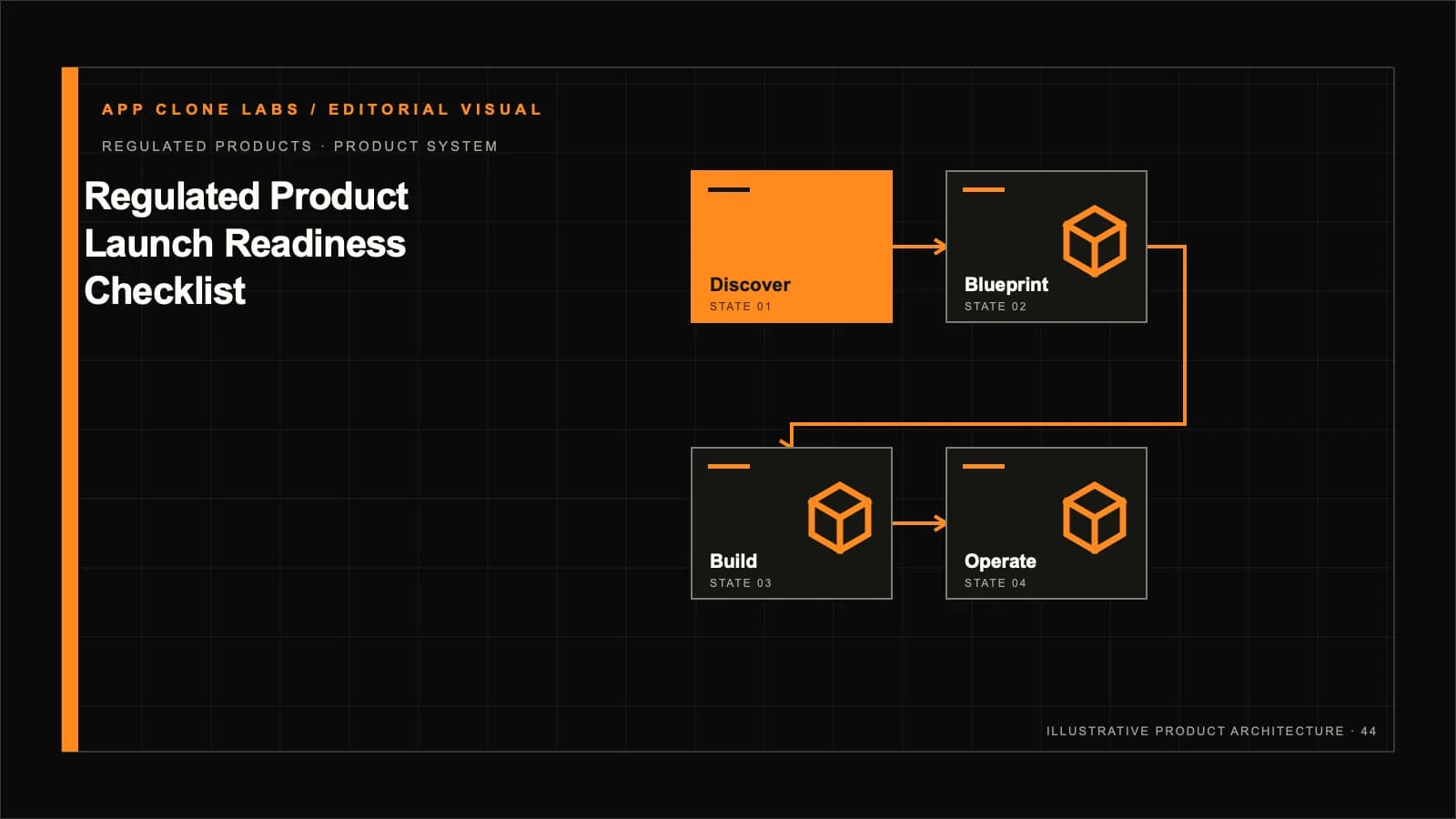
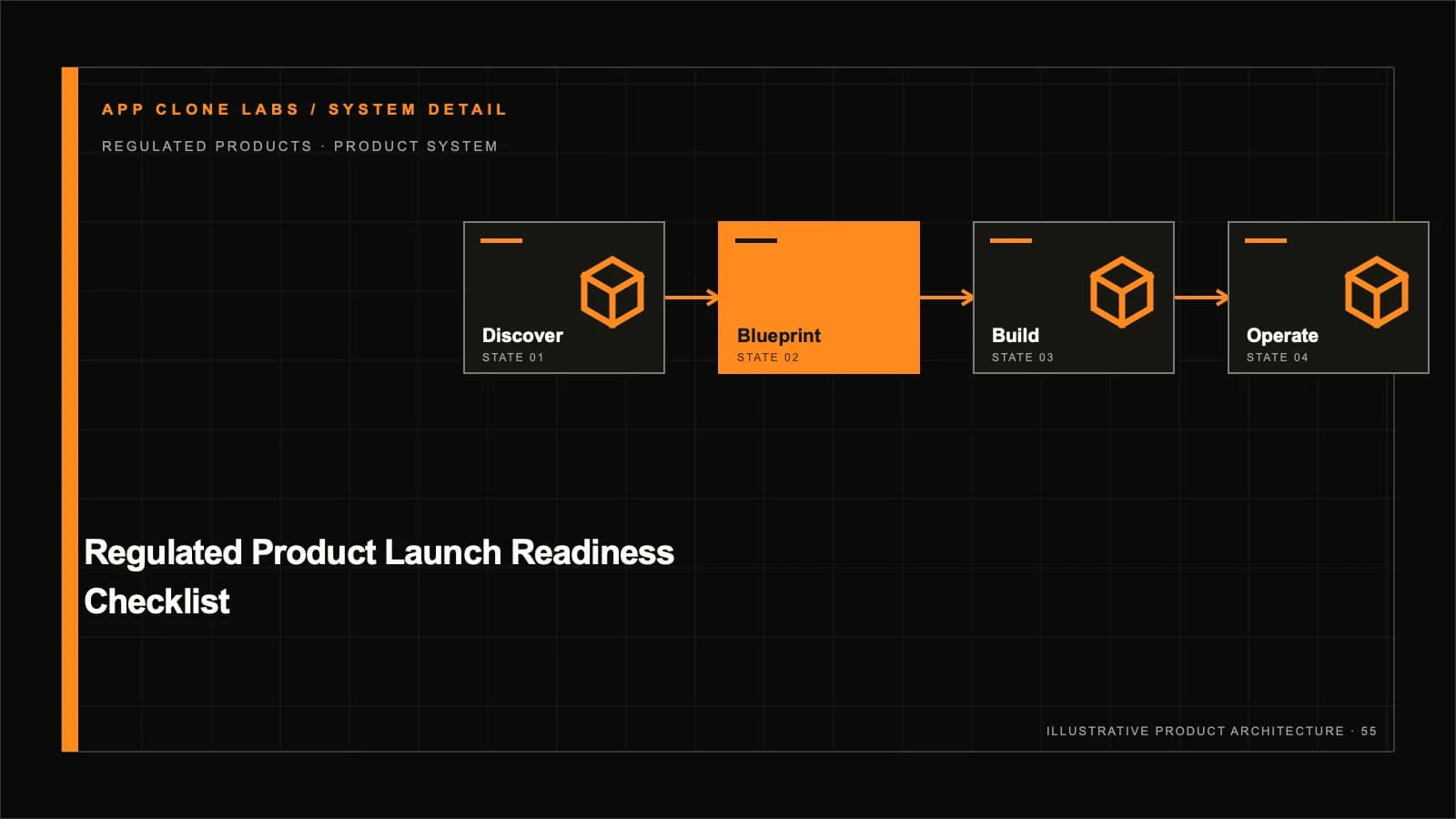
A regulated product is not ready to launch because the screens are finished. It is ready when the team can show which rules apply, who owns each decision, what evidence proves the controls work, how incidents will be handled, and which product claims have been approved. The launch packet—not the sprint board—is the artifact that makes that readiness visible.
This checklist is designed for founders, product leaders, engineering teams, security owners, operations teams, and specialist advisers working on fintech, health, identity, insurance, payments, AI, marketplaces, or other products where a failure can affect money, rights, safety, access, or sensitive data. It is a product-delivery framework, not legal, medical, security, or financial advice. Applicable duties depend on the product function, operator, users, data, geography, and distribution model.
The practical goal is not to collect compliance documents for their own sake. It is to build a traceable chain from an external obligation or internal risk to a product requirement, an implemented control, a test result, an accountable owner, and a monitoring signal. When one link is missing, the launch decision rests on hope.
The launch gate in one page
Before reviewing the detailed checklist, create a one-page launch gate. Every row should name the decision, required evidence, owner, due date, current status, unresolved risk, and the person authorised to accept that risk. Use plain language. “Security complete” is not a decision. “No unresolved critical vulnerabilities; high findings have documented treatment approved by the security owner” is testable.
- Regulatory perimeter: the product functions, jurisdictions, users, and legal entities have been mapped, with specialist advice recorded where needed.
- Claims and intended use: marketing, onboarding, store listings, sales material, and in-product language describe what the product actually does without creating an unintended regulated promise.
- Data responsibility: collected data, purpose, lawful basis or permission, processors, retention, deletion, export, and incident handling are documented and match the running system.
- Technical assurance: threat modelling, secure-development controls, test evidence, dependency review, access controls, audit logs, backups, recovery, and monitoring meet the accepted risk level.
- Operational assurance: people can review exceptions, investigate complaints, reverse or correct actions, support users, escalate incidents, and reconcile important records.
- Distribution readiness: app-store declarations, privacy disclosures, reviewer access, content ratings, sensitive-permission explanations, and production credentials are complete and consistent.
A useful gate has three outcomes: go, conditional go, or no-go. Conditional go should be rare and time-bound. It must identify the residual risk, compensating control, owner, deadline, and rollback trigger. A vague list of “post-launch improvements” is not risk acceptance.
1. Define the regulatory perimeter before finalising scope
The first question is not “Are we compliant?” It is “What exactly are we operating?” A marketplace that introduces buyers and sellers has a different perimeter from one that holds funds, makes eligibility decisions, supplies medical recommendations, verifies identity, or controls fulfilment. Small feature choices can change obligations. The team needs a function-by-function map before treating the product category as settled.
- List every user-facing and operator-facing function in verbs: collect identity, recommend treatment, initiate payment, hold balance, rank applicants, verify age, share location, moderate content, generate advice, or transfer records.
- For each function, record the user, operator, legal entity, country or region, data used, decision produced, third parties involved, and the consequence of an incorrect result.
- Separate launch functions from roadmap ideas. Do not seek a broad opinion on a hypothetical future platform when the release boundary can be assessed precisely.
- Ask qualified advisers to confirm the perimeter where the answer affects licensing, registration, required review, disclosures, recordkeeping, or the ability to launch.
This prevents a common failure: receiving advice about a generic category and then shipping functions that were not described to the reviewer. The perimeter record should be versioned. When a product function changes, the team can see whether the earlier conclusion still applies.
2. Control the promises the product makes
Regulation often follows function and intended use, not the label chosen by the founder. A wellness app can move toward a medical-device question when it produces patient-specific diagnostic or treatment outputs. A software tool can move toward a financial-services question when it holds funds, executes transactions, or makes consequential eligibility decisions. A generic AI assistant can become higher risk when it is placed inside employment, lending, health, education, or critical operations.
The FDA describes a function-specific and risk-based approach for device software, with greater attention to functions whose failure could create patient-safety risk. Review the current FDA device software guidance when a US health product may cross that boundary.
Create a claims register covering the website, sales deck, app-store listing, onboarding, help centre, notifications, AI prompts, and support scripts. For every claim, record its owner, evidence, approval state, geographic limits, and expiry or review date. The running product and public description must agree. If the interface says a decision is “verified,” define who verified it, using what information, and what the status guarantees.
Avoid absolutes such as “fully compliant,” “bank-grade,” “100% secure,” “guaranteed approval,” or “clinically accurate” unless the organisation can substantiate the precise statement and its scope. A strong launch page explains controls and limitations instead of using trust adjectives as substitutes for evidence.
3. Build a requirement-to-evidence matrix
A compliance checklist becomes operational when every requirement is connected to evidence. Start with authoritative obligations, regulator guidance, contractual duties, and the organisation’s accepted control framework. Translate each item into a product behaviour or operational procedure. Then name the test that proves it and the evidence that will be retained.
A practical matrix structure
- Source: regulation, regulator guidance, contract, store policy, security standard, internal policy, or risk treatment.
- Interpretation: a short statement reviewed by the responsible specialist; engineering should not invent legal conclusions.
- Requirement: the observable system or process behaviour.
- Implementation: service, screen, permission, queue, policy, infrastructure control, or runbook that fulfils the requirement.
- Verification: automated test, manual test, configuration review, log sample, restore exercise, tabletop, or specialist assessment.
- Evidence: immutable or access-controlled record with date, environment, version, result, exceptions, and reviewer.
- Owner and review trigger: the accountable role and events that require reassessment.
Do not force every obligation into software. Some controls belong to contracts, training, staffing, physical operations, vendor management, or formal review. The matrix should expose those dependencies rather than implying the application can solve them alone.
4. Map data before writing privacy copy
A privacy policy written before a data inventory will drift from reality. Build the inventory from the running architecture and SDK list. Track data from collection through transmission, processing, storage, support access, analytics, sharing, export, backup, and deletion. Include inferred data and operational metadata, not only obvious profile fields.
- What is collected directly, generated by the system, inferred, received from partners, or collected by embedded SDKs?
- Why is each field needed, and could the purpose be met with less precise, shorter-lived, or aggregated data?
- Where is it stored, in which region, encrypted with which key-management arrangement, and accessible by which roles?
- Which processors or independent parties receive it, under which agreement, and how does the user learn about that sharing?
- What retention event starts the clock, and does deletion propagate to search indexes, analytics stores, logs, exports, and backups according to the approved policy?
- How can a user access, correct, export, restrict, object to, or delete data where those rights apply?
For EU-facing processing, the GDPR includes data protection by design and by default and requires a data protection impact assessment where processing is likely to create high risk to people’s rights and freedoms. The exact legal analysis belongs with the organisation’s privacy adviser, but the product team must supply a real data-flow map, purpose description, risk assessment, and control evidence.
Mobile distribution adds another consistency check. Apple requires accessible privacy information and disclosure of collection, use, sharing, retention, deletion, and consent-related practices. Google Play requires developers to complete Data safety declarations, including data handled by third-party SDKs. Store declarations, product behaviour, SDK configuration, and the privacy notice must tell the same story.
5. Design identity, roles, and privileged actions
Regulated products usually fail at the edges of authorisation: support staff can see too much, an administrator can change a consequential state without review, an API trusts a client-supplied role, or a terminated operator keeps access. Create a role-and-action matrix before launch. It should describe permissions at the API and data layer, not only which navigation items are hidden.
- Use least privilege and separate routine operations from security administration, financial adjustment, policy configuration, and data export.
- Require stronger authentication and step-up controls for sensitive actions based on risk, not simply for every screen.
- Define joiner, mover, and leaver workflows; temporary access; emergency access; service accounts; credential rotation; and periodic access review.
- Record who performed a privileged action, the affected object, before-and-after state, reason, timestamp, authentication context, and approval where dual control is required.
- Make high-impact changes idempotent or safely reversible where the business process allows it. A retry must not create a second payment, benefit, account, or irreversible decision.
Test denial paths as deliberately as success paths. A permissions matrix is not proven because authorised users can act; it is proven when unauthorised roles, tenants, devices, and service identities cannot act and the attempted access becomes observable.
6. Treat auditability as a product capability
An audit log is useful only if an investigator can reconstruct what happened. Console logs scattered across services are not an audit trail. Define auditable events from the product’s consequential decisions: identity review, consent change, eligibility result, policy override, payout adjustment, prescription status, model recommendation, content enforcement, data export, deletion, and administrative impersonation.
Protect logs against inappropriate alteration, restrict access, synchronise time, document retention, and avoid placing unnecessary secrets or sensitive payloads into log messages. Connect user-facing support records to technical correlation identifiers so operations can investigate without broad database access. Sample the complete trail during acceptance testing: request, decision, notification, admin view, downstream event, and final state.
The test question is simple: six months later, could an authorised reviewer determine what the system knew, which rule or model version acted, who approved an exception, what the user was told, and whether remediation completed? If not, the product is not operationally ready.
7. Use a secure-development evidence pack
Security readiness is not a penetration-test PDF attached at the end of development. NIST’s Secure Software Development Framework describes practices that can be integrated into the software-development lifecycle to reduce vulnerabilities, mitigate the impact of remaining issues, and address root causes. A small team can implement this proportionally without creating enterprise theatre.
Minimum release evidence
- Threat model for important data flows, trust boundaries, abuse cases, privileged actions, and third-party integrations.
- Repository protection, branch review, secret handling, build provenance, environment separation, and controlled production access.
- Dependency inventory and vulnerability review with documented treatment for relevant findings—not a screenshot that ignores exploitability and exposure.
- Static, dynamic, and manual testing appropriate to the stack and risk; mobile controls can be organised against a standard such as OWASP MASVS.
- Infrastructure review covering network exposure, encryption, key management, backups, restore tests, logging, alerting, and change history.
- Release manifest tying the deployed build, configuration, database migration, mobile binaries, and evidence to one approved version.
Define severity and release criteria before results arrive. “No findings” is rarely a credible objective. The gate should distinguish exploitable critical risk from accepted low risk, record compensating controls, and block release where unresolved exposure exceeds the organisation’s tolerance.
8. Add AI-specific governance when models influence outcomes
AI introduces changeable behaviour, probabilistic output, data-lineage questions, evaluation drift, and new misuse paths. The NIST AI Risk Management Framework organises work around Govern, Map, Measure, and Manage. Its Generative AI Profile adds risks and suggested actions specific to generative systems. These are voluntary frameworks, not a declaration of regulatory compliance, but they provide a useful structure for evidence.
- Document the use case, affected people, unacceptable outcomes, human decision boundary, fallback path, and conditions under which the AI feature must be disabled.
- Version prompts, models, retrieval sources, safety settings, evaluation sets, and tool permissions. A model name alone is not a reproducible release record.
- Evaluate on representative cases, difficult edge cases, adversarial inputs, subgroup risks where relevant, and operational failure such as provider timeout or stale retrieval.
- Separate assistance from authority. If a person is accountable for the decision, give that reviewer sufficient context, time, controls, and a meaningful ability to disagree.
- Monitor quality, overrides, complaints, harmful output, security events, cost, and latency. Define thresholds that trigger investigation, rollback, or model replacement.
For products offered in or affecting the European Union, the EU AI Act may add role- and risk-dependent duties with staged application dates. Do not infer classification from a marketing label. Map the use case, provider/deployer roles, affected context, geography, and current application timeline with qualified advice.
9. Separate payment state from product state
Products that accept card payments should minimise the payment-data environment and understand which party stores, processes, or transmits account data. PCI DSS provides a baseline of technical and operational requirements for entities that can affect the security of the cardholder-data environment. Using a payment provider reduces some handling, but it does not remove responsibility for secure integration, access, scripts, webhooks, and operational processes.
Model payment intent, authorisation, capture, transfer, refund, dispute, payout, and reconciliation as distinct states. Product fulfilment should not assume a payment event succeeded because the browser returned to a success page. Verify signed provider events, make handlers idempotent, record provider identifiers, and reconcile internal records against provider reports.
Before launch, test timeout, duplicate webhook, delayed webhook, partial refund, chargeback, expired authorisation, failed payout, and manual adjustment. Finance and support need a shared event trail. If engineering is required to explain every mismatch, the operating model is incomplete.
10. Prove the operational exception paths
A regulated workflow cannot be accepted only through its happy path. Build an exception catalogue from real operating questions. What happens when identity cannot be verified, a document conflicts with another record, a user appeals a decision, a payment is reversed, a clinician or reviewer is unavailable, an automated recommendation is low confidence, or a required downstream provider is offline?
For each exception, define the queue, priority, service target, authorised roles, information shown, permitted actions, required reason, user communication, escalation, and terminal states. Use synthetic or properly governed test data to walk the workflow end to end. Confirm that the action changes the correct system of record and that stale queues cannot overwrite a later decision.
Operations readiness also includes staffing. Name the launch-day owner for each queue, the escalation contact, coverage hours, handover method, and maximum acceptable backlog. Software cannot compensate for a queue nobody monitors.
11. Test accessibility, safety, and user comprehension
A technically correct disclosure can still fail if a user cannot perceive or understand it. Test critical journeys with keyboard navigation, screen readers, zoom, colour contrast, dynamic text, reduced motion, error recovery, and clear focus order. Validate on the actual supported device and browser matrix, not only desktop emulation.
Safety-sensitive instructions, consent choices, financial totals, decision reasons, and destructive actions need plain language and deliberate hierarchy. Do not use colour alone to communicate status. Avoid dark patterns that make refusal, cancellation, deletion, or appeal harder than acceptance. Record usability findings that could change informed choice or safe task completion.
Where users may be vulnerable, underage, distressed, or under time pressure, include those conditions in the risk model. The team should be able to explain how the design limits predictable misuse and how support responds when prevention fails.
12. Prepare app-store and distribution evidence
Store review is a separate launch dependency. Prepare reviewer credentials, seeded test data, setup instructions, hardware or account requirements, and explanations for non-obvious background activity or sensitive permissions. Ensure the review account can reach every submitted function without depending on a production employee.
For Apple, review the current App Review Guidelines, especially safety, business, design, legal, and privacy requirements. For Google Play, complete the App content and Data safety information using the final SDK and data inventory. Confirm target audience, ads, permissions, content rating, news or health declarations where relevant, and developer-account verification requirements.
Archive the submitted binary, store listing, screenshots, privacy answers, reviewer notes, and approval outcome. When the app changes, compare the new release against those declarations. A previously accepted version is not evidence that a materially changed version remains compliant with current policy.
13. Run recovery and incident exercises before launch
A backup is not proven until it has been restored. Run a restore into an isolated environment, verify record counts and media, confirm secrets are not embedded in the archive, and record recovery time and data loss against the approved objectives. Test rollback for application code and database changes; destructive migrations need a forward-recovery plan, not wishful reversal.
Conduct a tabletop exercise using a scenario appropriate to the product: exposed credential, unauthorised data export, incorrect automated decision, payment duplication, provider outage, malicious administrator, or lost audit trail. Walk through detection, triage, containment, specialist notification, user communication, evidence preservation, recovery, and post-incident review.
Incident contacts, regulator or contractual notification assessments, and public communications require accountable owners. The engineering alert is only the beginning. The launch packet should identify the current runbook, on-call path, decision authority, and where incident evidence will be retained.
14. Define the first 30 days of monitoring
Launch approval should include a monitoring plan with named metrics and thresholds. Combine technical health with product risk: authentication failures, privileged changes, identity-review backlog, payment mismatches, model overrides, complaint themes, deletion failures, consent withdrawal, suspicious access, store crashes, support response, and recovery events.
Every alert needs an owner and a response. Dashboards without decision thresholds create false comfort. Hold short daily reviews during the initial launch window, record changes made, and compare observed behaviour with the assumptions in the original perimeter and impact assessments.
Schedule formal reviews when the product enters a new jurisdiction, changes legal entity, adds a consequential feature, changes data purpose, integrates a new processor, alters an AI model, expands to children or vulnerable users, changes payment flow, or experiences a material incident. Readiness is a maintained state, not a launch-day certificate.
A founder-ready release dossier
The final dossier should be small enough to navigate and complete enough to defend. Link to evidence rather than pasting screenshots into one enormous document. Control access because the packet will contain sensitive architecture, findings, and operational information.
- Release summary: scope, version, environments, owners, approved claims, launch geography, supported users, and explicit exclusions.
- Perimeter and advice register: functions, jurisdictions, classifications, specialist conclusions, assumptions, and review triggers.
- Data pack: inventory, flow diagram, processor list, retention schedule, privacy assessment, notices, consent or permission design, and rights procedures.
- Assurance pack: threat model, secure-development checklist, test reports, finding treatment, access review, backup restore, recovery plan, and release manifest.
- Operations pack: role matrix, exception catalogue, queue ownership, audit-event catalogue, complaint and appeal flows, incident runbook, and monitoring thresholds.
- Distribution pack: store declarations, reviewer access, content ratings, permission explanations, privacy links, approved screenshots, and submitted build identifiers.
- Decision record: go/no-go outcome, open risks, approvals, dates, conditions, rollback triggers, and next review.
A good dossier does not guarantee that nothing will fail. It shows that the organisation understood the release, reduced avoidable risk, made unresolved risk visible, and can respond when reality differs from the plan.
FAQ
Does a long checklist prove regulatory compliance?
No. Compliance depends on applicable law, product facts, organisational practice, and qualified interpretation. This checklist helps a delivery team organise questions and evidence. It cannot replace legal advice, regulatory review, security assessment, clinical evaluation, financial-control expertise, or other specialist work required for a particular product.
When should regulatory review begin?
Begin when the first meaningful function and market are defined, before architecture and public claims harden. Review again when scope changes. Early review is useful only when the team provides specific functions, users, data, geography, parties, and intended outcomes rather than asking about a vague product category.
Can a regulated MVP still be small?
Yes, but small should mean a narrow complete workflow—not missing controls. Reduce geography, user roles, integrations, products, or decision types. Do not remove auditability, security, support, correction, incident handling, or mandatory disclosures merely to meet a date.
What should block launch?
Examples include an unresolved critical security exposure, unknown regulatory perimeter, material mismatch between data behaviour and disclosures, inability to restore essential records, missing owner for consequential exceptions, untested payment reconciliation, misleading product claims, or required approval that has not been obtained. The organisation should define its own criteria before final testing.
How often should the dossier be reviewed?
Review it at every material release and whenever a defined trigger occurs. Some evidence can be continuously generated by delivery systems; other items require scheduled access review, risk assessment, vendor review, tabletop exercise, or specialist reconsideration. Each artifact should name its owner and next review condition.
Use the checklist to make a decision, not decorate a launch
The strongest signal of readiness is not the number of documents. It is whether a founder, operator, engineer, security owner, and specialist adviser can inspect the same release and reach the same understanding of what it does, what it does not do, which risks remain, and how the team will respond.
For implementation planning, connect this dossier to the App Clone Labs QA and testing service, cloud-security work, DevOps release controls, and delivery process. Keep the regulatory interpretation with qualified advisers; use product and engineering work to make approved requirements observable, testable, and operable.
- 01
- 02
- 03
- 04
- 05
- 06
- 07
- 08
- 09
- 10
- 11
Reviewed by the App Clone Labs product strategy team
This guide is written for founders and operators planning clone-inspired platforms, SaaS products, marketplaces, and mobile apps. It is reviewed against App Clone Labs delivery patterns, product scoping standards, and current implementation realities before being published.
Review the editorial team structureRelated product paths
Continue with the services, solutions, guides, and articles that connect this topic to a real software build.
Services, solutions, and guides
Related articles
Read next