
A buyer pays for products from two sellers. One ships immediately; the other cancels. The marketplace has already allocated commission, a promotion and shipping charges across the basket. What should the buyer receive back, what does each seller still earn, and who absorbs the payment-processing cost? Those decisions determine the build cost more than the checkout button does.
This guide gives founders and procurement teams a way to price a multi-vendor marketplace with split payments. It covers the transaction model, seller onboarding, allocations, refunds, settlement evidence and operating responsibilities. Numerical examples are invented worksheets, not App Clone Labs quotations, provider tariffs or industry averages. Tax, legal, accounting and regulated-payment questions require appropriate professional review for the proposed business and jurisdictions.
Price one complete transaction before pricing features
Define a narrow buying scenario: one country, one currency, physical products, two independent sellers and one payment provider. State whether the platform is selling to the customer or facilitating the sellers' sales, as determined with appropriate advice and contractual review. Identify who issues invoices, sets refund terms and bears disputed-payment losses.
Then trace the basket through checkout, seller acceptance, fulfilment, partial cancellation, payment reconciliation and seller payout. A list saying customer app, vendor app and admin panel does not establish these behaviours. Two suppliers can quote that same list while assuming completely different financial responsibilities and failure handling.
Keep a transaction worksheet beside the interface specification. Record the original order amount, allocation rules, shipping treatment, promotion funding, tax ownership, platform fees and expected seller proceeds. Specify rounding and the version of the rule applied. If a commercial policy changes later, completed orders should remain explainable under their original terms rather than silently recalculating against today's settings.
Distinguish charges, transfers and payouts
A customer payment, an allocation to a seller and a deposit into that seller's external bank account are different events. Use those distinctions in the proposal, database and support console. A seller shown as paid should not simply mean the platform created a transfer request while the external payout remains unresolved.
Stripe documents destination charges and separate charges and transfers as different Connect integration patterns. Destination charges associate a platform charge with a connected account; separate charges and transfers support transferring platform-collected funds to multiple connected accounts. Eligibility, geographic support, payment methods and responsibility must be checked against the current provider agreement and integration documentation.
The choice should follow the commerce model, not a developer's favourite tutorial. One seller per checkout may justify a different design from a basket spanning several sellers. Delayed fulfilment and independent refund decisions add requirements beyond initial collection. Ask the supplier to show the selected pattern on the transaction worksheet and explain which party's balance is affected when something goes wrong. Do not accept split payments as a sufficiently precise architecture description.
Do not rename delayed payouts as escrow
Holding a seller payout until a delivery milestone may be a useful commercial requirement, but escrow has a specific legal meaning. Stripe explicitly states that it does not provide escrow services or support escrow accounts. Its manual-payout documentation describes country-dependent limits and permitted payout timing; those details need checking for the actual configuration.
Avoid promising that funds can be held indefinitely or that adding a release button creates a regulated escrow arrangement. If the business truly needs escrow, obtain suitable professional advice and investigate an appropriately authorised service. That decision can change vendor selection, contracts, technical integration and the overall budget.
For a standard marketplace proposal, describe the actual control: when funds become eligible for transfer or payout, which evidence establishes the milestone, who can pause the process and what happens on a dispute. Make the customer and seller terms consistent with the implementation. The cheapest way to remove this risk is accurate scoping and language before development, not a disclaimer added after marketing has sold an unsupported financial promise.
Include seller onboarding in the launch boundary
A seller needs more than a profile picture and product catalogue. Determine which account information, identity or business checks and banking details the provider requires for the selected arrangement. Establish how the platform handles missing information, restricted capabilities, rejected accounts and changes to payout details. Production eligibility cannot be inferred from a sandbox account succeeding once.
Prefer the provider's supported collection and onboarding mechanisms where they fit the agreed requirements. Reduce unnecessary handling of sensitive identity and banking data. Confirm which information the marketplace must retain and who can access it. A custom seller form may add development and security responsibilities without improving the operating model.
Demonstrate a seller who can list products but cannot yet receive funds, then decide whether your platform should permit purchases in that condition. The answer belongs in approved business rules. Add onboarding status, required action and escalation ownership to operations. Budget seller support and periodic requirement changes separately from the one-time integration; the platform will continue receiving account-related events after the launch feature list is complete.
Make allocation rules explicit and testable
Consider an invented basket with seller A merchandise worth sixty dollars and seller B merchandise worth forty dollars. A ten-dollar platform-funded promotion is allocated proportionally, reducing the merchandise amounts to fifty-four and thirty-six dollars. At an assumed ten-percent commission on those discounted amounts, the platform allocation is nine dollars and the combined seller allocation is eighty-one dollars before other costs.
That is arithmetic illustrating one policy, not a recommendation or an actual provider calculation. A seller-funded promotion, commission on the original price or different shipping treatment produces different results. Document the intended policy rather than letting database implementation choices decide it accidentally.
Test small amounts and mixed quantities where proportional allocation requires rounding. Define where the final rounding difference belongs and verify that line allocations match the order total. Use an appropriate money representation and currency rules. Preserve an allocation snapshot for each transaction, including later refunds. The financial model should be reviewed with finance expertise; choosing a language with decimal support does not automatically make every allocation or tax decision correct.
Design partial refunds before automating seller release
If seller B cancels in the invented example, determine which discounted merchandise amount is refundable and how shipping, commission and promotional funding are treated. Do not divide the whole payment by the number of sellers. The correct result follows the approved allocation and refund policy, including the provider's capabilities and contractual conditions.
Keep order cancellation, customer refund and seller-transfer recovery as distinct operations. Their outcomes can differ or arrive at different times. An internal refund approval does not prove the provider returned money. Likewise, initiating a reversal does not establish that the seller's external bank payout has been recovered.
Include a refund after seller release, a failed refund, repeated requests and an account with insufficient recoverable funds in acceptance testing. Ask who investigates unresolved balances and which losses the platform may bear. These scenarios are part of the cost of split-payment commerce, not rare extras to ignore until support receives a complaint. Budget the operational queue and evidence history along with the API integration.
Build a reconciliation record, not a decorative wallet
The marketplace should retain traceable references for orders, payment attempts, allocations, transfers, refunds, disputes and payouts. A reviewed internal ledger or financial subledger can explain obligations and adjustments. It must be reconciled with provider and bank evidence appropriate to the operating arrangement. Internal arithmetic alone cannot prove that external funds arrived.
Avoid presenting one seller balance without defining its components. Pending, eligible, released, paid out and held for investigation are different positions. A seller needs to understand which amount can move, what is waiting and why. Operations needs a way to investigate a difference without manually editing history until the numbers appear to match.
Use controlled adjustment records with reasons and approval boundaries. Preserve the original event and its correction. Define reconciliation cutoffs and time zones so reports compare the same window. Ask the vendor to export a synthetic transaction from collection through final payout and explain every reference. If that walkthrough requires a developer to query several tables manually, the administrative scope is probably unfinished.
Make webhook processing safe to repeat
Payment integrations depend on asynchronous events. Stripe's webhook documentation describes signature verification and event-handling considerations. The application must be prepared for repeated notifications and should not rely on receiving events in a convenient business order. Store sufficient safe references to identify processed work without copying sensitive payment data into general logs.
Separate accepting an event from performing every downstream operation synchronously. Validate the sender, persist the work and apply permitted state transitions. A repeated success notification must not generate a second seller release. A late notification should not overwrite a more authoritative completed state merely because it was received last.
Use provider-supported idempotency for relevant requests and document its limits. Stripe's API reference distinguishes behaviour and retention across API versions, so avoid assuming a key provides permanent duplicate protection. Your application also needs its own durable intent references and recovery logic. Test a connection lost after provider acceptance and an application restart before acknowledgement. The desired result is one economic operation with an explainable history, not a blanket retry-until-success loop.
Scope the customer and seller experience together
A single receipt may conceal multiple fulfilments. Show which seller supplies each line, what delivery expectations apply and how the customer requests help. Explain the effect of a partial cancellation. If different sellers use different shipping or return processes, the product should communicate that before payment rather than surprising the customer afterwards.
The seller workspace needs order acceptance, fulfilment updates, refund visibility and a clear earnings explanation. Decide which actions sellers can perform directly and which need platform review. Keep financial and operational permissions separate where appropriate. A catalogue editor does not necessarily need access to payout-account changes or full customer contact details.
Mobile usability matters for these workflows even when the public storefront is polished. Test long product names, large baskets, small screens and keyboard navigation. A seller should be able to understand a held amount without opening an unreadable desktop-only spreadsheet. Budget purposeful interface states for pending and failed operations. Reusing a generic success toast for every money-moving request makes support harder and can mislead both buyers and sellers.
Separate development cost from transaction economics
The implementation worksheet uses fictional allowances of eighty hours for discovery and financial rules, one hundred twenty for seller onboarding, one hundred eighty for checkout and allocation, one hundred forty for refunds and disputes, one hundred forty for ledger and reconciliation work, and one hundred eighty for testing and handover. That totals eight hundred forty hours.
At an assumed fifty dollars per hour, labour would be forty-two thousand dollars. This is a transparent planning example, not a quotation or a claim about typical marketplace prices. It excludes payment-provider charges, licences, tax advice, legal work, infrastructure, data migration, independent assurance, working capital, taxes and contingency.
Ask suppliers to identify what changes those allowances. Multiple currencies, separate tax responsibilities, subscriptions, international sellers and complex returns may expand scope. Provider approval delays are dependencies, not developer productivity failures. Compare proposals against the same transaction and exception matrix. A lower bid achieved by omitting reconciliation or post-payout refund handling is not an equivalent implementation delivered more efficiently.
Forecast payment fees using the selected arrangement
Create a provider-cost sheet that records the country, currency, payment methods, connected-account arrangement, volumes and pricing date. Include processing, relevant account or payout charges, dispute costs and other contractual fees. Current terms may differ by configuration, so do not apply a familiar card percentage to every marketplace without checking it.
In an invented month, assume two thousand customer payments at an average order value of fifty dollars. Gross payment volume is one hundred thousand dollars. If a purely hypothetical variable processing allowance were three percent plus thirty cents per payment, the arithmetic would be thirty-six hundred dollars. These are not Stripe rates. They demonstrate why transaction count and average order value both belong in the model.
Add a separate adverse case for refunds, disputes and lower average baskets. Identify whether fees are refunded under the actual agreement; never presume they all reverse automatically. Model platform revenue and seller obligations independently. A commission percentage is not net profit, particularly when the platform funds promotions, support and unrecovered losses. Finance should review the full economics before the feature is sold as an automated revenue engine.
Reserve budget for operating controls
Customer support needs safe access to transaction history, not unrestricted provider credentials. Finance needs reconciliations and exports. Risk or operations teams may need controlled holds and investigations. Define who can approve refunds, change commission rules and update payout settings, with appropriate audit records and review of sensitive actions.
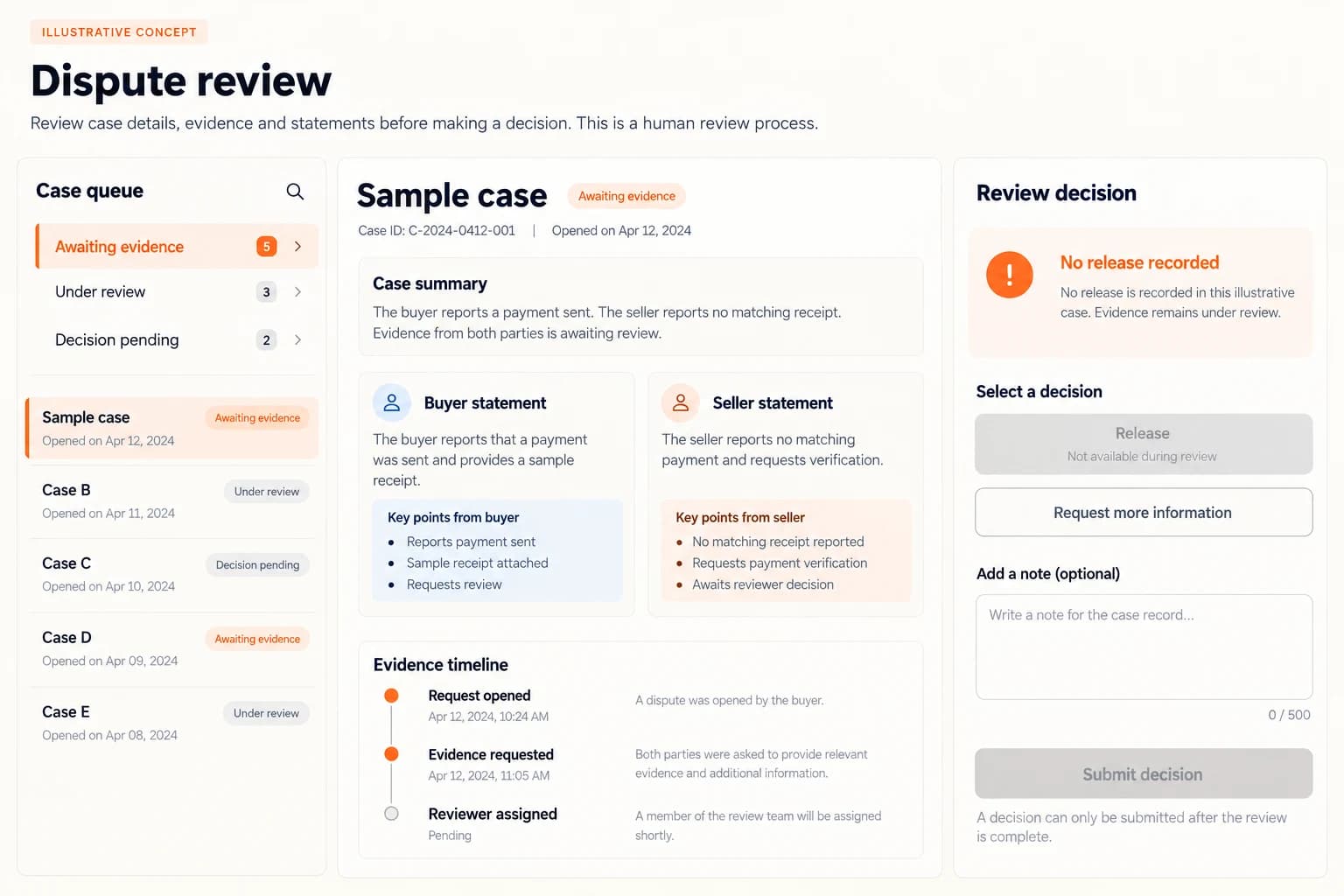
The concept image shows a human dispute-review workspace, not a live payment integration or proof of financial authority. During procurement, request a synthetic demonstration of a case moving from reported issue to evidence review and an approved action. Show both permitted and denied actions, including what happens if a reviewer tries to approve their own restricted request.
Budget alert ownership and incident recovery. Watch for unresolved payments, repeated job failures, unexplained balance differences and unusual administrative changes. A dashboard that reports these conditions without assigning responsibility is incomplete. Support coverage and response commitments should be agreed separately from initial delivery. Automation reduces repetitive work only when exceptions are visible and staff have safe, documented ways to resolve them.
Test accounting outcomes, not just checkout completion
Use a compact synthetic test catalogue with mixed seller baskets, discounts, shipping and quantities. Cover successful payment, delayed payment, seller cancellation, partial refund, disputed charge and failed payout. For each scenario, record expected order states, financial allocations, provider references, customer messages and administrative permissions.
Include adverse sequences: the same event twice, a refund request during another refund, a seller becoming restricted after purchase and a timeout with an unknown result. Ask for evidence of the final financial position, not only a screenshot that checkout succeeded. Tests should identify discrepancies rather than silently tolerating them as rounding or eventual consistency without a defined boundary.
Validate privacy and access separately. One seller must not retrieve another seller's earnings or customer records by altering an identifier. Sensitive provider secrets stay on the server, and logs should avoid payment credentials. Independent security review may be appropriate to the risk and contract. Its scope and remediation responsibilities should be explicit; using a provider's payment form does not certify the security of your whole marketplace.
Plan releases around open financial obligations
An application rollback does not undo a payment or seller transfer already submitted. Before deployment, identify how older in-flight transactions remain understandable to the new version and how background jobs recover. Keep rule versions compatible with historical orders. A commission change should not alter an already agreed seller entitlement simply because a report was regenerated.
Back up the relevant data and prove restore procedures in an isolated environment. Prevent test restores from issuing live provider requests or customer notifications. Recovery should preserve identifiers used for deduplication and reconciliation. Losing those references can turn an otherwise successful restore into a duplicate-operation risk.
At handover, confirm access to source code, approved provider accounts, deployment settings, operating documentation and usable exports under the agreement. Clarify pre-existing and third-party licences. A source archive alone does not transfer a payment-provider contract or teach finance how to investigate unresolved balances. Ask the vendor to train the people who will own these tasks rather than assuming the original developer remains available indefinitely.
Decide whether a combined basket earns its complexity
One alternative to a multi-seller payment is a separate checkout for each seller. That can simplify the relationship between a payment and an order, but it creates additional customer steps and potentially different fixed-fee economics. It may also make a platform-wide promotion harder to explain. Evaluate that alternative honestly rather than assuming the most complex basket is essential to launch.
Use a synthetic example with three sellers, one unavailable product and different delivery dates. In the combined design, ask what the buyer approves once and which amounts can change later. In the separate design, ask how a partially completed shopping session is presented and whether stock remains reserved after the first checkout. Neither approach eliminates the need for clear cancellation and refund rules.
Compare both against actual buyer intent. If customers normally purchase from one specialist seller, a combined basket might add little early value. If the proposition depends on assembling a single purchase across several suppliers, separate checkouts could undermine the service. Discovery should establish that requirement through the intended workflow, not an unverified claim that every marketplace needs an Amazon-style basket.
Record the decision and its migration implications. An early single-seller checkout should not pretend to support multi-seller transactions through manual financial edits. If expansion is planned, retain clear seller ownership on order lines and avoid coupling reports to assumptions that cannot be changed safely. This is compatibility planning, not a reason to build every future feature now.
For procurement, request two bounded options with the same quality controls: the narrower checkout and the combined basket. Compare engineering effort, customer friction, provider suitability and support workload. Keep security, reconciliation and duplicate-operation prevention in both. A meaningful saving comes from reducing the commercial complexity you genuinely do not need, while retaining evidence that each transaction is correct.
Use the quote review to remove ambiguity
Ask each bidder to label assumptions as confirmed, awaiting provider approval or excluded. Request the chosen charge pattern, supported seller geography, refund responsibilities and payout controls in writing. Compare the same launch boundary and failure cases. Resolve marketing language such as escrow or instant payouts before it becomes a contractual promise the implementation cannot support.
Choose a controlled pilot with approved sellers and operational owners. Define the conditions that pause new purchases while allowing existing obligations to be resolved. Monitor the difference between collection, fulfilment and settlement instead of relying on a gross-sales chart. Expand only after the original transaction model reconciles predictably and staff can handle exceptions safely.
For an App Clone Labs scoping discussion, bring the seller model, sample basket, promotion rules, returns policy and proposed payment-provider arrangement. The useful output is an implementation boundary, a tested financial lifecycle and a first-year cost model with explicit exclusions. The linked ecommerce solution and delivery-process pages can help frame that work. Buy clarity about the transaction before buying a longer feature list.
Stripe Connect destination charges
Stripe Connect separate charges and transfers
Stripe manual payouts and the distinction from escrow
Stripe webhook validation and event handling
Stripe API idempotent-request semantics
Ecommerce marketplace solution
Marketplace payout ledger states
Comparison register
Illustrative split-payment marketplace implementation worksheet
Invented hours at USD 50/hour, not a quote or typical project price. Excludes provider fees, legal and tax advice, licences, infrastructure, migration, independent assurance, capital, taxes and contingency.
| Workstream | Assumed hours | Illustrative labour |
|---|---|---|
| Discovery and financial rules | 80 | USD 4,000 |
| Seller onboarding | 120 | USD 6,000 |
| Checkout and allocation | 180 | USD 9,000 |
| Refunds and disputes | 140 | USD 7,000 |
| Ledger and reconciliation | 140 | USD 7,000 |
| Testing and handover | 180 | USD 9,000 |
| Total | 840 | USD 42,000 |
- 01
- 02
- 03
- 04
- 05
Reviewed by Aditya Bhimrajka
This guide is written for founders and operators planning clone-inspired platforms, SaaS products, marketplaces, and mobile apps. It is reviewed against App Clone Labs delivery patterns, product scoping standards, and current implementation realities before being published.
Review the editorial team structureRelated product paths
Continue with the services, solutions, guides, and articles that connect this topic to a real software build.