
Ask a telehealth development vendor to demonstrate a revoked clinician account, a failed video consultation and an exported patient record. Those three exercises reveal more than a presentation covered in compliance badges. They show whether access actually stops, whether care teams can recover a disrupted appointment and whether sensitive data leaves the system through a controlled process.
This is a procurement guide for organisations evaluating software partners for US telehealth workflows involving HIPAA obligations. It is not legal advice, clinical guidance, a certification checklist or a claim that App Clone Labs or any described product is HIPAA certified. Your organisation's legal, privacy, security and clinical owners must determine applicable requirements and approve the operating model. Examples use synthetic scenarios, never real patient information.
Translate compliant into responsibilities and evidence
A supplier saying HIPAA compliant has not yet described what it will deliver. Ask which entity is operating the service, which activities the supplier performs and what protected information each party creates, receives, maintains or transmits. Separate application engineering from hosting, support, incident response and clinical operations. Those responsibilities can belong to different organisations.
HHS explains the business-associate relationship and the use of contractual assurances for applicable arrangements. Have counsel assess the actual relationship and required agreements. A signed business associate agreement, or BAA, does not replace the technical and operational safeguards needed for the service. Conversely, encryption does not remove the need to resolve an applicable contractual obligation.
Turn broad promises into an evidence register. For each requirement, record the owner, system boundary, implementation evidence, validation method and unresolved issue. Ask vendors to state exclusions explicitly. If monitoring, mobile-device management, workforce training or incident coordination is outside the contract, your organisation still needs an owner. Compliance work cannot disappear simply because it sits outside the development team's statement of work.
Map the data before choosing the stack
Begin with a synthetic appointment and trace every data movement. Registration, scheduling, intake, messages, video sessions, documents, clinical notes, billing and support can involve different services. List what each service receives, why it needs the information, where it stores it and who can retrieve it. Include administrative tools and background jobs, not just the visible patient portal.
Look beyond the database. Error reporting, session replay, customer chat, notification systems and analytics can receive sensitive information accidentally. A patient name in a URL or an intake answer in an exception message can spread into logs and third-party dashboards. Ask the vendor to demonstrate data minimisation in those paths with synthetic examples.
HHS risk-analysis guidance emphasises understanding where electronic protected health information exists and the risks affecting it. Use that principle to make the data map actionable. Every newly introduced service should trigger a boundary review. A diagram completed once at project kickoff is not enough if a later sprint adds transcription, a support widget or a different video provider without revisiting the information flow.
Examine the complete subcontractor chain
Request a register of hosting, video, messaging, storage, email, monitoring and support suppliers. Identify the service configuration and account owner, not only the company name. A provider may offer different products and contractual options, and your deployment must match the approved arrangement. A vendor's general marketing statement is not evidence that your selected service tier is covered.
HHS cloud guidance addresses responsibilities when cloud services maintain electronic protected health information. Use it with legal and security review to assess the actual arrangement. Ask who manages access, encryption keys, retention, backup recovery and incident notifications. Do not assume that a cloud vendor's involvement transfers all responsibility away from the healthcare organisation or application developer.
Agree a change-control process for subcontractors. The development team should not add a new analytics or AI service simply because it is convenient during debugging. Require disclosure, approval and configuration review before sensitive information enters a new service. Confirm that trial accounts and personal developer accounts cannot quietly become part of production. The contract should describe how material service changes are communicated and assessed.
Ask for a risk analysis that leads to action
A reusable security questionnaire can support procurement, but it is not a system-specific risk analysis. Ask what threats and vulnerabilities affect your actual workflows, data, devices and workforce. The useful output connects findings to mitigations, responsible owners, deadlines and a decision about residual risk. It should distinguish evidence from assumptions.
HHS does not prescribe one universal risk-analysis format for every organisation. That does not mean a generic template is sufficient. Have your responsible security and privacy teams evaluate the supplier's method and its coverage. Review whether cloud configuration, remote support, data exports, account recovery and availability are considered alongside application vulnerabilities.
For a fictional example, a shared clinic workstation may expose an unattended session. The response could involve session controls, device policy, staff procedures and an appropriate authentication workflow. Buying a different frontend framework would not address the whole risk. Ask vendors to explain a finding through to verification: what changed, who accepted it and how the control was tested after implementation. A long report without tracked remediation is weak evidence.
Test authorisation with deliberately wrong users
Create synthetic accounts for a patient, clinician, scheduling coordinator, billing user, support operator and administrator. Then test actions each should be denied. Can one patient retrieve another patient's document by changing an identifier? Can a receptionist read clinical notes unnecessarily? Can a support account export an entire organisation's records? Backend enforcement matters even when the interface hides a button.
Use a permission matrix approved by the organisation. Define scope by organisation, facility, care relationship and task where appropriate. Review treatment-related access and legal exceptions with qualified owners rather than applying a simplistic slogan to every clinical context. The engineering goal is explicit, justified access, not a single all-powerful staff role.
Test revocation and role changes during an active session. A clinician leaving the organisation should not retain access through a long-lived token, cached export link or another device. Define emergency access if needed, including justification, logging and subsequent review. Ask for automated negative tests as delivery artefacts. Screenshots of a working administrator account cannot prove tenant isolation or patient-record access boundaries.
Review authentication and recovery together
Strong login controls can be undermined by a weak password-reset or support-assisted recovery process. Ask how staff and patient identities are established, how sensitive account changes are verified and how lost devices are handled. Review multifactor authentication for privileged access and the organisation's requirements for other roles.
Sessions need appropriate lifetimes, revocation and behaviour on shared devices. The exact settings should reflect risk and clinical workflow rather than copying arbitrary timeouts from another application. Make session expiry understandable: staff should not lose a clinical note without warning, but an unattended browser should not remain an indefinite access path.
Demonstrate recovery with synthetic identities. An attacker who knows an email address should not gain access by persuading support to bypass established controls. Changes to a contact address, authentication factor or recovery method should leave appropriate evidence and trigger the approved notifications. Include service accounts, deployment credentials and emergency administrative access in the review; human login screens represent only part of the authentication surface.
Follow the appointment through a failed connection
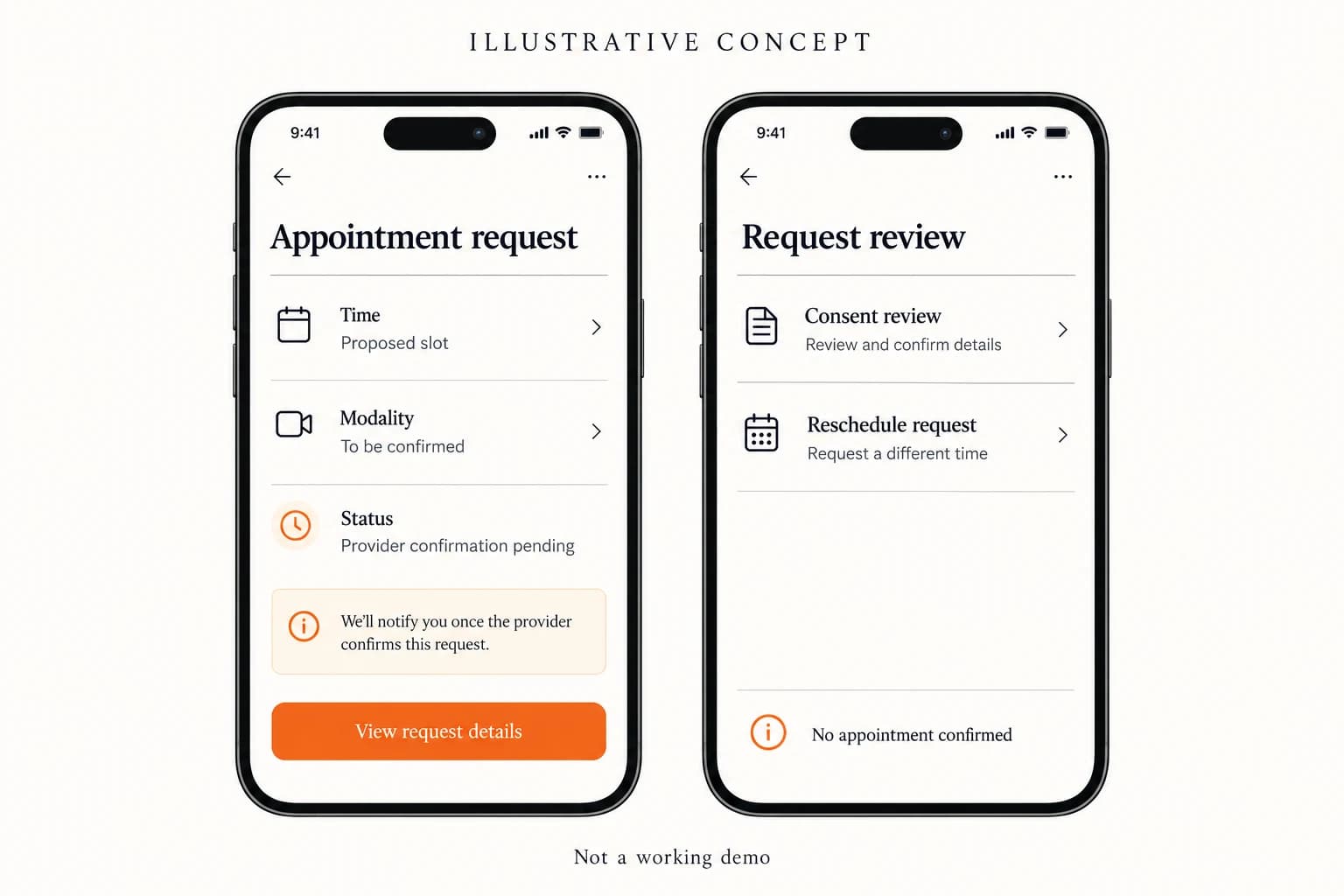
The accompanying appointment image is an illustrative concept, not a working telehealth demonstration or evidence of clinical suitability. A procurement exercise should instead show the intended workflow with synthetic records: appointment request, confirmation, identity checks where required, waiting-room entry, clinician connection, interruption and the approved fallback.
Clinical and operational owners must define the fallback and escalation process. The software should communicate what happened, preserve relevant non-duplicated work and help staff follow the approved procedure. It should not invent clinical triage rules or imply that an unavailable video session is an emergency service. Patient location, consent and service eligibility need appropriate policy and jurisdictional review.
Test weak connectivity, permission denial, a disconnected clinician and duplicate attempts to join. Check whether a meeting link can be reused or shared beyond its intended access. Decide whether recordings are needed at all; if they are, review consent, storage, access and retention separately. A video SDK connection succeeding once does not establish that the complete care workflow is safe, private or operationally ready.
Demand useful audit trails without copying clinical records
An audit trail should help authorised reviewers determine who accessed or changed information, when, through which operation and with what result. Record appropriate references and context while avoiding unnecessary duplication of sensitive content. Do not put full clinical notes into general application logs simply to claim comprehensive auditing.
Define how audit records are protected, retained, searched and reviewed. Access to the audit system itself should be controlled. A normal application administrator should not be able to erase evidence of their own sensitive actions without detection or accountability. The particular storage and integrity design should match the organisation's risk assessment and obligations.
Run an investigation exercise using synthetic events. Ask the vendor to find a document access, a failed export, a role change and a corrected note. Can the reviewer distinguish an attempted action from a successful one? Can timestamps be interpreted consistently? Budget the review workflow and operational ownership as well as event capture. Millions of unexamined log lines do not automatically provide meaningful oversight or a practical incident investigation capability.
Make integrations prove identity and meaning
An EHR integration is not complete because a sample API request succeeds. Identify patient matching, encounter identifiers, consent context where applicable, coding expectations, update ownership and error recovery. State which system is authoritative for each data element. Avoid overwriting a newer record with an older update after a delayed retry.
If the project uses FHIR, specify the actual resources, profiles, version and implementation requirements agreed with the integration partner. A claim of FHIR support without that detail does not demonstrate interoperability. Use synthetic records to test ambiguous matches, missing identifiers, changed demographics and partial failures. Have clinical owners review whether the exchanged information retains its intended meaning.
Budget access to the partner environment and the time needed for interface approval. External organisations may impose onboarding requirements that are not controlled by the development team. Distinguish engineering completion from partner validation. Ask for replay and reconciliation tools that do not expose records to unauthorised staff. Integration exceptions should enter a managed queue, not disappear into a developer's inbox after the project is handed over.
Evaluate security testing beyond a certificate
Ask for a defined testing scope, tester independence where appropriate, severity handling and remediation evidence. A report may be genuine yet exclude the mobile application, cloud account, administrative console or new release. Confirm the tested version and environment. Close material findings with retesting rather than simply attaching the original report to a procurement pack.
OWASP's Application Security Verification Standard provides a structured application-security requirements framework. It can help specify testable expectations, but it is not a HIPAA certification. Map relevant requirements to your system and risk profile. Include authentication, authorisation, input handling, file uploads, cryptographic configuration and sensitive-data exposure in the agreed verification work.
Request dependency and secret-management practices too. Who reviews vulnerabilities, rotates exposed credentials and approves urgent patches? Can the team show that test data is synthetic and production data is not copied casually into developer laptops? Ask how remediation deadlines are handled when a third-party component is involved. A partner's process after discovery is often more important than a claim that its current software has no vulnerabilities.
Require a restore exercise, not just backup settings
Availability affects care operations as well as technical uptime. Agree recovery objectives with the organisation: how much data loss and downtime can the service tolerate, and what alternative process operates during an outage? Different workflows may have different needs. Do not accept one impressive uptime percentage without understanding exclusions and dependencies.
Ask the partner to restore an isolated environment from a backup and document the outcome. Confirm that encryption keys, configuration and required files are recoverable along with the database. Prevent restored test environments from sending real notifications or connecting to live clinical systems. Restrict access and dispose of test copies according to the approved policy.
Validate recovery with application-level checks. Records should be readable, permissions should remain correct and integrations should not replay actions unsafely. Identify who can initiate recovery outside normal office hours and what approval is required. Include backup retention, capacity monitoring and failure alerts in the support agreement. A scheduled backup job that has silently failed for weeks is not a recovery plan.
Put incident cooperation into the contract
The supplier should explain how a suspected exposure is reported, contained, investigated and communicated to your designated owners. Counsel and privacy teams should determine applicable notification duties and contractual timelines. Do not substitute a generic incident-response promise for a coordinated procedure covering the developer, hosting provider and other relevant suppliers.
Use a tabletop scenario with synthetic details: a support credential may have been compromised, and an unusual export appears in the audit trail. Ask who disables access, preserves evidence, determines scope and coordinates decisions. The team should distinguish verified facts from uncertainty rather than prematurely declaring no impact because the service remains online.
Clarify access to evidence and support after termination. The healthcare organisation may still need logs, exports or cooperation relating to an event discovered later. Define escalation contacts, coverage hours, evidence preservation and responsibility for costs. A partner that will answer technical questions only through an unmonitored sales inbox is a poor fit for a service requiring timely operational coordination.
Score vendors by deliverable evidence
The comparison matrix pairs procurement areas with evidence requests and warning signs. Use it as a discussion framework, not a mathematical compliance score. Some failures should stop a selection regardless of how attractive the interface looks. An unresolved data boundary or absent required agreement cannot be offset by extra features in a weighted spreadsheet.
Request a sample responsibility matrix, synthetic-data demonstration, permission test report, risk-remediation register, recovery exercise and handover pack. Verify that supplied artefacts are relevant and shareable; do not ask a vendor to disclose another customer's confidential patient information or security details. References can establish experience without exposing protected records.
Record what remains unproven. A promising prototype may deserve a paid discovery phase with clear gates rather than an immediate full implementation contract. Compare vendors against the same workflow and exclusions. If one proposal includes security testing, partner integration validation and operational training while another includes only application screens, the totals are not directly comparable. Make that difference visible before negotiating the headline price.
Budget ongoing control, not only the build
Separate discovery, application engineering, integration work, security verification, deployment and training in the initial estimate. Recurring lines may include hosting, video usage, storage, monitoring, support, access review and periodic assurance activities. Legal and specialist compliance work should be explicitly included or excluded. Do not assume it is provided merely because the supplier develops healthcare applications.
For a fictional workload, three hundred twenty staff hours of engineering, eighty of testing and forty of handover total four hundred forty hours. At an assumed sixty dollars per hour, that is twenty-six thousand four hundred dollars. This is arithmetic illustrating a worksheet, not a telehealth project quote, a market average or sufficient scope for your organisation. Replace every allowance after discovery.
Budget the changes that follow launch: new clinicians, a new facility, a changed video provider, additional integrations or altered retention requirements. Each can affect the data map and controls. Assign an owner for approving those changes and funding their validation. A fixed-price build without an operating owner can leave a technically complete product with unresolved responsibilities as soon as real organisational processes begin to change.
Check patient usability without weakening privacy
A secure portal can still fail if patients cannot complete an appointment. Ask the vendor to test keyboard navigation, screen-reader labels, readable contrast, meaningful validation errors and different screen sizes. Include consent and authentication flows rather than reviewing only the public landing page. Accessibility testing should use a defined standard and actual evidence, not a claim that a component library makes the whole service accessible.
Review messages that appear outside the authenticated session. Appointment reminders, lock-screen notifications and email subject lines can reveal more than intended. The approved content should reflect the information needed for the task and the organisation's policy. Test the exact templates and provider configuration, including failure messages, rather than approving a neutral example that differs from production.
Assistance also needs boundaries. Define how authorised caregivers, interpreters or other participants join where relevant, with appropriate identity, permission and consent handling. Do not solve access difficulties by sharing a clinician login or forwarding an unrestricted meeting link. Clinical, legal and operational owners should approve the relevant participation model.
Include usability defects in acceptance planning. A patient repeatedly blocked by an unclear error will often contact support, moving information into another channel and adding workload. A well-designed recovery path can reduce that pressure without relaxing access controls. The procurement goal is a service patients can use safely, with evidence that privacy and accessibility were considered together rather than traded against each other at the end.
For acceptance, preserve a short record of the tested devices, assistive technologies, workflows and unresolved limitations. Ask the vendor to distinguish automated checks from human testing. Both can contribute evidence, but neither should be misrepresented as an exhaustive guarantee. Assign responsibility for regression testing after design changes, especially when new consent screens, account recovery steps or embedded third-party components alter a previously reviewed patient journey.
Make handover and acceptance a controlled decision
Before acceptance, confirm ownership and access to source code, deployment configuration, provider accounts, documentation and appropriate exports under the signed agreement. Distinguish client-specific deliverables from licensed or third-party components. Test the export with synthetic records and confirm how access and data are handled when the supplier relationship ends.
Have the responsible legal, privacy, security, clinical and operational owners review their respective gates. A developer cannot approve clinical procedures on their behalf. Keep unresolved risks visible with a decision owner; do not relabel them completed because a deadline arrived. The release decision should identify the approved scope and any limits on use, not promise universal compliance for every future workflow.
App Clone Labs can help scope patient, clinician and administrative workflows against an agreed technical responsibility map. Bring the data-flow requirements, integration partners, required contractual boundaries and validation expectations to discovery. The healthcare solution and process pages linked below provide a starting point for defining the engagement. Choose the partner that can demonstrate controlled delivery and transparent limits, not the one that makes the broadest compliance claim.
HHS guidance on business associates and contractual assurances
HHS Security Rule risk-analysis guidance
HHS guidance on HIPAA and cloud computing
OWASP Application Security Verification Standard
HL7 FHIR introduction and interoperability boundaries
Comparison register
Telehealth partner evidence matrix
Procurement prompts, not legal advice, certification criteria or a substitute for organisation-specific professional review.
| Area | Evidence to request | Warning sign |
|---|---|---|
| Responsibilities | Approved scope and agreement review | Universal compliance promise without boundaries |
| Data flows | Current service and subcontractor register | Unapproved analytics or support tools |
| Access | Negative permission and revocation tests | One shared administrator account |
| Clinical workflow | Synthetic interruption and fallback exercise | Developer invents clinical procedures |
| Security | Scoped findings and remediation retests | Badge with no relevant test evidence |
| Recovery | Documented isolated restore exercise | Backup checkbox without restore proof |
| Handover | Usable exports, access and operating owners | Unclear exit and incident responsibilities |
- 01
- 02
- 03
- 04
- 05
Reviewed by Aditya Bhimrajka
This guide is written for founders and operators planning clone-inspired platforms, SaaS products, marketplaces, and mobile apps. It is reviewed against App Clone Labs delivery patterns, product scoping standards, and current implementation realities before being published.
Review the editorial team structureRelated product paths
Continue with the services, solutions, guides, and articles that connect this topic to a real software build.