
01Apply and assess
Keep applicant status separate from approval
Collect required evidence and risk acknowledgments under the selected operator rules. Show pending, rejected and approved decisions with reasons and authorized next steps.
Brokerage and market access
Broker client portal for leveraged-market account servicing and platform access. Planned for authorized brokers serving eligible self-directed trading customers with role-specific workflows, operator controls, integrations, and a handover boundary defined for the selected market.
From $9,099 one-time for the Professional plan. Enterprise customization is quoted on scope.
See product screens and demo accessCustom workflows
Brand-safe product strategy
Admin and operations tooling
Reference walkthrough by arrangement
Workflow
Each workflow stage is mapped to a role, screen, API, notification, admin control, and measurable launch outcome.
Collect required evidence and risk acknowledgments under the selected operator rules. Show pending, rejected and approved decisions with reasons and authorized next steps.
Request approved platform access, distinguish real and demo environments, and reconcile deposits before describing funds as available under the operator policy.
Present statements, controlled support and withdrawal progress. Keep refund decisions, ledger corrections and confirmed payment outcomes separate.
Deployable Product Architecture
Workflow / system register
Product delivery loop
Blueberry Markets-style Broker Portal workflow stages.
A focused release proves one complete workflow
Keep applicant status separate from approval
Confirm provider outcomes independently
Track withdrawals and complaints to evidence
Control note
Scope the customer action and the operator response as one system.
Operator controls
The control center is scoped as a first-class product surface, not an afterthought.
Risk notices, appropriateness review and account restrictions must follow the authorized operator model; software does not grant a broker license or global compliance.
Separate requested provisioning from a returned account identifier. Restrict credential recovery, staff permissions and account switching across demo and live environments.
Client ledgers do not prove custody or segregation. Attribute adjustments, investigate mismatches and maintain complaint ownership independently of commercial referral relationships.
Integrations
External systems that determine launch readiness, data flow, and operational continuity.
Authorized trading platform services with separate demo and live credentials, confirmed provisioning outcomes, permission checks and outage handling
Operator-approved identity, screening and funding providers with documented review ownership, restricted evidence access and reconciled event handling
Broker ledger, statement, complaint and introducer systems with controlled adjustments, client-money boundaries and auditable permission scopes
Scope drivers
The variables that most influence build effort, cost, and launch readiness.
Choose the jurisdiction, entity, client categories and actual approval rules before implementing onboarding or risk disclosures.
Establish authorized access, supported environments, reconciliation files and failure ownership rather than assuming the reference brand supplies integrations.
Define complaint escalation, withdrawal review, evidence retention and adjustment authority before expanding accounts or introducer access.
Deployable Product Architecture
Scope drivers / system register
Product delivery loop
Blueberry Markets-style Broker Portal scope drivers.
A focused release proves one complete workflow
Establish permitted customer and product scope
Confirm available interfaces and responsibilities
Staff the exception workflow
Control note
Scope the customer action and the operator response as one system.
V1 scope
Launch the smallest complete operating loop first, then scale the product with confidence.
Use synthetic evidence to test review, missing documents and an operator-defined rejection without provisioning an unauthorized live account.
Show demo and live access clearly, with pending requests and a provisioning failure that cannot become an apparently active account.
Test deposits, withdrawal review, duplicate events and refund reconciliation against fictional ledgers with accountable support and restricted staff actions.
Later phases
Capabilities that should usually wait until real usage proves the core loop.
Add instrument access only after reviewing entity permissions, customer categories, provider support and revised risk communication.
Extend provisioning and statements after validating environment identifiers, outage behavior and reconciliation differences in authorized test environments.
Introduce permitted referral reporting and compensation review with restricted customer visibility, complaint separation and attributable rule changes.
Deployable Product Architecture
Later phases / system register
Product delivery loop
Blueberry Markets-style Broker Portal post-launch expansion.
A focused release proves one complete workflow
Extend eligibility rules deliberately
Prove each adapter with real contracts
Add commercial scope without excessive access
Control note
Scope the customer action and the operator response as one system.
Regulatory review
Each flag must be reviewed by qualified counsel for your target market before build or launch.
Reference walkthrough
Ask us to confirm which reference surfaces are currently available for this product model. Rather than publishing shared demo credentials, we schedule a private guided walkthrough for qualified buyers.
Request a role-specific demonstration and confirm which capabilities are currently available. Review the proposed responsibility: Submit an application, distinguish demo access from live approval, and inspect confirmed funding and platform records without interpreting a login as trading permission.
Request a role-specific demonstration and confirm which capabilities are currently available. Review the proposed responsibility: Handle eligibility evidence, provisioning failures, funding discrepancies and complaints. Support access does not confer authority to change client money or override rejection.
Request a role-specific demonstration and confirm which capabilities are currently available. Review the proposed responsibility: Apply the actual operator rules, review permitted introducer activity and reconcile provider events against client ledgers with controlled adjustment approvals.
Request a live, private walkthrough of the reference implementation. We will confirm scope and discuss configured deployment versus custom build for your market.
Open registerDeployable Product Architecture
Reference walkthrough / system register
Product delivery loop
Request a Blueberry Markets-style Broker Portal reference walkthrough.
A focused release proves one complete workflow
Applicant and approved client: Understand account and funding status
Broker operations and support: Review exceptions with restricted authority
Compliance and finance reviewers: Maintain attributable decisions and reconciliations
Book a walkthrough
Control note
Scope the customer action and the operator response as one system.
User roles
Clone-inspired platforms usually need several coordinated interfaces, not just a customer app.
Submit an application, distinguish demo access from live approval, and inspect confirmed funding and platform records without interpreting a login as trading permission.
Handle eligibility evidence, provisioning failures, funding discrepancies and complaints. Support access does not confer authority to change client money or override rejection.
Apply the actual operator rules, review permitted introducer activity and reconcile provider events against client ledgers with controlled adjustment approvals.
Use this trading-preferences reference to discuss a Blueberry Markets-style client product. Ask for a working demo that connects account settings to the proposed broker, market-data source and order lifecycle. Agree the instruments, account eligibility and responsible providers in scope, and distinguish simulated quotes and orders from connected services.
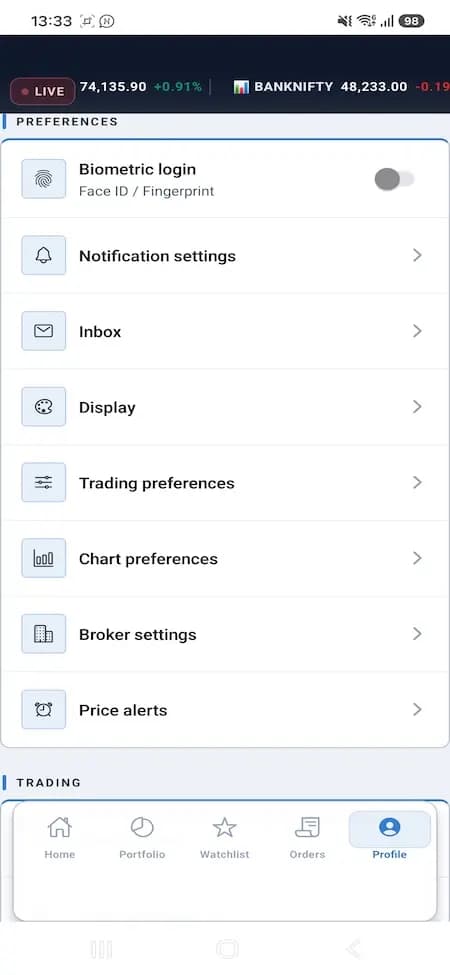
Illustrative trading-preferences reference at 450×975 with sample index quotes and a “LIVE” label. It is not an official Blueberry Markets interface or an affiliation or endorsement claim. Visible broker settings and biometric controls do not demonstrate connected broker feeds, order execution, custody, authorization or tested security. Provider connections and account records require separate evidence.
What to check in the walkthrough
Product flow
A visual map of how each role interacts with each workflow stage, with operator controls and integration boundaries.
Deployable product architecture
Blueberry Markets-style Broker Portal
Workflow
Roles in the loop
Operator controls
Integrations underneath
Monetization
We model monetization early so payments, admin controls, and reporting support the business.
Display applicable spreads, commissions and charges from authorized schedules without promising profit, execution quality or permission to offer instruments.
Charge only where the operating model permits the service, with clear billing, cancellation and refund handling separate from trading balances.
Record attribution and approved commission rules without granting introducers client document access, investment-advice authority or withdrawal control.
Artifact register
Reference screens illustrate workflows, not a contracted feature list. Sample prices, data, and responses are demonstration content; confirm the current scope during a walkthrough.
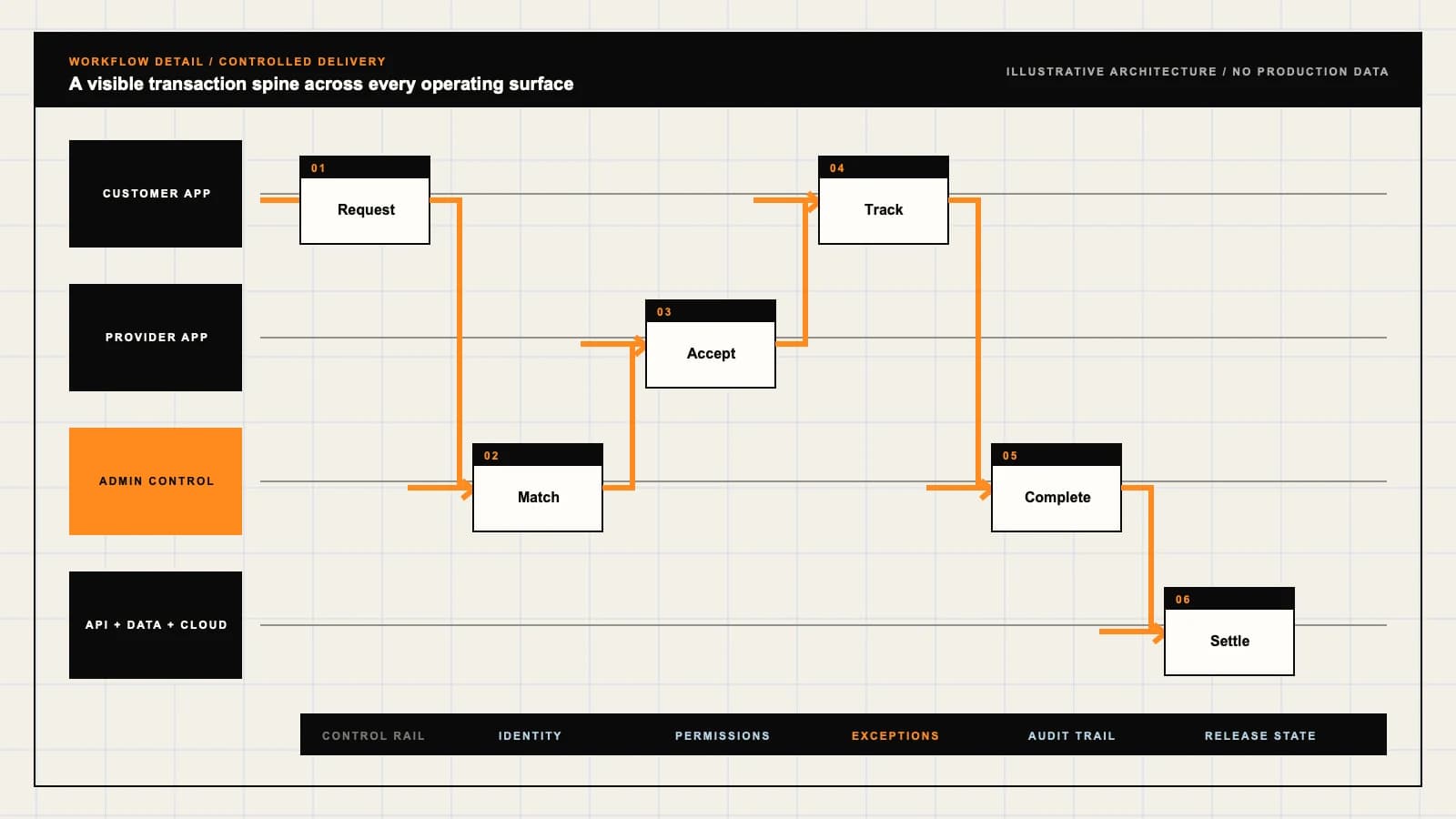
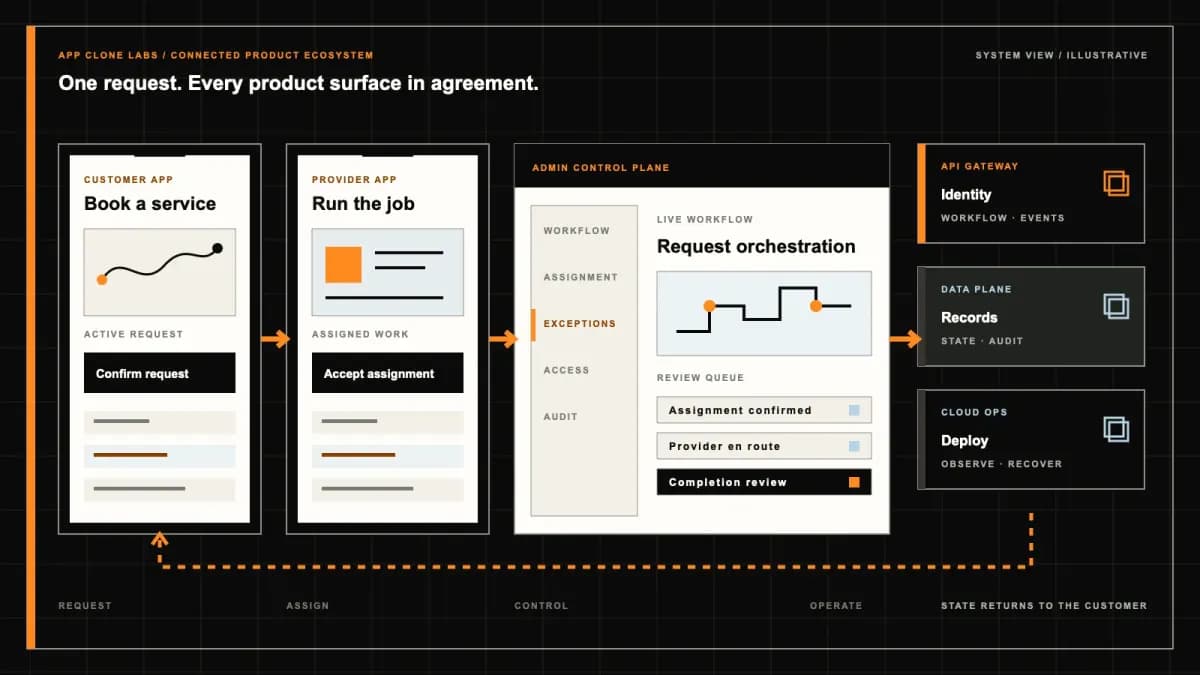
An applicant uploads identity evidence, creates a demo account and receives a deposit notification. None of those events alone establishes an approved, funded live trading account. A Blueberry Markets-style broker client portal needs to make the distinctions visible across customer, operations and finance views. The useful starting point is an account lifecycle with accountable decisions, rather than a dashboard that labels every registered person an active trader.
The official Blueberry help center organizes guidance around its client portal, trading accounts, platform guides, platform troubleshooting, deposits, withdrawals and partner resources. This is a narrow reference for documented service surfaces. It does not establish API access, provider availability or permissions for an independent product.
App Clone Labs scopes independently branded software. The reference does not convey Blueberry affiliation, a broker license, trading advice or guaranteed profit. Establish operating authority and provider contracts separately.
Our current reference build is a Next.js, React and Node.js application on PostgreSQL with six role areas (admin, client, partner, support, compliance and finance) and an Android client, running on sample data. We arrange a private walkthrough on request rather than publishing shared demo credentials, and we confirm which quote, order or platform views are included before any scope discussion.
A residence selector cannot establish which legal entity may serve a customer. Define the actual operator, permitted countries, client categories and product boundaries before translating an application form. The operator needs an approved process for determining eligibility and resolving unsupported combinations. Keep the decision and relevant rule version with the application so staff can explain why one applicant progresses while another remains under review or is rejected.
The FCA guidance on contracts for differences describes CFD risk and protections for retail consumers within its regulatory context, including concerns about inappropriate professional classification and introducers. Apply relevant requirements only where the actual operator and customer relationship fall within their scope. UK guidance is not evidence that Blueberry or this independent product has FCA authorization.
Qualified operator review must establish applicable requirements elsewhere; a reusable portal template cannot certify global compliance.
Separate a saved draft, submitted application, missing-evidence request, pending review, approved relationship and rejected application. Tell the applicant which action is available without exposing internal screening details that should remain restricted. An uploaded document is evidence received, not identity verified. Record the reviewer, decision time and approved reason category alongside the relevant evidence references. Limit downloads and avoid copying personal documents into ordinary support messages.
Agree correction and resubmission rules with the operator. A changed address or expired document may require another review rather than silently inheriting a previous decision. Rehearse an applicant correcting a typing error while a review is underway, a rejected applicant attempting live provisioning and a staff member without approval authority opening the case. Preserve the earlier decision while showing the current state. Account creation should never erase the distinction between registration and a permitted client relationship.
Determine which risk disclosures, knowledge questions, appropriateness assessments or other checks apply to the selected operator, jurisdiction and product. Do not turn a generic questionnaire into a claim that every customer is suitable to trade leveraged instruments. Record the applicable assessment version, response and review outcome under the authorized policy. Acknowledging a warning does not grant a customer access to every account category or remove restrictions.
Keep loss risk prominent where the operator requires it, including mobile journeys and translated notices. Describe product limits accurately without treating leverage as a promotional advantage. Test an incomplete assessment, a failed outcome and an applicant asking to change classification. Provide the actual review path instead of coaching answers that bypass controls. The portal should communicate established restrictions consistently across onboarding, platform provisioning and support; it must not invent legal thresholds or promise protection beyond the applicable arrangement.
Risk warning: contracts for difference (CFDs) are complex leveraged instruments and carry a high risk of losing money rapidly. Many retail accounts lose money when trading CFDs. This page describes software scope only; it is not an offer, promotion or advice about any financial product.
Label the account environment on selection screens, credentials, balances and support cases. Demo activity uses simulated resources under the selected provider arrangement; it does not establish a real funded balance or successful live execution. Define whether a demo can be requested before application approval and make that policy explicit. Switching environments should change the context clearly enough that a customer cannot mistake a practice balance for money available to withdraw.
Store provider identifiers with their environment and account owner. Similar account numbers across services should not cause records to merge. Rehearse a client with several demo records and one approved live account, a delayed demo response and an expired practice environment. Explain any limits established by the chosen provider without copying promises from another broker. A successful demo walkthrough demonstrates the portal behavior under test; it does not prove live provider access or production readiness.
An approved client may still be waiting for a platform account. Track a provisioning request separately from a confirmed account identifier, credential delivery and permitted access. Use provider truth when presenting the current outcome. A timeout means the result is unresolved until checked, not that the request failed safely or that a replacement account should immediately be created. Establish who investigates uncertain requests and which evidence permits a retry.
Protect account recovery and credential changes with the operator-approved security process. Staff should not read passwords or send sensitive credentials through a general complaint thread. Test a provider accepting a request before the connection drops, a duplicate callback and an explicit provisioning failure. The customer should receive a useful next step while operations sees the correlation reference. Provider contracts, API permissions and supported platforms require separate confirmation; a familiar platform logo does not establish integration availability.
Show the difference between a deposit instruction, provider acknowledgment, received payment and reconciled credit. Agree which state permits use of funds under the actual broker policy. Record currency, account destination, fees and provider reference without presenting an uncertain amount as settled cash. A customer screenshot can support an investigation but cannot replace the authorized payment record. Prevent repeated messages from creating duplicate credits.
Finance needs a queue for unmatched payments, wrong references and delayed confirmation. Rehearse a payment arriving for a rejected applicant and a deposit credited to an unintended account. Decide the authorized return or correction process before accepting funds through the portal. Explain expected next steps without inventing completion times. Reconciliation must connect provider records and the client ledger while preserving differences for investigation; changing a dashboard number does not demonstrate that money reached the correct legal account.
A portal can display a ledger and statements, but those records alone do not establish client-money segregation, custody protection or entitlement during an operator failure. Identify the actual banking, client-money and accounting arrangements through authorized operator documentation. Keep those legal and operational responsibilities distinct from software delivery. Avoid promises that funds are protected everywhere or that an interface balance is always immediately withdrawable.
Every correction needs an attributable reason and the approval required by the operator. Preserve the original entry, adjustment and reconciliation reference instead of overwriting history. Test currency conversion rounding, a late statement correction and staff attempting to alter a balance without permission. Clients need understandable records; finance needs sufficient evidence to reconcile them. Retention, access and statement delivery should follow the established obligations, including how corrected records remain available when an account is suspended or closed.
Separate withdrawal submission, required review, approval, provider instruction and confirmed completion. Display the actual available amount under the operator policy and explain why a request remains pending where disclosure is appropriate. A reviewer approving a withdrawal does not prove the payment provider has completed it. Reject unsupported destinations and route exceptions through authorized review rather than quietly changing the customer instruction.
Refunds require the same care. Record the remedy decision independently of the refund instruction and reconcile the final provider result with the ledger. Test an approved refund whose callback is delayed, a withdrawal cancelled before dispatch and a duplicate completion message. Resolve uncertainty before issuing another instruction. Support should identify the responsible queue and current evidence without promising an immediate payout. A financial correction must preserve complaint history and must not silently re-enable platform access for a restricted account.
Give complaints a reference, responsible owner and escalation route under the operator policy. Capture the reported issue and relevant account or payment references while restricting unnecessary personal data. A request about a missing withdrawal may also raise a conduct complaint; closing the payment discrepancy should not automatically close the complaint. Establish applicable response requirements with the operator rather than copying a universal resolution deadline.
Introducers need explicitly permitted referral and compensation functions. Attribution does not grant investment-advice authority, client document access or control of withdrawals. Review promotional material and restrict reporting to the agreed scope. Rehearse an introducer requesting a referred client’s identity documents and a complaint about referral pressure. Commercial staff must not suppress the case to protect commission. Show who approved each referral rule and how permissions are revoked when an agreement ends or a concern requires investigation.
Compare the Zerodha-style brokerage scope when cash-market investing, holdings and contract notes drive the product. A leveraged-market broker portal instead starts with the actual operator’s account eligibility, risk communication and platform servicing responsibilities. Shared interface patterns do not make the underlying permissions interchangeable.
Review the Binance-style exchange scope for venue, wallet and asset-transfer operations. An exchange matching engine or crypto custody model should not be assumed part of this broker client portal. Keep the first release bounded to applications, approved access, funding coordination, statements and support.
Price delivery around confirmed providers, environments, reconciliation detail and exception coverage. Add another platform or jurisdiction only after establishing its separate operating requirements. More screens cannot resolve a missing contract, an unclear approval owner or an unstaffed complaints queue.
Illustrative screens should be reviewed as a synthetic sandbox demonstration. Buyer acceptance needs an approved applicant and a rejected applicant, distinct real and demo contexts, a provisioning failure, a duplicate deposit event and refund reconciliation. Follow each case across customer, reviewer, finance and support views. Confirm that no rejected application gains live access and that uncertain payments remain visibly unresolved until supported evidence arrives.
Bring one operating entity and account journey to a broker portal scope discussion to agree provider permissions, risk review, money boundaries and staffed complaint ownership. Use fictional documents and funds for the walkthrough.
Use the delivery process to establish source-code terms, provider contracts, deployment access and acceptance evidence. Launch readiness depends on actual operator authorization and verified integrations, alongside the software behavior demonstrated in the agreed environment.
FAQ
An independently branded broker client portal for applications, approved platform access, funding coordination, statements and support, subject to the actual operator permissions.
No. Establish operating authority, original branding and provider contracts separately. The reference conveys neither affiliation nor permission to offer financial products.
No. Keep applicant review, approval, provisioning and confirmed funding as separate states, with rejected applications blocked from unauthorized live access.
No. The operator must establish applicable risk, appropriateness and eligibility rules for its actual entity, customers and products.
No. It is a UK regulatory reference whose applicability depends on the actual relationship. It does not establish FCA authorization for the reference brand or independent product.
Identify the environment in credentials, balances, account selection and support records. A simulated balance does not establish real money or live trading permission.
When the authorized provider confirms the required outcome. A submitted request or timeout must not be shown as a confirmed account.
No. Reconcile the authorized provider record with the client ledger and apply the operator funding policy before making availability claims.
No. Client-money, segregation and custody arrangements require separate operator documentation and actual operational controls.
Distinguish requested, reviewed, instructed and provider-confirmed outcomes. Reconcile adjustments and preserve unresolved discrepancies and complaint evidence.
Only the explicitly permitted referral and compensation scope. Referral attribution does not confer document access, advice authority or withdrawal control.
Use synthetic applicants to inspect approval and rejection, real versus demo contexts, failed provisioning, duplicate deposits, refund reconciliation, complaint ownership and revoked permissions.
Solution reference register
01 / Reference and IP
This page references third-party product names only to describe familiar product models and planning references. App Clone Labs is not affiliated with or endorsed by those brands. Build decisions require independent legal, regulatory, and operational review for your market.
02 / Regulatory caveat
Confirm licensing and market-specific authorization before enabling regulated activity · Define whether assets or funds are held by the operator, a qualified custodian, or not held at all · Apply security review, strong authentication, encryption, audit logging, recovery, and incident response · Present educational product information only and prohibit personalized financial, legal, tax, or wagering advice · Apply investor eligibility, disclosures, market-abuse surveillance, best-execution review, and complete books and records · Prominently disclose loss risk and restrict leveraged products by customer eligibility and jurisdiction · Show required CFD risk warnings and restrict leveraged products by customer eligibility and jurisdiction, as the operator’s regulator requires
Primary sources
Dated official documentation, standards, and research that support the factual claims on this page.
How to read this page
Scope, cost and timeline figures are planning guidance until confirmed in a written proposal. Diagrams and screens are illustrations, not client deliverables, and source-code rights and handover follow the signed agreement. See the delivery process and the full disclaimer.
Next decision
Define outcomes, constraints, evidence, rights and handover before delivery begins.
Commercial rights, repositories, environments, documentation, acceptance and handover remain contract-defined.
App Clone Labs is not affiliated with, sponsored by, or endorsed by Blueberry Markets. The name identifies a familiar product category; every delivered product is independently designed and built, and the mark remains its owner's property. Read the full legal notice.
