Validate the wallet context and market
Apply the intended jurisdiction and participant restrictions, confirm supported chain addresses and inspect allowance. Show required collateral, fees and consequential permissions before signing.
Digital-asset exchange
Non-custodial interface for eligible perpetual markets and liquidity-pool interactions. Planned for authorized decentralized-finance operators serving permitted professional or eligible users with role-specific workflows, operator controls, integrations, and a handover boundary defined for the selected market.
From $4,299 one-time for the Professional plan. Enterprise customization is quoted on scope.
See product screens and demo accessCustom workflows
Brand-safe product strategy
Admin and operations tooling
Reference walkthrough by arrangement
Workflow
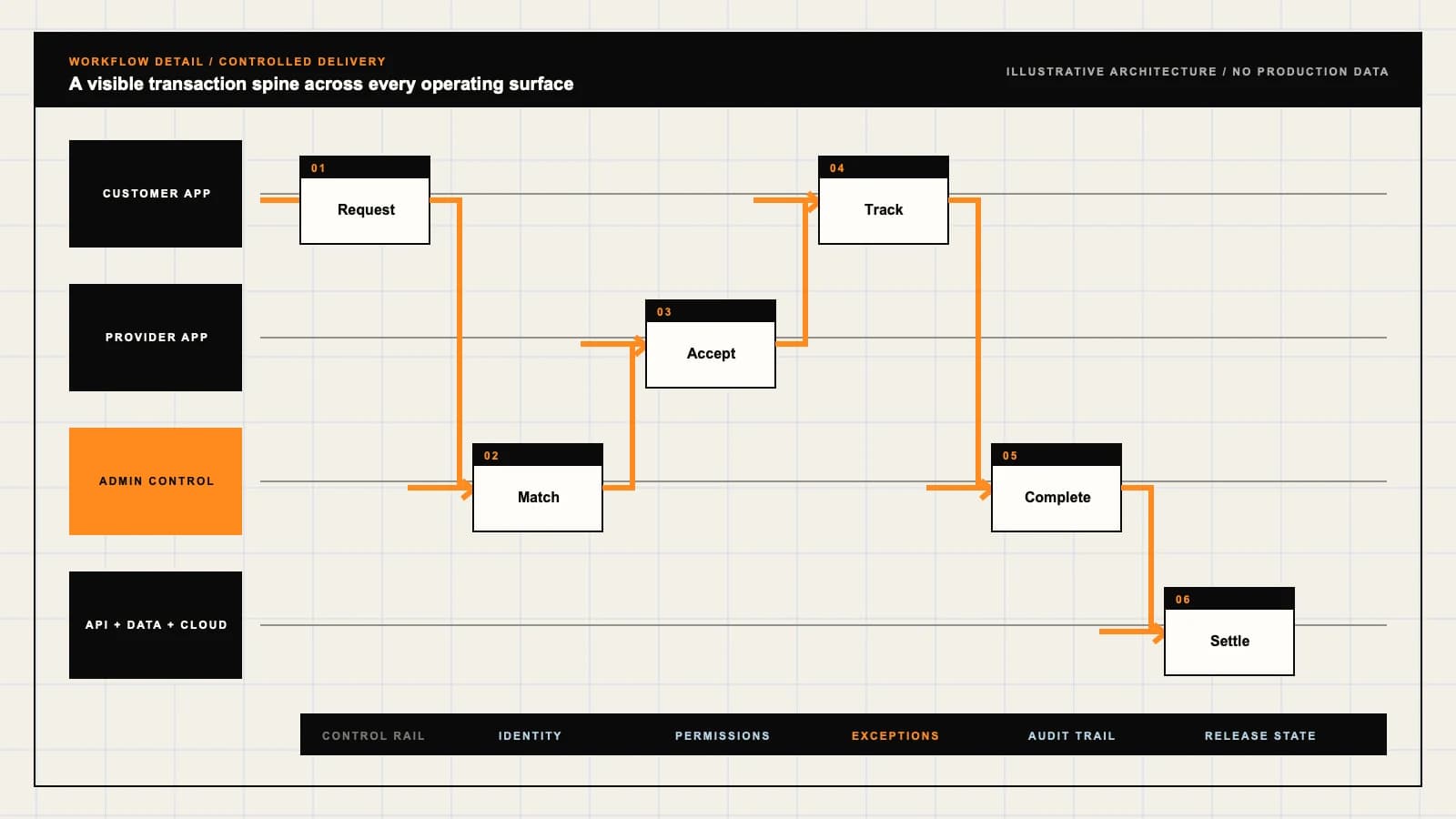
Each workflow stage is mapped to a role, screen, API, notification, admin control, and measurable launch outcome.
Apply the intended jurisdiction and participant restrictions, confirm supported chain addresses and inspect allowance. Show required collateral, fees and consequential permissions before signing.
Track the wallet transaction, on-chain request and resulting execution under stable references. Explain rejected, delayed and cancelled outcomes using authoritative evidence.
Present collateral, accrued costs, liquidation exposure and confirmed closure evidence. Reconcile replayed events and chain reorganizations before finalizing the displayed history.
Deployable Product Architecture
Workflow / system register
Product delivery loop
GMX-style On-chain Derivatives Interface workflow stages.
A focused release proves one complete workflow
Validate the wallet context and market
Keep keeper execution separate from submission
Explain position changes and unresolved states
Control note
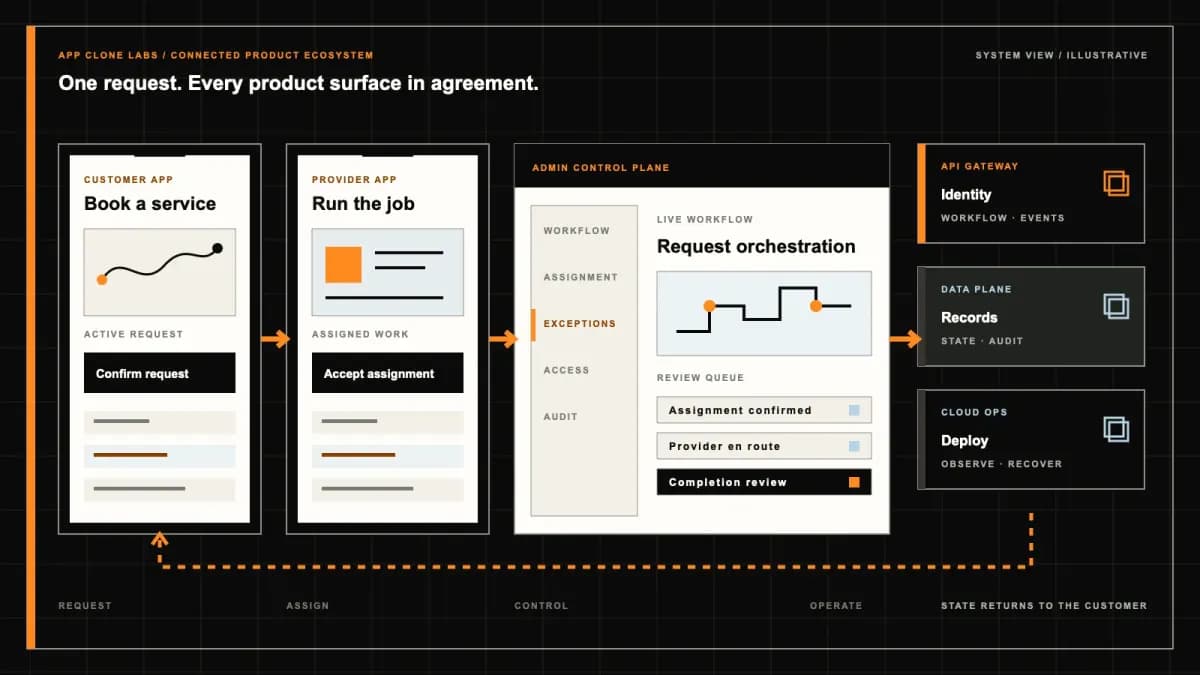
Scope the customer action and the operator response as one system.
Operator controls
The control center is scoped as a first-class product surface, not an afterthought.
Use reviewed deployment addresses and bounded permissions. Changing chains or wallets must invalidate stale signing assumptions and prevent cross-network state reuse.
Establish supported oracle evidence, slippage settings and margin rules. Reject unsupported conditions rather than filling gaps with a cached price or presumed keeper response.
Separate interface roles from protocol administration. Preserve contract versions, pending requests and recovery evidence while restricting sensitive operational access.
Integrations
External systems that determine launch readiness, data flow, and operational continuity.
Reviewed protocol deployments and supported wallet networks with verified chain identifiers, contract addresses, token precision and allowance boundaries
Authorized oracle, keeper and chain-observation services with request correlation, stale-data handling, execution evidence and recovery monitoring
Restricted wallet eligibility, incident and analytics systems with documented jurisdiction decisions, privileged-change records and canonical transaction reconciliation
Scope drivers
The variables that most influence build effort, cost, and launch readiness.
Count supported chains, contracts, collateral and perpetual markets independently. Each expansion requires compatibility, permission and failure-case review.
Scope margin, funding, borrowing, liquidation, price impact and keeper delays against the selected contract version. Do not assume another deployment shares every parameter.
Establish interface authority, protocol dependencies, monitoring and user communication. Non-custodial interaction does not settle the operator’s qualifying-jurisdiction obligations.
Deployable Product Architecture
Scope drivers / system register
Product delivery loop
GMX-style On-chain Derivatives Interface scope drivers.
A focused release proves one complete workflow
Choose a bounded on-chain operating envelope
Define what the interface must explain
Assign governance and incident ownership
Control note
Scope the customer action and the operator response as one system.
V1 scope
Launch the smallest complete operating loop first, then scale the product with confidence.
Include network validation, reviewed contracts, explicit allowance and bounded order preparation. Test wallet switching, unsupported collateral and insufficient execution-fee balance.
Track keeper outcomes, position collateral and risk estimates with fresh source references. Rehearse stale oracle data, rejected slippage and a request waiting without execution.
Provide canonical event reconciliation, restricted incident tools and accountable notices. Test duplicate events, a simulated chain reorganization and liquidation racing a close request.
Later phases
Capabilities that should usually wait until real usage proves the core loop.
Add assets only after validating precision, oracle coverage, collateral behavior and permitted access. An existing wallet connector does not establish market readiness.
Add reviewed data sources or observation redundancy with disagreement handling. Multiple endpoints do not make an uncertain transaction final.
Add deposit, withdrawal and pool reporting after their distinct risk, accounting and permissions review. Keep pool participation separate from leveraged trading acceptance.
Deployable Product Architecture
Later phases / system register
Product delivery loop
GMX-style On-chain Derivatives Interface post-launch expansion.
A focused release proves one complete workflow
Extend a tested risk surface
Reduce unexamined provider dependence
Expand pool interaction deliberately
Control note
Scope the customer action and the operator response as one system.
Regulatory review
Each flag must be reviewed by qualified counsel for your target market before build or launch.
Reference walkthrough
Ask us to confirm which reference surfaces are currently available for this product model. Rather than publishing shared demo credentials, we schedule a private guided walkthrough for qualified buyers.
Request a role-specific demonstration and confirm which capabilities are currently available. Review the proposed responsibility: Confirm the network, collateral and token allowance before requesting supported actions. Distinguish a signed request from executed exposure and confirmed settlement.
Request a role-specific demonstration and confirm which capabilities are currently available. Review the proposed responsibility: Publish supported contracts, markets and risk disclosures under established permissions. Interface administration does not grant authority to alter protocol positions or sign for customers.
Request a role-specific demonstration and confirm which capabilities are currently available. Review the proposed responsibility: Monitor pending requests, liquidation evidence and chain discrepancies. Record governance dependencies and accountable communication without promising recovery or uninterrupted execution.
Request a live, private walkthrough of the reference implementation. We will confirm scope and discuss configured deployment versus custom build for your market.
Open registerDeployable Product Architecture
Reference walkthrough / system register
Product delivery loop
Request a GMX-style On-chain Derivatives Interface reference walkthrough.
A focused release proves one complete workflow
Eligible wallet participant: Inspect permissions and position risk
Interface and market operator: Maintain reviewed access and configuration
Protocol risk and incident team: Investigate oracle and execution exceptions
Book a walkthrough
Control note
Scope the customer action and the operator response as one system.
User roles
Clone-inspired platforms usually need several coordinated interfaces, not just a customer app.
Confirm the network, collateral and token allowance before requesting supported actions. Distinguish a signed request from executed exposure and confirmed settlement.
Publish supported contracts, markets and risk disclosures under established permissions. Interface administration does not grant authority to alter protocol positions or sign for customers.
Monitor pending requests, liquidation evidence and chain discrepancies. Record governance dependencies and accountable communication without promising recovery or uninterrupted execution.
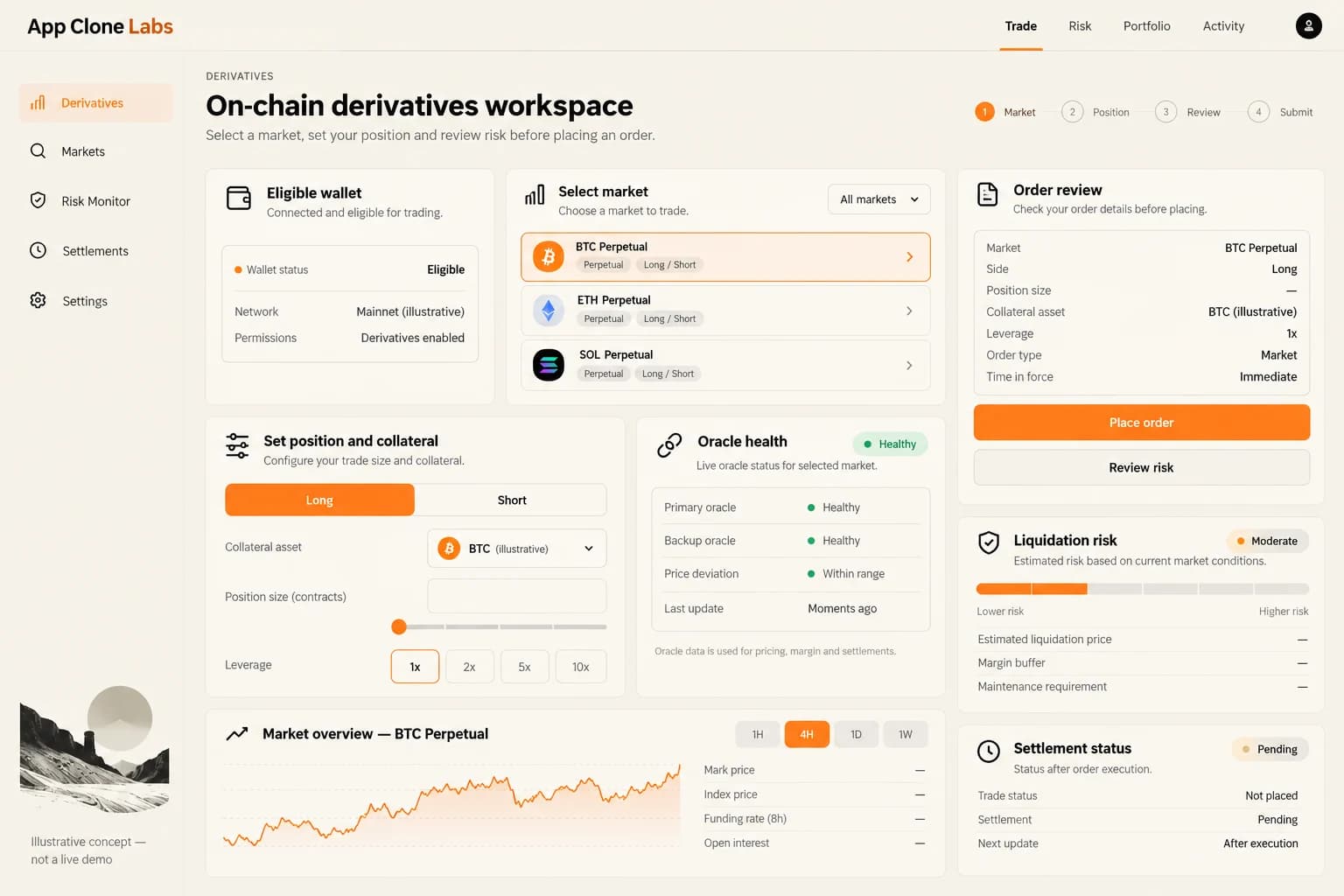
GMX is the on-chain derivatives reference here, not the email provider. Review this original risk-workspace concept alongside market eligibility, oracle dependencies and independent contract review. It is not GMX UI, a working exchange or evidence of authorisation, custody, execution or returns.

Original derivatives-workspace concept. Wallet, oracle and order states are illustrative; the image does not establish audited contracts, safe leverage, execution, settlement or regulatory permission.
What to check in the walkthrough
Product flow
A visual map of how each role interacts with each workflow stage, with operator controls and integration boundaries.
Deployable product architecture
GMX-style On-chain Derivatives Interface
Workflow
Roles in the loop
Operator controls
Integrations underneath
Monetization
We model monetization early so payments, admin controls, and reporting support the business.
Explain applicable charges, accrual and execution costs for the selected deployment. An estimated fee or signed request does not establish a completed trade or earned revenue.
State the supported deposit and withdrawal scope with its own risk and permission review. Pool fees do not establish guaranteed yield, principal protection or immediate redemption.
Define permitted reporting, support and connectivity deliverables. A paid service cannot bypass jurisdiction restrictions, contract checks or liquidation behavior.
Artifact register
Reference screens illustrate workflows, not a contracted feature list. Sample prices, data, and responses are demonstration content; confirm the current scope during a walkthrough.


A trader signs a transaction, sees it confirmed on the selected chain and returns to a position screen that still shows no new exposure. The request may exist while execution remains pending. A GMX-style on-chain derivatives interface needs to explain that gap, including the request reference, expected next event and relevant risk conditions. A wallet success message cannot prove that a keeper executed the order or that the resulting position matches the original preview.
App Clone Labs scopes independently branded interfaces for permitted users and reviewed protocol interactions. Software delivery does not establish GMX affiliation, integration access, operating permission or a protocol security audit. No trading returns are guaranteed. Start with synthetic positions or an explicitly supported test network; production interaction requires separate assessment of contracts, derivatives permissions, participant restrictions and operational responsibility for the intended jurisdictions.
GMX is a trademark of its owners; “GMX-style” describes a product category only. Leveraged crypto derivatives are prohibited or restricted for retail users in many jurisdictions. Positions can be liquidated quickly and losses can exceed the collateral a user expects to risk. Offering any access requires jurisdiction-specific legal advice.
Our current reference build is a React wallet interface covering a market dashboard, statistics, liquidity pools, order and position overviews, referrals and leaderboards on sample or test-network data. Operator and administration consoles are not part of that reference and are scoped per project. Third-party contract or interface code is reused only where its licence permits, and licence terms are reviewed for each engagement.
Define who may access each supported product before presenting a trade form. Review derivatives, interface operation, pool participation and governance responsibilities separately with appropriately qualified advisers. A wallet address is not proof of jurisdiction or participant eligibility. Choose the evidence and restrictions required by the operating model, with understandable unavailable states and restricted review access. Do not market a technical ability to call a contract as permission to serve every user.
Keep access decisions attributable and establish how changes affect existing positions, pending requests and support. Rehearse a participant losing access while an order is waiting and a screening dependency becoming unavailable. The interface needs an approved route for explaining affected actions without promising that an operator can reverse protocol events. Preserve relevant records and escalation ownership. An eligibility check supports a defined control; it does not certify the whole offering or transfer the institution’s responsibilities to a software vendor.
Show the connected wallet, selected chain, collateral token and reviewed contract addresses before signing. A familiar token symbol can exist on different networks or identify unrelated contracts. Validate chain identifiers and token precision at the interaction boundary. Changing wallets or networks must clear stale balances and approvals rather than reuse an enabled submit button based on the previous account. Explain unsupported networks without prompting the user to sign an unrelated transaction.
Distinguish permission to spend a token from the later order transaction. Name the spender and requested allowance, and provide the supported revocation route. Disconnecting a wallet should not be described as revoking a contract allowance. Rehearse an allowance smaller than the requested collateral, a rejected approval and a network switch after approval. A read-only dashboard should not request asset-spending permission merely to display positions. Keep signing requests legible and accessible so the participant can understand the consequential action.
GMX’s official contract architecture reference describes a two-phase model: an on-chain request is created, then a keeper submits execution with signed oracle prices. It also describes execution latency and contract-side validation. These details support separate request and execution states; they do not guarantee execution speed, keeper availability or suitability of an independently deployed integration.
Record the request identity, transaction reference, parameters and resulting execution or cancellation evidence. Show pending, failed and uncertain outcomes using the selected protocol’s actual behavior. A transaction receipt for request creation must not create a fictional position in local history. Rehearse a request confirmed while the keeper is delayed, an execution transaction that reverts and a browser reconnect after submission. Recover the existing request before inviting another economically equivalent order, and explain the supported cancellation path without promising that a pending cancellation outruns execution.
Identify the price source and the freshness assumptions used for each preview and position estimate. A chart candle, indexed trade or cached API response can serve a different purpose from the price accepted by the execution contract. Mark stale data visibly and establish which actions should pause when required evidence is missing. Do not manufacture an executable quote by repeating the last observed number after its relevant validity conditions stop being satisfied.
Specify supported oracle failure and disagreement behavior for the chosen deployment. Test missing price evidence, inconsistent observation endpoints and a preview produced before a large update. The operator should see the affected requests and the source of uncertainty without receiving authority to substitute an arbitrary price. A second data provider is useful only with a defined reconciliation policy. Fresh-looking timestamps and redundant endpoints alone cannot prove price integrity or remove the market risk between request and execution.
Explain the meaning of the selected acceptable-price or slippage setting using the actual protocol rules. Show estimated price impact separately where applicable rather than combine every difference into an unexplained percentage. Give the participant the collateral, direction, position size and consequential thresholds before signing. An order outside its permitted execution conditions should receive the supported outcome, not silently widen tolerance because the original request no longer fits the market.
Rehearse price movement between preview and execution, a changed tolerance and an insufficient-liquidity condition. Preserve the parameters the participant actually approved and compare them with execution evidence. A tighter setting can prevent execution; it does not make a profitable trade or protect against every cost. Avoid a default that implies a guaranteed fill. Operations needs an attributable explanation when a request remains pending, is rejected or requires an explicit new decision from the wallet owner.
Present collateral, notional exposure, direction and the contract’s current position state together. Explain the difference between an initial leverage preview and ongoing margin conditions. Funding, borrowing and other applicable costs can change the position over time, while unrealized profit is an estimate until the relevant settlement event. Label the units and source time of every figure so a participant does not mistake a stale estimate for withdrawable collateral.
Use exact financial units and the selected contract’s rules for calculations and rounding. Rehearse collateral with different decimal precision, a funding update while a position remains open and a partial close. Reconcile position history against authoritative events rather than recompute past executions from today’s price chart. If an indexer lags, show the disagreement and refresh path. An attractive profit-and-loss display does not establish that the interface correctly accounts for fees, reserves or the amount available for a later action.
GMX’s liquidation and execution-risk documentation explains that accrued costs can move liquidation conditions and that a related protective order is not guaranteed to execute before liquidation. That narrow warning matters when displaying a stop-loss or additional-collateral request. The interface must not present either action as certain protection against a rapidly changing position.
Show liquidation estimates with their assumptions and update them when relevant position evidence changes. Distinguish placing a protective order from its execution. Rehearse a rapid oracle update, a collateral deposit delayed by execution and a close request racing a liquidation event. Preserve the actual order of confirmed outcomes and explain any remaining pending instruction. A simulation can demonstrate intended behavior under supplied conditions, but it cannot establish future market outcomes, avoid every loss or certify the safety of the selected protocol.
Track wallet rejection, broadcast, inclusion and the chosen confirmation policy explicitly. A transaction hash alone does not prove inclusion, and an observed receipt can later require correction under a chain reorganization. Associate requests and execution events with network and block evidence. Repeated notifications must not create duplicate positions, fees or claims. Keep the participant informed when the observation service cannot determine the current outcome.
Rehearse a replacement transaction, a receipt temporarily disappearing and replayed events after reconnect. Rebuild affected state from the canonical evidence under the selected network policy instead of freezing the first successful screen forever. Distinguish an observation outage from a failed contract action and avoid encouraging repeated asset movement while the earlier outcome is uncertain. The buyer should inspect how event correction changes history and support records without erasing the evidence behind an earlier message.
A liquidity deposit is a separate product decision from opening a perpetual position. Define supported pool contracts, assets, deposit and withdrawal mechanics, costs and participant restrictions before enabling that journey. Show estimated pool exposure without describing fee income as guaranteed yield or promising principal protection. A withdraw button does not establish immediate redemption when the actual request and execution conditions remain unresolved.
Use the configurable exchange core brief to compare ledger, custody and venue responsibilities with this contract interaction model. Keep pool records and trading positions distinct even when they share a wallet. Rehearse a deposit waiting for execution, a withdrawal with changed pool conditions and a token balance arriving before local indexing catches up. Reconcile the confirmed outcome before updating a participant’s available pool holdings or claiming that the requested exit completed.
Document who controls the interface configuration, reviewed deployment addresses, emergency notices and privileged protocol actions. Those are different responsibilities. An interface administrator must not be described as able to pause an independent contract unless that authority actually exists. Track the contract and parameter versions relevant to the user journey, and establish a review process before adopting an upgrade or enabling a new market.
Compare the centralized spot exchange journey when the product needs venue-controlled matching and custody operations. This derivatives interface instead depends on wallet signatures and the selected protocol’s execution and governance boundaries. Rehearse a revoked operator, an address update awaiting review and an incident during pending requests. Assign communication ownership and preserve uncertainty; a restored web page does not prove that oracle, keeper and contract dependencies have all recovered.
Request a sandbox buyer walkthrough using fictional wallets, synthetic prices and an explicitly supported test network where available. Reject an unsupported chain, approve a bounded allowance and submit an order that waits for execution. Then introduce stale oracle evidence, a failed tolerance check, accrued funding and a liquidation race. Buyer acceptance should reconcile request, transaction and position records across participant and operational views, including a simulated chain reorganization and repeated events.
Bring one market and an uncertain execution example to a derivatives interface scope discussion to define permissions, evidence sources and staffed incident handling.
Use the delivery process to agree contract assessment, source-code terms, integration access and acceptance evidence. Illustrative results are not returns, an audit, production approval or a promise of uninterrupted protocol access.

FAQ
It covers eligible wallet access, selected perpetual markets, bounded order requests, position evidence and protocol monitoring. Production scope depends on separately reviewed contracts, permissions and operating responsibilities.
No. A reference-style interface does not establish affiliation, provider access or a protocol audit. Review the selected deployment, security evidence and integration terms independently before production interaction.
No. Jurisdiction and participant restrictions require their own reviewed decisions. Technical access to a wallet or contract does not establish permission to offer derivatives or serve that participant.
Show the network, token, spender and requested allowance separately from the order. Clear stale assumptions when wallets change and explain the supported revocation path without equating disconnection with revocation.
Not necessarily. Preserve request creation separately from keeper execution and the resulting position state. Correlate both events using authoritative references before presenting a completed trading outcome.
Mark affected previews and establish which actions pause under the selected deployment rules. Preserve uncertainty and investigation evidence instead of presenting a cached value as an executable current price.
No. Explain its actual contract meaning and keep price impact and costs distinct. An order may fail its permitted conditions; tolerance must not widen without the participant’s explicit new decision.
Yes, applicable accrued costs and market conditions must remain visible under the selected contract rules. Reconcile current collateral and risk estimates with authoritative evidence rather than relying on the opening preview.
No. Protective orders still depend on execution conditions and timing. Show their actual state and risk assumptions, and rehearse delayed execution or rapid price updates without promising that losses are prevented.
Reconcile observed receipts and events against canonical chain evidence under the chosen confirmation policy. Correct affected position history while retaining attributable evidence of earlier observations and communications.
No. Pool participation needs separate review of contracts, assets, risk, permissions and withdrawal mechanics. Pool fees do not establish guaranteed yield, principal protection or immediate redemption.
Use synthetic or supported test-network evidence for wallet changes, stale oracle data, execution delays, slippage rejection, funding, liquidation races, replayed events and chain reorganizations across participant and operator views.
Solution reference register
01 / Reference and IP
This page references third-party product names only to describe familiar product models and planning references. App Clone Labs is not affiliated with or endorsed by those brands. Build decisions require independent legal, regulatory, and operational review for your market.
02 / Regulatory caveat
Confirm licensing and market-specific authorization before enabling regulated activity · Define whether assets or funds are held by the operator, a qualified custodian, or not held at all · Apply security review, strong authentication, encryption, audit logging, recovery, and incident response · Present educational product information only and prohibit personalized financial, legal, tax, or wagering advice · Apply customer verification, sanctions screening, blockchain monitoring, asset-listing review, and travel-rule processes where required · Classify derivatives, pool participation, interface operation, and decentralized governance obligations separately · Leveraged crypto derivatives are prohibited or restricted for retail users in many jurisdictions; obtain jurisdiction-specific legal advice before offering any access
Primary sources
Dated official documentation, standards, and research that support the factual claims on this page.
How to read this page
Scope, cost and timeline figures are planning guidance until confirmed in a written proposal. Diagrams and screens are illustrations, not client deliverables, and source-code rights and handover follow the signed agreement. See the delivery process and the full disclaimer.
Next decision
Define outcomes, constraints, evidence, rights and handover before delivery begins.
Commercial rights, repositories, environments, documentation, acceptance and handover remain contract-defined.
App Clone Labs is not affiliated with, sponsored by, or endorsed by GMX. The name identifies a familiar product category; every delivered product is independently designed and built, and the mark remains its owner's property. Read the full legal notice.