Banking and financial operations

Revolut Clone: Multi-product Finance App — Custom-Built for Your Market

Unified interface for institution-backed accounts, cards, exchange, budgeting, and separately authorized investment features. Planned for businesses working with licensed banking, card and fx partners in one customer experience with role-specific workflows, operator controls, integrations, and a handover boundary defined for the selected market.

From $15,999 one-time for the Professional plan. Enterprise customization is quoted on scope.

See product screens and demo access

Custom workflows

Brand-safe product strategy

Admin and operations tooling

Reference walkthrough by arrangement

Workflow

Revolut-style Multi-product Finance App workflow stages.

Each workflow stage is mapped to a role, screen, API, notification, admin control, and measurable launch outcome.

01Establish and inspect

Connect eligible products to responsible providers

Present account status, currency balances and permissions using current provider evidence. Explain unavailable products and incomplete checks without implying universal eligibility.

02Review and instruct

Confirm a defined card or exchange action

Separate card freeze requests from acknowledged restrictions, and indicative rates from executable quotes. Enforce current customer permissions and quote validity before submission.

03Reconcile and service

Retain financial evidence through uncertainty

Follow pending authorizations, clearing, reversals and exchange confirmations. Route disputes to the responsible team with case references and supported customer remedies.

Deployable Product Architecture

Workflow / system register

Revision BPlanning surface

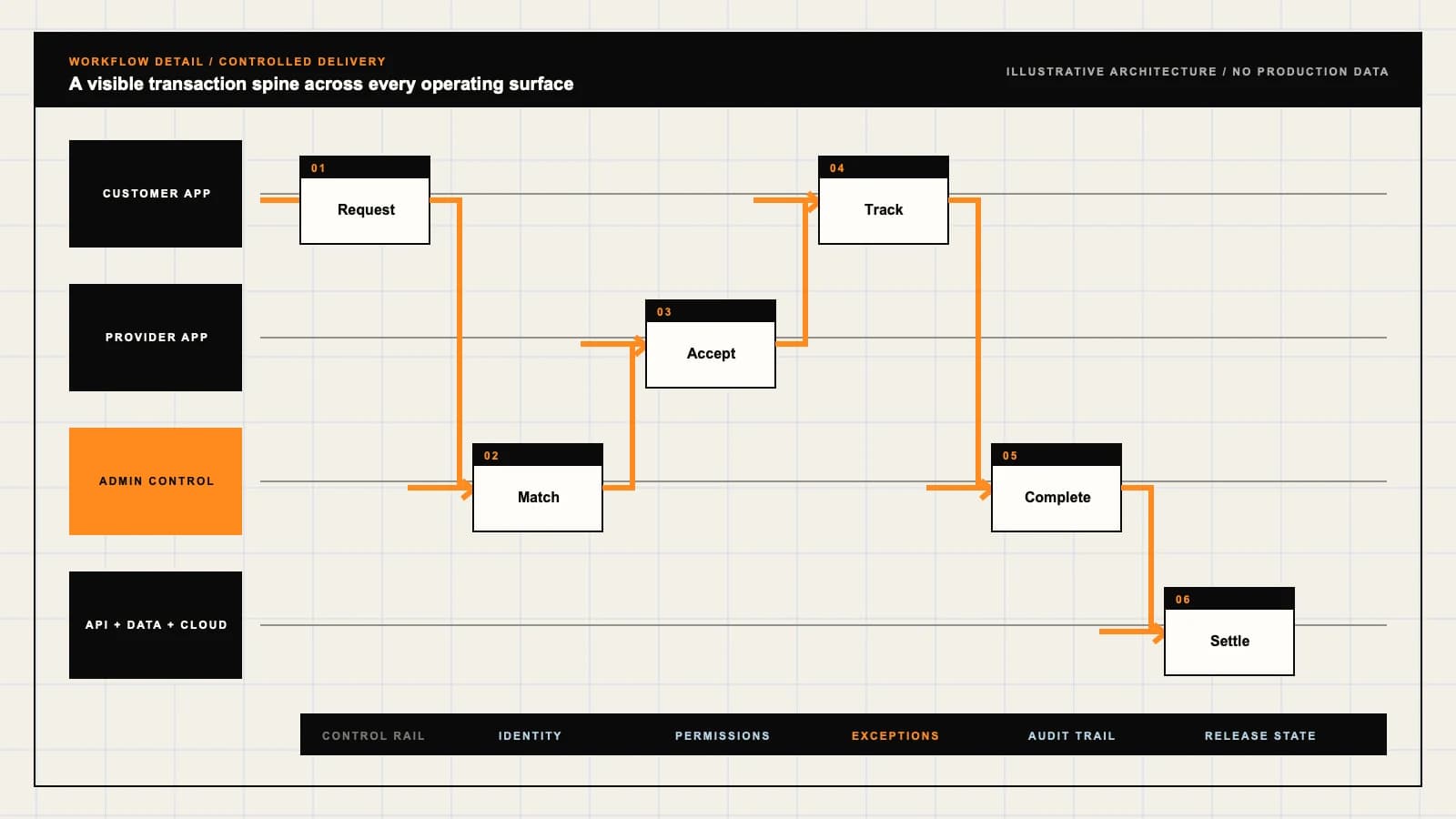
Product delivery loop

Revolut-style Multi-product Finance App workflow stages.

A focused release proves one complete workflow

Product delivery loop: Revolut-style Multi-product Finance App workflow stages.A focused release proves one complete workflow. Scope the customer action and the operator response as one system.
01

Connect eligible products to responsible providers

02

Confirm a defined card or exchange action

03

Retain financial evidence through uncertainty

Control note

Scope the customer action and the operator response as one system.

Illustrative architecture register; validate against the accepted scope.

Operator controls

Revolut-style Multi-product Finance App admin and operator controls.

The control center is scoped as a first-class product surface, not an afterthought.

01Entity and product boundaries

Identify who provides each service

Tie eligibility, disclosures and complaints to the actual account, card or exchange arrangement. Do not infer banking status or protection from an interface label.

02Balance and quote integrity

Prevent unsupported spending and stale execution

Distinguish available funds from holds and indicative totals. Bind exchange confirmation to exact currencies, amounts, costs and a valid provider quote.

03Customer settings and case authority

Make consequential changes accountable

Authenticate card controls and record provider acknowledgements. Restrict adjustment authority and preserve the evidence behind complaints, reversals and disputed transactions.

Integrations

Revolut-style Multi-product Finance App integration surface.

External systems that determine launch readiness, data flow, and operational continuity.

01Integration

Account and ledger providers

Selected authorized account and ledger providers with currency-level balances, eligibility, restriction evidence and reconciled statements

02Integration

Card issuing and processing

Actual card issuing and processing providers with authorization, clearing, freeze acknowledgement and dispute case interfaces

03Integration

FX quote and identity services

Selected FX quote and execution services plus identity, monitoring and support systems with explicit permissions and accountable exceptions

Scope drivers

Revolut-style Multi-product Finance App scope drivers.

The variables that most influence build effort, cost, and launch readiness.

01Providers and currencies

Count financial boundaries behind the app

Choose operating markets, account arrangements and supported balances. Additional currencies and entities add disclosure, reconciliation and complaint ownership.

02Card lifecycle and controls

Define behavior beyond a toggle

Scope issuing, replacement, supported restrictions and authorization states. Clarify pending payments and recurring transactions through the selected processor arrangement.

03Exchange and servicing depth

Cover quote expiry and uncertain outcomes

Specify rate sources, quote validity, execution receipts and disputes. Recovery and customer communication must reflect the actual provider capabilities.

Deployable Product Architecture

Scope drivers / system register

Revision CPlanning surface

Product delivery loop

Revolut-style Multi-product Finance App scope drivers.

A focused release proves one complete workflow

Product delivery loop: Revolut-style Multi-product Finance App scope drivers.A focused release proves one complete workflow. Scope the customer action and the operator response as one system.
01

Count financial boundaries behind the app

02

Define behavior beyond a toggle

03

Cover quote expiry and uncertain outcomes

Control note

Scope the customer action and the operator response as one system.

Illustrative architecture register; validate against the accepted scope.

V1 scope

Revolut-style Multi-product Finance App V1 foundation.

Launch the smallest complete operating loop first, then scale the product with confidence.

01Selected personal currency balances

Explain spendable funds

Demonstrate fictional accounts, separate holds and currency-specific statements. Show an unavailable balance source without inventing a current total.

02Supported card controls

Follow requests to provider acknowledgement

Provide card freeze and unfreeze with clear pending states. Rehearse a concurrent authorization, delayed acknowledgement and customer session recovery.

03Bounded FX and servicing

Reconcile accepted instructions

Review selected currency quotes and reject expiry before execution. Demonstrate an uncertain exchange, a pending card authorization and a dispute routed to its responsible team.

Later phases

Revolut-style Multi-product Finance App post-launch expansion.

Capabilities that should usually wait until real usage proves the core loop.

01Additional currency and card arrangements

Expand after reconciliation evidence

Add providers and supported currencies when eligibility, statement consistency, controls and staffed support are demonstrated for the expanded operating scope.

02Richer budgeting and customer preferences

Improve explanations without changing authority

Add reviewed categorization and notification choices with correction paths. Spending insights do not create account balances or override provider transaction status.

03Separately authorized financial products

Keep each product accountable

Consider investments or other optional products only with distinct permissions, eligibility, consent and support. Existing account access does not establish suitability or insurance coverage.

Deployable Product Architecture

Later phases / system register

Revision FPlanning surface

Product delivery loop

Revolut-style Multi-product Finance App post-launch expansion.

A focused release proves one complete workflow

Product delivery loop: Revolut-style Multi-product Finance App post-launch expansion.A focused release proves one complete workflow. Scope the customer action and the operator response as one system.
01

Expand after reconciliation evidence

02

Improve explanations without changing authority

03

Keep each product accountable

Control note

Scope the customer action and the operator response as one system.

Illustrative architecture register; validate against the accepted scope.

Regulatory review

Revolut-style Multi-product Finance App regulatory and compliance flags.

Each flag must be reviewed by qualified counsel for your target market before build or launch.

Confirm licensing and market-specific authorization before enabling regulated activity

Define whether assets or funds are held by the operator, a qualified custodian, or not held at all

Apply security review, strong authentication, encryption, audit logging, recovery, and incident response

Present educational product information only and prohibit personalized financial, legal, tax, or wagering advice

Apply identity, sanctions, transaction monitoring, complaint, and suspicious-activity procedures

Identify the responsible regulated entity, protection regime, custody model, and complaint route for every product

Reference walkthrough

Request a Revolut-style Multi-product Finance App reference walkthrough.

Ask us to confirm which reference surfaces are currently available for this product model. Rather than publishing shared demo credentials, we schedule a private guided walkthrough for qualified buyers.

01Reference surface

Personal account customer: Understand usable funds and controls

Request a role-specific demonstration and confirm which capabilities are currently available. Review the proposed responsibility: Inspect balances by currency, review exchange costs and manage supported card settings. A combined home screen must not imply all products share one provider or protection regime.

02Reference surface

Account, card and exchange providers: Own the actual financial instruction

Request a role-specific demonstration and confirm which capabilities are currently available. Review the proposed responsibility: Define eligible accounts, authorization behavior, quotes and settlement evidence. The independent app needs explicit arrangements for each selected provider and operating market.

03Reference surface

Servicing and financial operations: Resolve exceptions across providers

Request a role-specific demonstration and confirm which capabilities are currently available. Review the proposed responsibility: Reconcile holds, card events and exchange outcomes with attributable cases. Support access cannot confer permission to release funds or promise a dispute result.

04Next step

Book a walkthrough

Request a live, private walkthrough of the reference implementation. We will confirm scope and discuss configured deployment versus custom build for your market.

Open register

Deployable Product Architecture

Reference walkthrough / system register

Revision CPlanning surface

Product delivery loop

Request a Revolut-style Multi-product Finance App reference walkthrough.

A focused release proves one complete workflow

Product delivery loop: Request a Revolut-style Multi-product Finance App reference walkthrough.A focused release proves one complete workflow. Scope the customer action and the operator response as one system.
01

Personal account customer: Understand usable funds and controls

02

Account, card and exchange providers: Own the actual financial instruction

03

Servicing and financial operations: Resolve exceptions across providers

04

Book a walkthrough

Control note

Scope the customer action and the operator response as one system.

Illustrative architecture register; validate against the accepted scope.

User roles

Revolut-style Multi-product Finance App roles and workflows.

Clone-inspired platforms usually need several coordinated interfaces, not just a customer app.

01Personal account customer

Understand usable funds and controls

Inspect balances by currency, review exchange costs and manage supported card settings. A combined home screen must not imply all products share one provider or protection regime.

02Account, card and exchange providers

Own the actual financial instruction

Define eligible accounts, authorization behavior, quotes and settlement evidence. The independent app needs explicit arrangements for each selected provider and operating market.

03Servicing and financial operations

Resolve exceptions across providers

Reconcile holds, card events and exchange outcomes with attributable cases. Support access cannot confer permission to release funds or promise a dispute result.

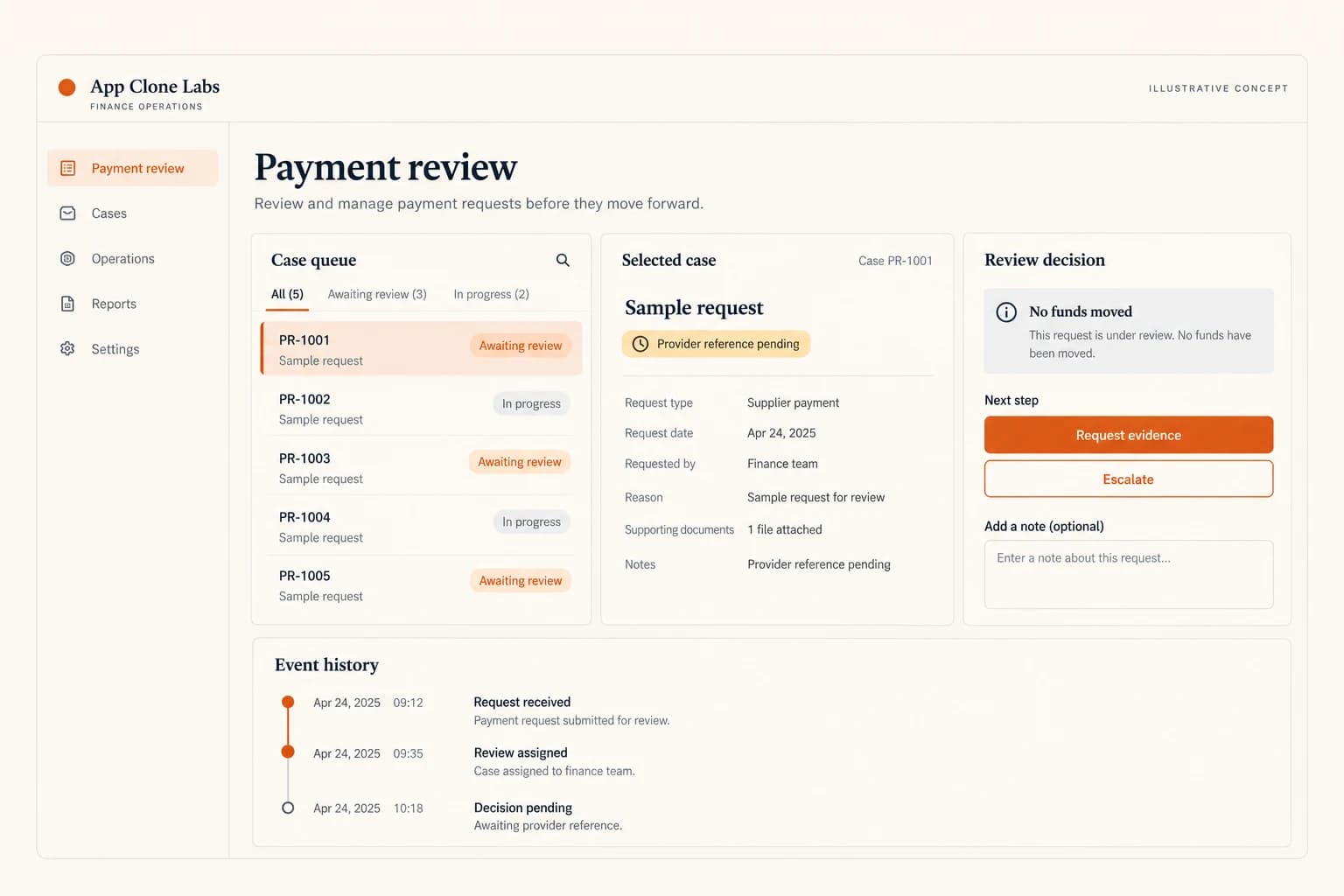
Review institution scope, exchange quotes and reconciliation in a Revolut-style demo.

Use this generic finance-review illustration to discuss operational review, then request a working Revolut-style demo for the proposed account, currency and transfer scope. Identify the responsible institutions, quote sources and authoritative records for each flow, and separate simulated events from demonstrated provider connections.

Payment-review concept with a sample request and escalation controls

Payment-review concept with a sample request and escalation controls

Original App Clone Labs generic finance-review illustration at 1536×1024: supplier-payment review queue, provider pending and no funds moved. It does not demonstrate accounts, foreign-exchange quotes, currency conversion or transfers. Request a working Revolut-style demo for the agreed scope and verify institution and provider responsibilities separately. This concept is not an official Revolut interface or an affiliation or endorsement claim.

What to check in the walkthrough

  • Institution and scope: Which institution would hold each proposed account or balance, and which provider would process each currency and corridor? Ask to map a sample customer record, funding instruction and transfer to the responsible party, supported scope and contract dependency. Require the working demo to label simulations and unavailable flows; a displayed balance does not establish an account or authorization.
  • Foreign-exchange quote and review: Can the working demo show source and destination amounts, rate, fees and expiry before a customer accepts a sample conversion? Ask to expire the quote, change the amount and introduce a review hold, then inspect the refreshed quote and customer status. Identify the quote source and who approves or releases the proposed review; the illustration supplies no exchange service.
  • Reconciliation and recovery: Who owns the authoritative account and payment records when a provider event is delayed, duplicated or reversed? Ask to follow a sample transaction from the customer view to provider identifiers, ledger entries and an unresolved reconciliation case, then inspect a restricted correction and its history. Agree who investigates differences and communicates the final provider-confirmed outcome.
Open full-size reference

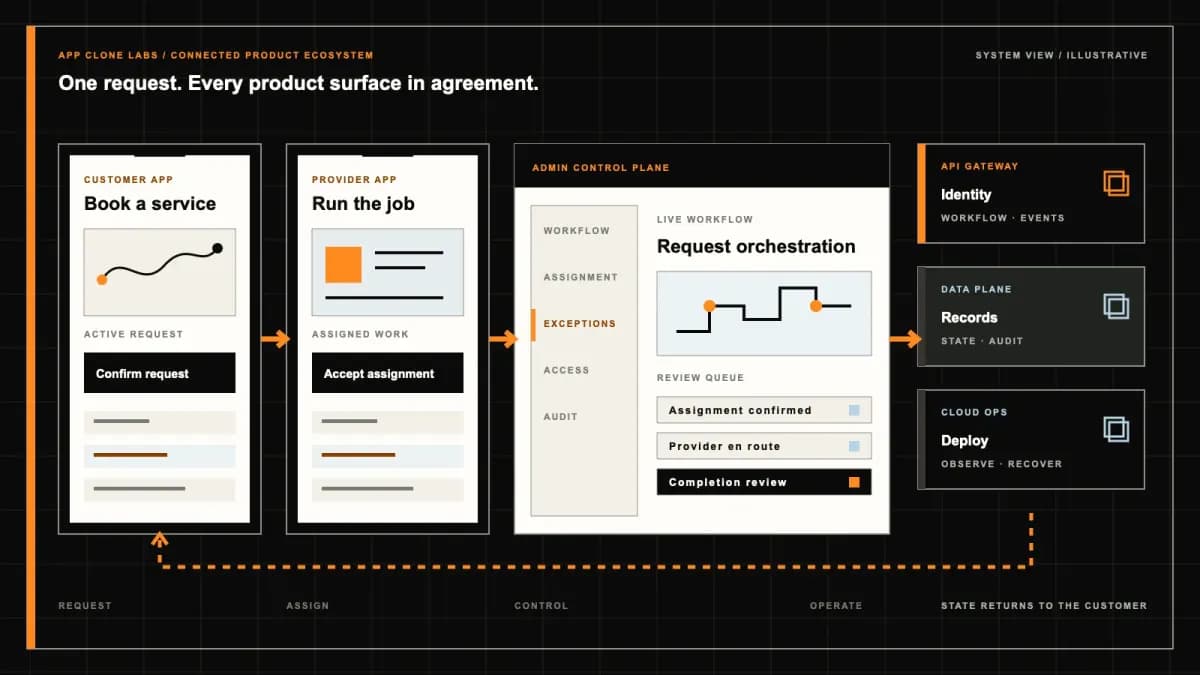
Product flow

Role-workflow flow diagram.

A visual map of how each role interacts with each workflow stage, with operator controls and integration boundaries.

Deployable product architecture

Revolut-style Multi-product Finance App

Workflow

  1. 01Connect eligible products to responsible providers
  2. 02Confirm a defined card or exchange action
  3. 03Retain financial evidence through uncertainty

Roles in the loop

  • Personal account customerUnderstand usable funds and controls
  • Account, card and exchange providersOwn the actual financial instruction
  • Servicing and financial operationsResolve exceptions across providers

Operator controls

  • Identify who provides each service
  • Prevent unsupported spending and stale execution
  • Make consequential changes accountable

Integrations underneath

  • Account and ledger providers
  • Card issuing and processing
  • FX quote and identity services
Illustrative validation artifact — role-workflow flow diagram; final surfaces, boundaries, and integration topology are confirmed during discovery.

Monetization

Revolut-style Multi-product Finance App monetization models.

We model monetization early so payments, admin controls, and reporting support the business.

Price defined servicing capabilities

Disclose plan costs, limits and actual eligibility. A paid tier must not suggest guaranteed onboarding, dispute reimbursement or access to separately restricted products.

Explain the full conversion cost

Show applicable rates, fees and received amounts under selected provider terms. Do not copy a reference spread or market a universal best rate.

Describe the agreed commercial arrangement

Scope permitted revenue and servicing responsibilities with actual providers. Software delivery does not establish issuing rights, scheme membership or automatic partner approval.

A frozen card can still have a payment waiting to settle

A fictional customer, Maya, sees a hotel payment pending against her euro balance and freezes her card before a flight. She also has a sterling balance and an exchange quote open on another screen. A buyer evaluating a Revolut-style app should inspect what the app says next: which funds remain available, whether the card provider acknowledged the freeze and whether an expired quote can still be submitted. One reassuring home total cannot answer those questions.

App Clone Labs scopes independently branded personal finance software around multi-currency account views, card controls, reviewed exchange instructions and accountable servicing. This reference does not imply Revolut affiliation, a financial license, provider approval or insurance coverage. Establish the actual institutions, permissions and customer protections separately. Synthetic account activity demonstrates software behavior; it cannot establish authorization to hold funds, issue cards or offer an additional financial product.

Our current reference build is a Next.js and React application on PostgreSQL with an Android client. It shows personal, business and family account views, virtual cards, savings vaults with round-ups, cashback, plan tiers and an investing view, with admin, support and analytics panels. All data is fictional: the reference holds no funds and carries no licence. Investment views are illustrative; real trading needs an authorised broker, capital is at risk and nothing here is investment advice.

Every product needs a responsible provider and permission boundary

Identify the entity supplying the account, the card arrangement and the currency exchange service before combining them in one interface. Define eligible customers, operating markets and supported product states through those actual arrangements. An account accepted by one provider does not establish eligibility for another product. Keep required checks and customer disclosures attached to the product that needs them, including any restrictions while review remains incomplete.

Give operations a written responsibility map for onboarding, financial records, complaints and incidents. Explain applicable protection using approved facts about the actual service; do not label every balance a bank deposit or imply a uniform protection regime. Rehearse a customer eligible for a currency account but not a card, and a provider changing a product restriction. Navigation should communicate the decision without offering an action the server cannot authorize.

Currency balances should separate available money from holds

Show each currency balance with its own unit, source and availability evidence. Separate posted funds, pending authorizations and restrictions under the selected ledger arrangement. A converted home total can help orientation, but it needs a stated valuation basis and must not appear to be a single spendable account. Stale provider data should have a visible state, especially when the customer is preparing a card purchase or an exchange.

Rehearse Maya holding both euros and sterling while a euro authorization remains pending. The available amount, transaction detail and statement should tell a consistent story. Define exact monetary units and rounding at accounting boundaries. Never release a hold because a screen refresh omitted it or merge provider records using a matching display name. An unexplained difference needs investigation ownership rather than a manual balance edit that makes the app look tidy.

Pending authorization is a distinct card payment state

Revolut’s UK personal help on pending card payments distinguishes authorization from full processing and explains that a pending payment cannot simply be cancelled by the service before the indicated date. This is a reference example, not a timetable or capability promise for an independent card program.

Agree how authorization, clearing, reversal and expiry arrive from the actual processor. Keep the amount held distinct from final settlement, including changed merchant amounts or supported currency differences. Show relevant references and the expected next action without promising every pending payment resolves in the same period. Rehearse a merchant cancellation arriving after a customer contacts support, then a duplicate reversal event. Reconcile the financial result once and retain the original authorization trail so the customer and operations can explain the released amount.

Card freeze needs acknowledgement and a precise explanation

Treat card freeze as a consequential instruction to a selected provider, not merely a local visual toggle. Authenticate the customer, submit the intended card reference and track acknowledgement. Distinguish requested, pending, effective and failed states where the provider supports them. Explain the scope of the restriction using the agreed card rules. A freeze screen should not imply that already authorized payments are refunded or that every possible transaction path is blocked.

Rehearse an authorization racing the freeze request, a processor timeout and a customer opening the app on a second device. The interface should show the best established state and a supported escalation route. Unfreeze must respect independent account or fraud restrictions; reversing a customer preference cannot override a provider decision. Keep an attributable record of who requested the change and what the provider confirmed. Lost-card replacement needs a separate supported lifecycle rather than an overloaded freeze button.

The spending currency policy must be understandable before travel

Define which supported balance funds a card payment and whether the selected arrangement permits automatic conversion. Explain insufficient funds, unavailable currencies and any fallback order. Do not infer that every currency visible in the app is usable by the card. Account balances, merchant transaction currency and settlement currency can serve different roles, so retain those identifiers in transaction details when the provider supplies them.

Rehearse a euro purchase when Maya has a partial euro balance and sufficient sterling, then repeat while exchange is unavailable. Show the actual supported outcome rather than inventing a universal split-payment rule. Clarify how a later reversal or refund is recorded, including the provider treatment of currency conversion and fees. A spending preference should be a customer control with documented limits, not an assurance that every merchant or network will apply the customer’s preferred rate.

An exchange quote is more specific than a displayed rate

Revolut’s UK personal explanation of exchange rates and costs describes variable rates and reviewing rate and fee information before an in-app exchange. It also distinguishes the timing of cost information for card transactions requiring conversion. Verify the selected provider’s actual quote and disclosure behavior independently.

Bind a supported exchange quote to source currency, destination currency, debit amount, received amount, fees and validity. Explain whether a displayed rate is indicative or executable. Rehearse FX quote expiry while the customer reads the confirmation screen, and require a renewed review when the provider supplies changed terms. Do not execute a materially different conversion under an earlier confirmation. Preserve the accepted quote and provider reference so support can compare the reviewed instruction with the resulting account entries.

An uncertain exchange should not invite an accidental second debit

Separate quote acceptance, instruction submission, provider confirmation and ledger reconciliation. If the connection fails after submission, retain the instruction reference and query its result through the supported interface. A timeout is not proof that no exchange occurred. Explain the pending state and prevent an impatient refresh from silently creating another conversion. Any retry policy needs to preserve the identity of the intended financial instruction.

Rehearse a confirmed provider exchange whose account update is delayed, followed by repeated callbacks. Reconcile one source debit and its corresponding destination credit, with fees recorded as agreed. Distinguish missing evidence from confirmed failure and route unmatched entries to the responsible operations team. Staff should not fabricate a receipt or release spending capacity based on a hopeful assumption. Define what the customer can do while review continues and how an unresolved case reaches the actual provider.

Budgets and notifications need correction paths

Present budgeting as an explanation of recorded activity, with clear treatment of pending payments, refunds and internal exchanges. A transfer between currency balances should not automatically become new spending in every category. Let customers correct supported merchant categorization without changing the underlying financial transaction. Explain whether a budget uses transaction currency or a selected reporting currency and how valuation affects historical comparisons.

Rehearse the hotel authorization becoming a different settled amount, then a refund arriving in a later reporting period. Notifications should follow meaningful state changes without duplicating the same event after reconnection. Give customers accessible controls over supported alerts, while preserving required service communication under the actual policy. Avoid exposing sensitive balances in notification previews by default. A missed notification does not alter payment status, and an attractive budget chart cannot substitute for reconciled account records.

Disputes need evidence and a team that owns the next step

Offer a transaction-specific help route that distinguishes an unfamiliar payment, a merchant disagreement and a pending authorization question. Collect appropriate evidence without requesting unnecessary sensitive documents. Explain the responsible provider, case reference and supported communication path. Filing a dispute is not the same as receiving a refund; do not promise a successful chargeback, immediate funds release or a single universal resolution deadline.

Rehearse Maya reporting the hotel payment while it remains pending, then returning after settlement with additional merchant evidence. Keep the financial state and support case connected without conflating them. Record evidence requests, submissions and attributable decisions, and preserve a route for complaints appropriate to the actual service. Restrict financial adjustment authority and document any supported provisional treatment. A support agent acknowledging a message must not make the interface imply that the provider has accepted liability or completed the investigation.

Choose personal finance coordination before adding unrelated products

Compare the digital banking front-end platform when the main decision is a selected institution-backed account experience. This brief adds explicit coordination across personal currency balances, card spending controls and exchange quotes. Start with a small set of actual providers whose responsibilities can be explained and tested.

Review the Wise-style cross-border money movement scope when recipient setup, funding and corridor payout are the central workflow. Those transfer stages differ from managing daily card authorizations and internal currency conversion. Investments and insurance require separate eligibility, disclosures, consent and servicing arrangements; their icons should not appear as actionable products merely because the home screen has room.

Follow one customer through freeze, expiry and dispute review

Use a synthetic sandbox with Maya, fictional currency balances and controlled provider events. Buyer acceptance should distinguish available funds from a pending authorization, freeze a card through acknowledgement and show an independent restriction blocking unfreeze. Expire an FX quote, review changed terms and interrupt a submitted exchange. Recover its result once, reconcile both currency entries and follow the hotel payment into an attributable dispute case.

Set expected outcomes before the walkthrough and retain the observed provider events alongside the customer view. A freeze request should not appear effective before acknowledgement; an expired quote should stop before a debit; repeated settlement evidence should produce one financial result. Verify that support can identify the responsible provider and next action without gaining unauthorized adjustment powers. Record unresolved exceptions as acceptance gaps with an owner.

Bring one provider arrangement and one unresolved payment to a personal finance scope discussion to define account boundaries, card behavior, exchange confirmation and staffed support.

Use the delivery process to agree source-code terms, permissions and acceptance evidence. Demonstrations do not establish licensing, live funds access, issuing approval or protection for real customers.

FAQ

Questions to resolve before the build.

01What distinguishes this Revolut-style personal finance scope?

It coordinates personal currency balances, card authorization states, customer controls and exchange quotes, with explicit provider responsibilities and reconciled servicing across those related activities.

02Does software delivery include Revolut affiliation or licensing?

No. Establish independent branding, actual provider arrangements and permissions for the selected markets. A software demonstration does not confer licensing, issuing rights or partner approval.

03Can the home total represent spendable funds?

Only the actual account arrangement determines spendable funds. A converted summary needs a stated valuation basis and must remain distinguishable from currency balances and holds.

04Does pending authorization mean the payment has settled?

No. Keep authorization, clearing, reversal and expiry distinct using actual processor evidence. Explain held funds and supported next steps without imposing a universal completion timetable.

05Does freezing a card refund pending payments?

A freeze must follow the selected provider rules and acknowledgement. It must not imply that earlier authorizations are cancelled, refunded or universally prevented from settling.

06Can unfreeze override a provider restriction?

No. Customer preferences and independent provider restrictions are separate decisions. Show why an action remains unavailable and give the customer an accountable support route.

07Which balance funds a card purchase abroad?

That depends on the actual card and account arrangement. Disclose supported currencies, conversion behavior and fallback rules rather than assuming every displayed balance can fund spending.

08What happens when an exchange quote expires?

Reject stale execution and obtain current provider terms. Require renewed review where amounts or costs change, retaining the accepted quote and resulting instruction references.

09Should a timed-out exchange be submitted again?

First establish the original instruction result through the supported provider interface. Retain its reference and explain uncertainty so a retry cannot silently cause another debit.

10Do spending categories change account records?

Customer category corrections should change the reporting view, not underlying financial transactions. Define treatment of pending payments, internal exchanges, refunds and reporting currency consistently.

11Does opening a dispute guarantee reimbursement?

No. Preserve case evidence, responsible provider and supported next steps. Acknowledgement of a complaint does not establish liability, successful chargeback or immediate release of funds.

12What should buyer acceptance demonstrate?

Use fictional balances and controlled events to test card freeze acknowledgement, pending authorizations, FX quote expiry, uncertain execution, reconciliation and disputes with attributable servicing ownership.

Solution reference register

01 / Reference and IP

This page references third-party product names only to describe familiar product models and planning references. App Clone Labs is not affiliated with or endorsed by those brands. Build decisions require independent legal, regulatory, and operational review for your market.

02 / Regulatory caveat

Confirm licensing and market-specific authorization before enabling regulated activity · Define whether assets or funds are held by the operator, a qualified custodian, or not held at all · Apply security review, strong authentication, encryption, audit logging, recovery, and incident response · Present educational product information only and prohibit personalized financial, legal, tax, or wagering advice · Apply identity, sanctions, transaction monitoring, complaint, and suspicious-activity procedures · Identify the responsible regulated entity, protection regime, custody model, and complaint route for every product

Primary sources

References behind this page

Dated official documentation, standards, and research that support the factual claims on this page.

  1. 01
  2. 02

How to read this page

Scope, cost and timeline figures are planning guidance until confirmed in a written proposal. Diagrams and screens are illustrations, not client deliverables, and source-code rights and handover follow the signed agreement. See the delivery process and the full disclaimer.

Next decision

Turn the brief into an accepted product scope.

Define outcomes, constraints, evidence, rights and handover before delivery begins.

Commercial rights, repositories, environments, documentation, acceptance and handover remain contract-defined.

Independent from Revolut

App Clone Labs is not affiliated with, sponsored by, or endorsed by Revolut. The name identifies a familiar product category; every delivered product is independently designed and built, and the mark remains its owner's property. Read the full legal notice.