
01Quote and recipient
Record the proposition the sender accepts
Validate required destination details and present exact amounts, fees, rate, expiry and estimated delivery. Refresh an expired or materially changed quote before confirmation.
Banking and financial operations
Transparent multi-currency account and international transfer coordination service. Planned for authorized payment institutions serving consumers and businesses across currency corridors with role-specific workflows, operator controls, integrations, and a handover boundary defined for the selected market.
From $12,999 one-time for the Professional plan. Enterprise customization is quoted on scope.
See product screens and demo accessCustom workflows
Brand-safe product strategy
Admin and operations tooling
Reference walkthrough by arrangement
Workflow
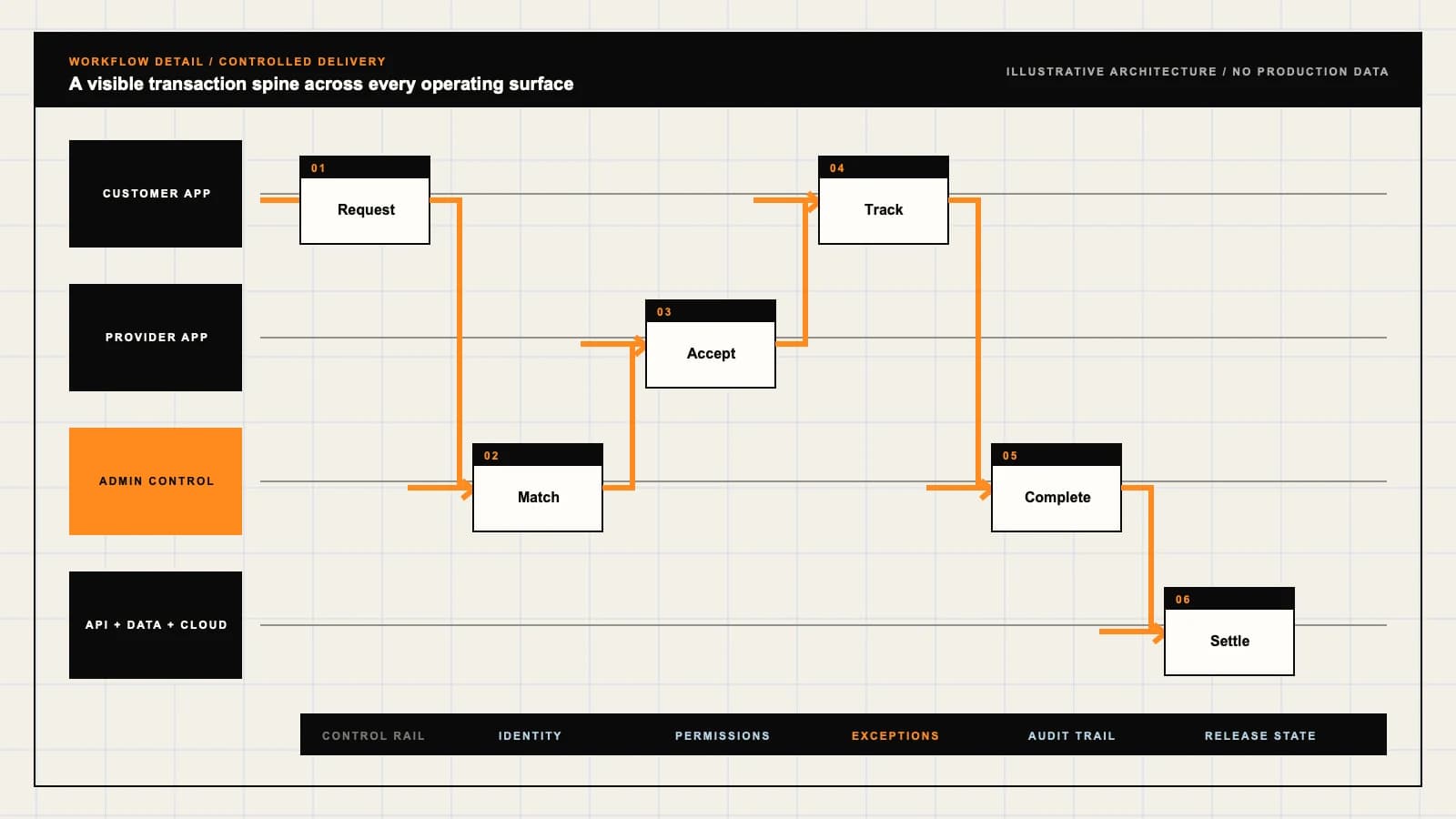
Each workflow stage is mapped to a role, screen, API, notification, admin control, and measurable launch outcome.
Validate required destination details and present exact amounts, fees, rate, expiry and estimated delivery. Refresh an expired or materially changed quote before confirmation.
Issue supported funding references, match received amounts and complete the required review. A sender payment claim does not prove funds are available for execution.
Submit one attributable partner instruction, preserve uncertain results and reconcile delivery or return evidence. Keep unresolved obligations visible across customer and operations views.
Deployable Product Architecture
Workflow / system register
Product delivery loop
Wise-style Cross-border Money Movement workflow stages.
A focused release proves one complete workflow
Record the proposition the sender accepts
Establish receipt and transfer eligibility
Track payout and return outcomes
Control note
Scope the customer action and the operator response as one system.
Operator controls
The control center is scoped as a first-class product surface, not an afterthought.
Retain quote identifiers, validity, fees and beneficiary versions. Changed recipient details or expired terms require the appropriate renewed validation and customer decision.
Match authoritative funding evidence and restrict review overrides. Provider access, safeguarding arrangements and payout authority need independently established operating responsibilities.
Correlate funding, submission, payout and refund records using stable references. Duplicate or late messages cannot create a second transfer or erase an unresolved return.
Integrations
External systems that determine launch readiness, data flow, and operational continuity.
Contracted banking and local payment partners with permitted corridors, funding references, payout identifiers and authoritative transfer status evidence
Authorized foreign-exchange, treasury and safeguarding systems with time-bound quotes, exact-unit amounts and independently reconciled obligations
Permitted identity, sanctions, recipient-validation and case services with attributable review decisions, restricted evidence and customer notification records
Scope drivers
The variables that most influence build effort, cost, and launch readiness.
Specify source and destination markets, customer types, currencies and required beneficiary fields. Each added route introduces partner and exception responsibilities.
Choose permitted funding methods and partner execution interfaces. Delayed, partial or unmatched funding requires distinct accounting and customer guidance.
Scope screening queues, partner enquiries, return investigation and support coverage. Transfer volume alone does not measure the work created by uncertain outcomes.
Deployable Product Architecture
Scope drivers / system register
Product delivery loop
Wise-style Cross-border Money Movement scope drivers.
A focused release proves one complete workflow
Count supported operating boundaries
Define how money reaches each boundary
Staff the unresolved transfer journey
Control note
Scope the customer action and the operator response as one system.
V1 scope
Launch the smallest complete operating loop first, then scale the product with confidence.
Support reviewed corridors, required beneficiary fields and disclosed quotes. Demonstrate expired terms and wrong recipient details before submission.
Provide traceable funding instructions, review decisions and one correlated payout request. Rehearse delayed funding and an unknown status after submission.
Connect customer tracking to partner events, controlled adjustments and return evidence. Demonstrate a returned payout and an unresolved difference without fabricating completion.
Later phases
Capabilities that should usually wait until real usage proves the core loop.
Add currencies and payment partners only after confirming permissions, recipient requirements, funding behavior and staffed return coverage for each route.
Add reviewed approval thresholds, beneficiary changes and exports. Preserve separation between business authorization and institution execution or compliance authority.
Evaluate partner recovery and permitted multi-currency balance capabilities after proving reconciliation. Cards, investments and broader account products require separate product and provider decisions.
Deployable Product Architecture
Later phases / system register
Product delivery loop
Wise-style Cross-border Money Movement post-launch expansion.
A focused release proves one complete workflow
Expand from tested operating evidence
Extend attributable instruction control
Scope each added service independently
Control note
Scope the customer action and the operator response as one system.
Regulatory review
Each flag must be reviewed by qualified counsel for your target market before build or launch.
Reference walkthrough
Ask us to confirm which reference surfaces are currently available for this product model. Rather than publishing shared demo credentials, we schedule a private guided walkthrough for qualified buyers.
Request a role-specific demonstration and confirm which capabilities are currently available. Review the proposed responsibility: Review recipient details, source and destination amounts, fees, quote validity and funding instructions. Business approval applies to the recorded instruction rather than any later edited recipient.
Request a role-specific demonstration and confirm which capabilities are currently available. Review the proposed responsibility: Investigate unmatched funding, screening holds and partner uncertainty through authorized evidence. A queue-clearing action cannot substitute for an actual payout confirmation.
Request a role-specific demonstration and confirm which capabilities are currently available. Review the proposed responsibility: Match transfer events with partner and funding records, investigate returns and provide scoped customer updates. Keep adjustments attributable and sensitive documents restricted.
Request a live, private walkthrough of the reference implementation. We will confirm scope and discuss configured deployment versus custom build for your market.
Open registerDeployable Product Architecture
Reference walkthrough / system register
Product delivery loop
Request a Wise-style Cross-border Money Movement reference walkthrough.
A focused release proves one complete workflow
Eligible senders and business approvers: Confirm a specific transfer proposition
Payment and review operations: Resolve funding and execution exceptions
Treasury, reconciliation and support: Explain outstanding customer obligations
Book a walkthrough
Control note
Scope the customer action and the operator response as one system.
User roles
Clone-inspired platforms usually need several coordinated interfaces, not just a customer app.
Review recipient details, source and destination amounts, fees, quote validity and funding instructions. Business approval applies to the recorded instruction rather than any later edited recipient.
Investigate unmatched funding, screening holds and partner uncertainty through authorized evidence. A queue-clearing action cannot substitute for an actual payout confirmation.
Match transfer events with partner and funding records, investigate returns and provide scoped customer updates. Keep adjustments attributable and sensitive documents restricted.
Use this help-centre reference to assess support for a Wise-style cross-border transfer product. Ask to connect customer guidance to recipient validation, disclosed exchange quotes, funding instructions and partner events in the working demo. Identify simulated records, responsible institutions and the authorized corridors proposed for your scope.
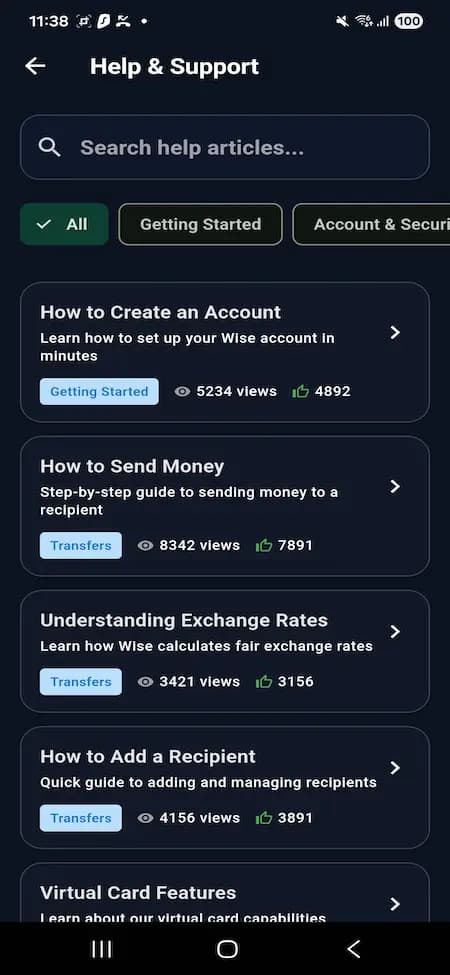
Illustrative mobile help-centre reference with sample article engagement counts and third-party Wise wording. This is not an official Wise interface, endorsement or affiliation claim. Article titles do not prove exchange rates, card availability, multi-currency balances, safeguarding or transfer execution. Request a working demo and confirm institution, corridor and provider responsibilities separately.
What to check in the walkthrough
Product flow
A visual map of how each role interacts with each workflow stage, with operator controls and integration boundaries.
Deployable product architecture
Wise-style Cross-border Money Movement
Workflow
Roles in the loop
Operator controls
Integrations underneath
Monetization
We model monetization early so payments, admin controls, and reporting support the business.
Record the amount and currency of service charges alongside the quote. Specify cancellation and return treatment without assuming every external bank fee is recoverable.
Disclose the applicable rate and pricing method with the accepted transfer. A reference screen does not establish a live provider rate or universal pricing advantage.
Define supported approval flows, reporting and service capacity. Paid plans do not bypass customer eligibility, compliance decisions or actual corridor availability.
Artifact register
Reference screens illustrate workflows, not a contracted feature list. Sample prices, data, and responses are demonstration content; confirm the current scope during a walkthrough.
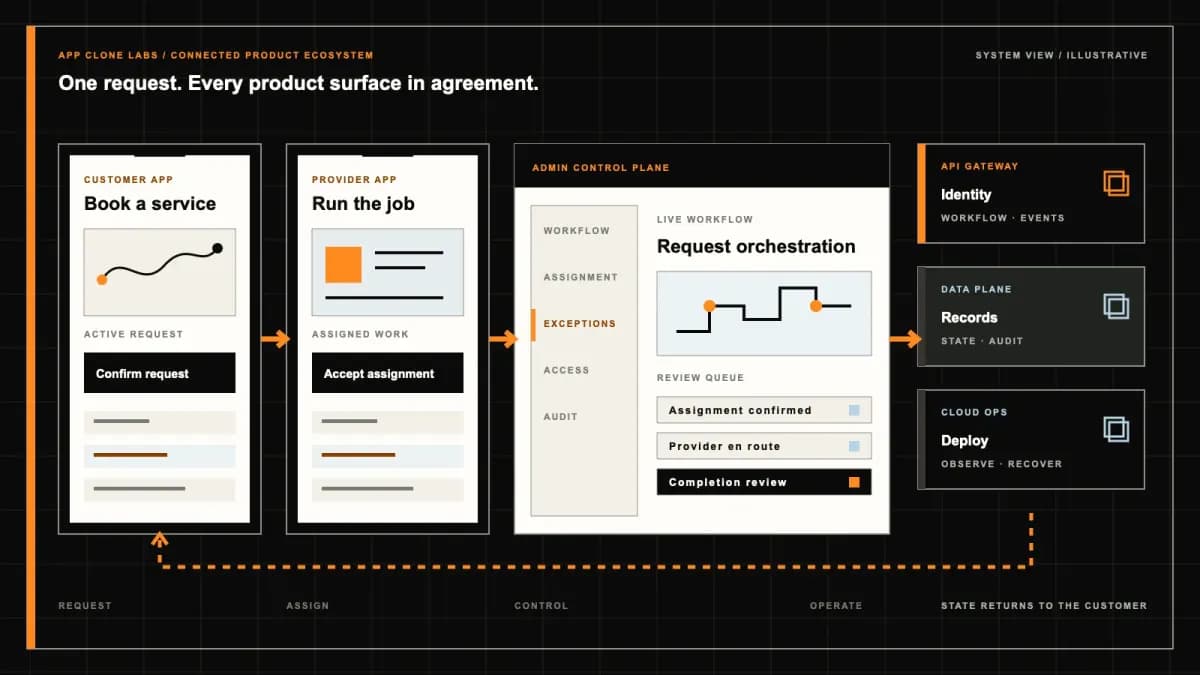
A fictional sender confirms a transfer from ALPHA to BETA, fictional currencies used for a sandbox review. The quote expires before funding arrives, the recipient account contains an incorrect digit and the payout partner later returns an unknown status. These are different exceptions with different owners. A Wise-style transfer experience needs to explain the accepted proposition, money received, execution evidence and any amount still owed to the customer.
App Clone Labs scopes independently branded cross-border money-movement software around that journey. This reference does not imply Wise affiliation, a financial-service licence, provider access or availability in any particular market. Establish the responsible institutions, permitted corridors and safeguarding arrangements independently. No fixed transfer speed is guaranteed. A polished receipt or help article cannot establish that funding arrived, a recipient was paid or a returned amount reached its proper destination.
Choose the initial source market, destination market, customer type, currencies, funding method and payout route. Identify who contracts with the sender, receives money, converts currency, performs screening and executes payment. Record complaint ownership and the applicable protection disclosures. Calling a product an account does not establish that it is a bank deposit or that a particular protection regime applies.
A route should become selectable only after its operating decisions and provider dependencies are established. Rehearse an unsupported destination and a previously supported route becoming unavailable while a transfer is pending. The customer needs a supported explanation and an owner for outstanding money. Do not infer permission from a provider logo or a familiar currency code. Multi-currency balances are a separate funds-handling commitment; define their institution, ledger and permitted use before including them in the first release.
Wise Platform’s authenticated quote documentation describes profile-specific quotes, quote identifiers, validity and rate-expiry fields. Those distinctions are useful reference points for a transfer proposition. They do not supply an independent product with Wise rates, integration permission or the same customer terms.
Present source amount, destination amount, fees, rate basis, recipient, funding method and estimated delivery together. Make clear whether the sender fixes the amount paid or the amount intended for receipt. Store the proposition and its validity when the customer agrees. Test an expired quote, a changed recipient and a stale confirmation screen. Refresh the proposition and obtain the appropriate renewed acceptance rather than silently replacing a rate or fee. Define separately what happens when a validly created transfer receives funding after its rate conditions expire.
Collect the beneficiary fields required for the actual destination and payment rail. Account number formats, bank identifiers and recipient categories can differ. Separate format validation from any available account or name verification. A field passing a checksum does not prove that it belongs to the intended person, and unavailable verification should not appear as a successful ownership check.
Let the sender inspect the relevant details before confirming. Record the beneficiary version used for the transfer so a later address-book edit does not rewrite payment history. Rehearse wrong recipient details, a closed account and a changed bank identifier. Before submission, support correction with renewed validation and any required approval. After submission, route the issue through the actual partner’s amendment or recovery capability. Do not promise that editing a saved recipient can recall money already sent or guarantee recovery from a different account holder.
Provide the selected funding destination, amount, currency and matching reference through an authorized channel. Explain whose account receives the funds and what evidence establishes receipt. A sender selecting paid or uploading a bank receipt is a claim that may help investigation; it is not authoritative funding confirmation. Keep delayed funding, unmatched funds and an insufficient amount distinguishable.
Test two transfers with similar amounts, a missing reference, a duplicate notification and funding arriving after cancellation. Match against actual bank or partner records under the agreed model. Retain unresolved money in the relevant investigation and accounting view instead of discarding it because the original transfer is no longer active. If stored balances fund a transfer, prevent simultaneous instructions from spending the same available amount. The customer should see the missing requirement and next step without being told that a bank transfer will arrive on a universal schedule.
Identity, sanctions and transaction-review decisions need an explicit operating boundary. Specify which institution performs the checks, which customer information is necessary and who can request additional evidence. A funded transfer can remain under review; funding receipt should not automatically authorize execution. Keep the payment obligation visible while the decision is pending.
Restrict identity documents and financial evidence to legitimate reviewers. Customer support should see the permitted explanation, case owner and next action without acquiring access to unrelated sensitive files. Rehearse a review hold after funding, a customer supplying revised evidence and a reviewer unavailable at handover. Retain decision reasons and versions rather than letting staff replace the outcome to clear the queue. Customer notices must reflect what can lawfully and accurately be disclosed under the operator’s actual procedures, without inventing a reason or a completion deadline.
Assign a stable correlation reference to the transfer and preserve the partner’s identifiers. A request accepted, a payment submitted and funds delivered can represent different stages. Map the selected provider’s events to customer language without overstating their meaning. A successful network response may confirm receipt of the instruction while leaving execution unresolved.
Rehearse repeated taps, a lost response and the provider accepting an instruction before the application times out. Investigate the existing request before submitting another payment. Prevent retries from creating duplicate obligations and retain the authoritative response when it becomes available. Record timing estimates with their assumptions, including funding, review and partner cutoffs. Update the customer when evidence changes, but do not transform an estimate into a guaranteed arrival time. A support receipt must distinguish submission evidence from a confirmed destination payment.
An unknown status means the platform lacks enough evidence to declare a final outcome. It does not prove failure, so retrying the payment or returning its funding automatically can create a second exposure. Keep the customer instruction, partner reference, last verified event and enquiry ownership together. Show when the status was last checked and what action is currently permitted.
Test a delayed webhook, an older event arriving after a newer one and a partner outage spanning a shift change. Preserve the event history and reconcile conflicting observations through the provider contract. A customer reopening the app should see the same unresolved obligation that operations sees. Provide scoped escalation and complaint routes rather than resetting the transfer to a fresh draft. Unknown results need measurable operational follow-up; hiding them from the transaction list makes a clean interface at the cost of an unaccounted customer payment.
Wise Platform’s refund documentation describes bounce backs, cancellations and refund methods linked to the funding model, including partial-refund scenarios. This supports treating return handling as distinct work. It does not guarantee that another provider can recover every payment or return the full original amount.
Specify the evidence for a payout rejected, money returned to the operator or partner, and a refund delivered to the appropriate destination. These events may occur separately. Match the original amount, currencies, charges and observed return before presenting a resolved refund. Test wrong beneficiary details causing a return, a refund smaller than the original payment and a refund notification arriving twice. Explain any supported difference with evidence and an accountable owner. A canceled transfer must remain visible while its refund is still outstanding.
Join quote, beneficiary version, funding record, review decision, payout instruction and return events through stable transfer identity. Compare customer obligations against the relevant bank and partner records at agreed checkpoints. Separate pending money, completed transfers, returns and unresolved differences. Exact-unit amounts and currency identity matter at every boundary; a rounded dashboard total is insufficient evidence.
Rehearse an unmatched funding entry, a payout appearing only in the partner statement and a returned amount with unexplained charges. Assign each difference to an investigator with the supporting references. Corrections require attributable adjustment records instead of silent edits to transfer history. Business reports should distinguish an operational status from financial settlement. Establish retention, access and export responsibilities so a complaint can be reconstructed without exposing another customer’s data. Reconciliation remains necessary even when every individual screen appears successful.
Define a handover record for unresolved cases with the last verified observation, missing evidence, responsible institution and next permitted enquiry. A replacement analyst should understand why the fictional ALPHA funding is received while the BETA payout remains uncertain. Rehearse that shift change without allowing a second instruction or losing the customer’s complaint. Reports should retain the outstanding amount and its currency until supported records explain the outcome. A case marked reviewed is not necessarily a payment obligation discharged, and those two conclusions should remain separately inspectable.
Compare the Revolut-style multi-product finance scope when the main decision involves accounts, cards and separately authorized products in one interface. This Wise-style brief centers on cross-border remittance quote, funding, recipient and payment execution, with return reconciliation following the same transfer.
Use the white-label remittance software brief when evaluating branding, configurable foundations and deployment handover. Price transfer fees, conversion terms and business services against the actual operating footprint. Additional corridors, account features or approval flows need their own evidence, provider readiness and support capacity rather than being included because a reference menu contains them.
Buyer acceptance should use a synthetic sandbox with fictional ALPHA and BETA records and controlled provider events. Expire a quote, correct wrong recipient details, delay funding and place the transfer under review. Submit once, introduce an unknown status, then record a returned payout and reconcile its refund. Inspect customer tracking, restricted support access and the operational exception report together. Illustrative screens do not demonstrate live rates, provider availability or real payment execution.
Bring one corridor and unresolved transfer example to a cross-border transfer scope discussion to establish funding evidence, responsible institutions and supported remedies.
Use the delivery process to agree provider dependencies, source-code terms and acceptance records before expanding the proposed money-movement service.
FAQ
It follows a cross-border transfer through recipient setup, disclosed quotes, funding, review, partner execution, tracking and reconciled returns, with accountable owners for unresolved obligations.
No. Establish independent branding, responsible institutions, lawful permissions, provider contracts and permitted corridors separately. Software delivery does not confer affiliation, authorization or universal market availability.
Apply the actual provider and operator conditions, refresh the proposition where required and obtain renewed acceptance. Do not silently replace the rate or fee after customer approval.
No. Format checks and any available account verification are distinct. Show coverage accurately, preserve the recipient version and let the sender inspect details before confirmation.
Separate instructions issued, customer payment claims and authoritative receipt. Preserve late or unmatched money as an investigation and accounting obligation with a visible next step.
No. Record required review decisions independently and preserve the customer obligation while evidence is pending. Support access should reveal permitted status without exposing unrelated private documents.
No. Map instruction acceptance, execution and delivery to their actual evidence. A successful request response can leave payment unresolved and must not create an unsupported completion claim.
Investigate the existing reference, retain the last verified event and keep ownership visible. Blind retries or immediate refunds can create duplicate payments or inconsistent obligations.
No. Recovery depends on the actual provider, payment stage and recipient circumstances. Editing the address book cannot guarantee an amendment, recall or return of sent funds.
No. Reconcile the observed return, applicable charges and refund destination under the funding model. Keep cancellation, return receipt and refund delivery distinct until evidence supports resolution.
This brief emphasizes the cross-border transfer lifecycle and its exceptions. The Revolut-style scope coordinates several financial products with separate eligibility, institution responsibilities and product ledgers.
Use fictional records to test expired quotes, wrong recipient details, delayed funding, review holds, unknown status and returns. Inspect authoritative event references and reconciled customer obligations.
Solution reference register
01 / Reference and IP
This page references third-party product names only to describe familiar product models and planning references. App Clone Labs is not affiliated with or endorsed by those brands. Build decisions require independent legal, regulatory, and operational review for your market.
02 / Regulatory caveat
Confirm licensing and market-specific authorization before enabling regulated activity · Define whether assets or funds are held by the operator, a qualified custodian, or not held at all · Apply security review, strong authentication, encryption, audit logging, recovery, and incident response · Present educational product information only and prohibit personalized financial, legal, tax, or wagering advice · Apply identity, sanctions, transaction monitoring, complaint, and suspicious-activity procedures · Do not describe a transfer as a bank deposit unless the responsible institution and protection status support that statement
Primary sources
Dated official documentation, standards, and research that support the factual claims on this page.
How to read this page
Scope, cost and timeline figures are planning guidance until confirmed in a written proposal. Diagrams and screens are illustrations, not client deliverables, and source-code rights and handover follow the signed agreement. See the delivery process and the full disclaimer.
Next decision
Define outcomes, constraints, evidence, rights and handover before delivery begins.
Commercial rights, repositories, environments, documentation, acceptance and handover remain contract-defined.
App Clone Labs is not affiliated with, sponsored by, or endorsed by Wise. The name identifies a familiar product category; every delivered product is independently designed and built, and the mark remains its owner's property. Read the full legal notice.