Case record / Courier logistics
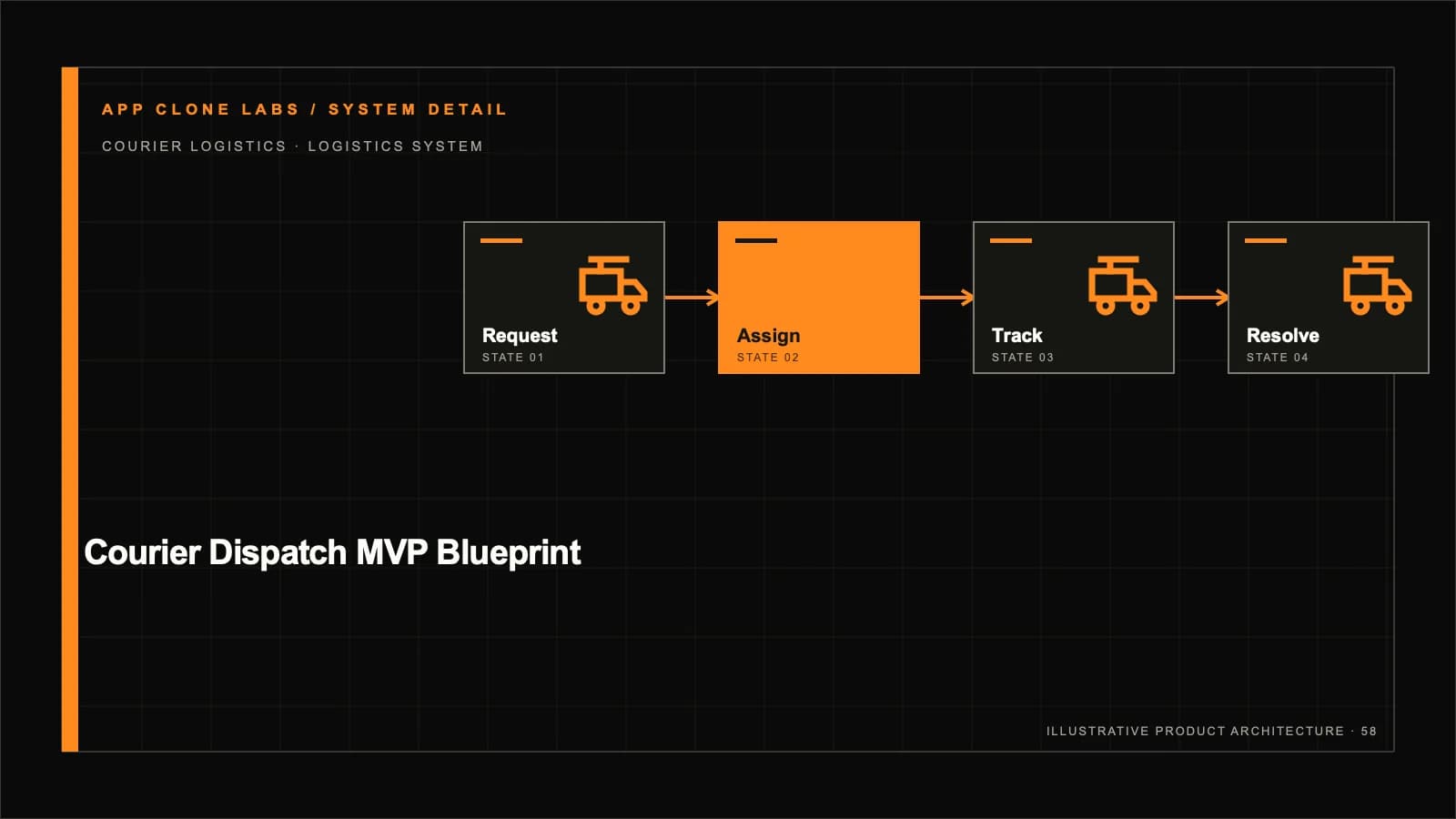
Courier Dispatch MVP Blueprint
A conceptual delivery blueprint pending verification of project provenance, permissions, implementation status, and outcomes.
Published outcome claim / not independently verified here
Conceptual reference only; no client result is claimed.
Request a similar build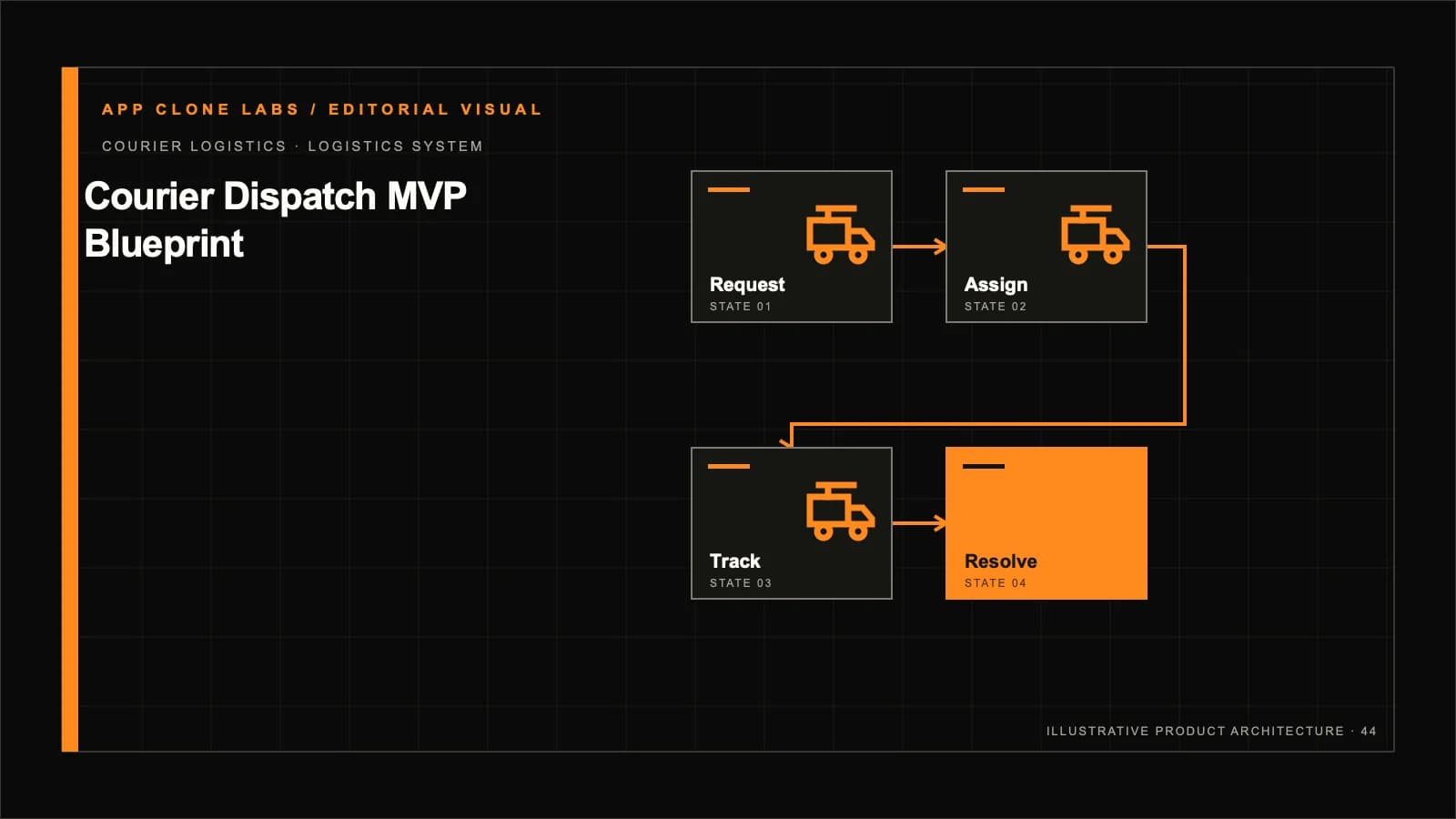
Proof status / evidence boundary
What this record can and cannot establish
Recorded project context
The industry, summary, service list, stack, narrative, and body are fields supplied by the case-study record.
Architecture and workflow
The workflow and technology labels describe the published delivery scope. They are not presented here as a new contractual commitment.
Outcome evidence boundary
Public outcome evidence is not attached to this record.
Evidence status: Blueprint / Last reviewed: Not recorded
Context / delivery read
A similar product needs workflow clarity before interface polish.
The fastest path is to map the commercial loop, user roles, admin controls, integrations, reporting, and launch handoff before design and engineering scale up.
Recorded services
Workflow and deliverables
Role-specific user journeys before interface design
Admin, support, reporting, and operations controls
Payment, notification, map, media, or AI integrations scoped early
Launch documentation, cloud context, and ownership handoff
The logistics operator needed courier booking and dispatch visibility without starting with enterprise fleet complexity.
App Clone Labs separated pickup creation, driver availability, route status, proof of delivery, failed delivery handling, customer support, and dispatcher override into a launchable operating model.
The anonymized deliverables included a route-state diagram, driver app checklist, proof-of-delivery flow, dispatch dashboard scope, and post-launch reporting backlog.
Technical architecture and system design
FleetPulse was architected as a React Native driver app paired with a Node.js service layer and PostgreSQL on AWS, with a Maps API integration abstracted behind an internal routing interface so the provider could be swapped without touching the dispatch engine. Dispatch state was modeled as an explicit state machine—requested, assigned, picked up, in transit, delivered, failed, cancelled—so every transition could be audited and replayed for support disputes, with each transition timestamped and attributed to the actor that triggered it. The dispatch engine was isolated as its own service so driver assignment and route status could scale independently of the pickup-creation API, and the two communicated through a queued event bus so a surge in pickups would not block the assignment loop. Proof of delivery was captured as a structured event with photo, signature, and geo-stamp rather than a single boolean, ensuring disputes had evidence, and the event was hashed at capture time so tampering after the fact could be detected by comparing the stored hash against a recomputed one. The driver app cached proof-of-delivery events locally on the device so a drop-off completed in a cellular dead zone would upload once connectivity returned, with a retry queue that preserved the original capture timestamp so the route log reflected when the delivery actually happened rather than when the server received it.
API design separated the customer pickup journey from the dispatcher management journey, with route status and proof of delivery enforced server-side rather than trusted from the driver client, so a compromised or offline driver app could not fabricate a delivery. Real-time requirements were handled through a WebSocket gateway that pushed route-status changes to customers, dispatchers, and the driver app without polling, with a heartbeat and reconnect protocol so flaky cellular connections on the road did not drop the driver into a stale state. The architecture deferred enterprise fleet complexity, multi-warehouse orchestration, and route optimization to later phases so the first release could prove the pickup-to-delivery loop under real load, and each deferred module was documented with the trigger condition—such as a fleet size threshold—that would justify building it. Database choices favored PostgreSQL with spatial indexing using PostGIS for route queries, keeping nearby-driver and route-progress lookups fast as the active fleet grew, with a GiST index on the driver location point so the nearest-available query stayed sub-millisecond even with thousands of active drivers.
Development methodology and sprint breakdown
The build ran in two-week sprints, opening with a discovery sprint that locked the 4 dispatch states, route-state diagram, and proof-of-delivery flow before any UI work, with the state diagram printed and pinned in the team room so every engineer referenced the same source of truth. Sprint one delivered pickup creation and driver assignment against stubbed routing, while sprint two introduced live route status, proof of delivery, and the dispatch dashboard, with the WebSocket gateway added in sprint two so the dashboard was live from the first demo rather than bolted on later. QA covered the full dispatch lifecycle on each build using device farms for the React Native driver app, with particular attention to failed-delivery and dispatcher-override edge cases, including tests that simulated network dropouts mid-route to verify the reconnect protocol restored state correctly. Each sprint closed with a demoable release reviewed by the logistics operator, and release sequencing kept dispatch tooling in the same sprint as the driver feature it governed so a driver-side change never shipped without the dispatcher visibility to manage it.
A hardening sprint before launch stress-tested failed-delivery handling, proof-of-delivery evidence integrity, and dispatcher override paths, since these were the workflows most likely to generate support load, and each was tested against a synthetic fleet of fifty simulated drivers hitting the API concurrently to surface race conditions in the assignment logic. Automated regression checks validated that no route could enter an illegal state and that proof-of-delivery events reconciled against the route log, with a checksum comparison that flagged any delivery event whose hash did not match the captured payload. The final release checklist included cloud handoff, monitoring for stalled routes with an alert when a route stayed in transit beyond the configured SLA, and a support runbook for delivery disputes that walked agents through reading the geo-stamped photo evidence. This sequencing kept the courier MVP focused on pickup, dispatch, and delivery while leaving a documented backlog for route optimization, each item annotated with the fleet-size threshold that would trigger its build so the founder could see the investment horizon.
Operational challenges and resolutions
The dominant operational challenge was failed-delivery handling, where unsuccessful drops created customer disputes and re-delivery cost that eroded margin on already-thin per-package economics. The resolution was a failed state with structured reason codes—recipient absent, wrong address, damaged in transit, refused—photo evidence, and an automated re-dispatch workflow surfaced to the dispatcher console so the next available driver could be assigned without a manual ticket. Driver availability gaps during peak windows caused assignment delays that customers noticed as long wait times; the team introduced a dispatcher boost control that widened the assignment radius temporarily and a real-time heat map of unassigned pickups rather than shipping automated optimization in V1, because the operator wanted manual control until the fleet was large enough for optimization to have meaningful data. Proof-of-delivery disputes, where customers claimed non-receipt, were resolved by the geo-stamped photo evidence captured at drop-off, viewable by support in one click, and the geo-stamp included accuracy radius so support could distinguish a genuine doorstep photo from one taken a block away.
Route status drift from low-end driver devices was handled with a server-side staleness threshold so dispatch never relied on a stale location fix, and any location update older than the threshold was discarded in favor of the last known good position with a visual indicator on the dispatcher map. Customer support for lost packages was streamlined by linking each ticket to the underlying route and proof-of-delivery record, giving agents full context without switching systems, and the ticket view rendered the route timeline inline so agents could see every state transition and the geo-stamp without opening a separate map view. Each resolution was captured as a runbook so the logistics operations team could manage the platform independently after handoff, with each runbook including the exact admin-console path and the expected resolution time so new dispatchers could be onboarded in hours rather than days. These operational fixes directly supported the 4 dispatch states simplified for MVP, and the structured reason codes became the foundation for the failure analytics that informed which zones needed additional driver capacity at peak.
Admin and operator tooling
The dispatch dashboard was built as a first-class surface, covering live route status, driver availability, dispatcher override, failed-delivery review, and fleet reporting, with the map view as the default tab so dispatchers could assess the fleet at a glance before drilling into any single route. Operators could view active routes, assignment latency, and delivery success rates on a single map console, with drill-downs into individual records that showed the full state timeline and proof-of-delivery evidence side by side. Support tooling linked each ticket to the underlying route and proof-of-delivery evidence, giving agents full context without switching systems, and the ticket-to-route link was bidirectional so a dispatcher viewing a route could see any open support tickets attached to it. Reporting dashboards exposed pickup volume, delivery success rate, failed-delivery reasons, and driver utilization, refreshed on a near-real-time pipeline backed by a materialized view that recomputed every five minutes so the dispatcher always saw current fleet economics.
Operational controls included configurable failed-delivery policies with per-zone reason-code thresholds, a driver block list for abuse that prevented new assignments while letting in-progress routes complete, a re-dispatch workflow that queued failed packages for the next available driver, and a release-control surface for toggling features per zone so a new capability could be piloted in one neighborhood before a city-wide rollout. The admin dashboard provided audit logs for every dispatcher override and route-state change so post-incident reviews had a clear trail, and the logs were filterable by driver, zone, and time window so a dispute could be reconstructed in minutes. This tooling layer was what made the courier platform operable at launch, not just bookable, and it directly enabled the 4 dispatch states simplified for MVP. Dispatcher teams could manage routes and review failures without engineering involvement, keeping the delivery cadence independent of the deploy cycle, which was critical because delivery volume spiked during holidays and the operations team could not wait for an engineer to adjust a threshold.
Launch outcomes and lessons
The MVP launched with a capped driver pool and a documented expansion playbook, proving the pickup-to-delivery loop before any route optimization was added, and the capped pool kept the dispatcher surface area manageable so the two-person operations team could personally verify every failed delivery during the first month. What worked well was the explicit dispatch-state machine, which made failed-delivery disputes resolvable in minutes because the agent could see the exact transition that produced the failure, and the structured proof-of-delivery event, which provided evidence without manual lookup because the photo, signature, and geo-stamp were rendered together in the support view. What did not work was underestimating driver device fragmentation, which caused location drift on lower-end handsets and required the staleness fix post-launch after a handful of drivers appeared to teleport across the map when their GPS reset. The lesson was that proof of delivery must be structured evidence, not a boolean, and that the evidence must be captured and hashed on the device before any network upload so a flaky connection cannot corrupt it. A third lesson, surfaced after the first holiday surge, was that the dispatcher boost control needed a configurable radius cap so an overzealous dispatcher could not widen the assignment zone to the point where drivers spent more time in transit than at drop-offs, eroding per-package economics without anyone noticing until the weekly utilization report arrived.
A second lesson was that dispatcher override must ship with the driver app, not after it, because manual control absorbs early assignment imbalances without code changes and the operations team trusted the system more once they could see they could always intervene. Founders evaluating a similar courier build should resist launching route optimization or multi-warehouse orchestration early, because their operational complexity dwarfs the dispatch MVP and optimization engines need months of historical data before they produce better assignments than a competent dispatcher. The anonymized launch plan captured these lessons as a checklist for the next zone rollout, with each item tied to the specific incident that produced it so the next team understood the reasoning rather than just the rule. Overall, the launch validated that clone-inspired logistics products succeed when the operating layer is engineered as carefully as the driver app, and that the unglamorous parts—staleness thresholds, reason codes, and audit logs—are what keep a courier platform trustworthy once customers start relying on it for time-critical deliveries.
Scalability and post-launch evolution
The architecture was designed to scale by isolating dispatch, pickup, proof of delivery, and admin into independently deployable services on AWS, each with its own autoscaling policy so a spike in pickups could scale the pickup service without over-provisioning the admin console. PostgreSQL with spatial indexing handled route queries for the launch zone, with a sharding plan documented for multi-zone expansion keyed by geographic region using PostGIS table partitioning so each zone routes stayed in a contiguous index. The WebSocket gateway was built to fan out across multiple instances so concurrent route-status pushes would not bottleneck on a single node, with a sticky-session-free design that used a shared Redis pub-sub layer so any instance could deliver an update to any connected client. Deferred to later phases were route optimization, multi-warehouse orchestration, driver incentive engines, and a customer loyalty program, each scoped as a separate service to avoid entangling the core dispatch loop and each given an interface contract so the dispatch engine could call them without coupling to their internals.
Post-launch evolution followed the documented backlog: new zones were added by replicating the deployment with zone-specific dispatch rules, validated through per-zone feature toggles so a misconfigured zone could be paused without affecting the rest of the network. Real-time analytics were upgraded from near-real-time to a streaming pipeline once route volume justified the investment, with the materialized views replaced by a Kafka-backed stream that fed a ClickHouse warehouse so the operator could run failure-rate analysis across months of routes without loading the transactional database. The dispatch service later absorbed a predictive ETA model that used historical route durations to estimate arrival windows, but only after the MVP proved that deterministic ETAs were sufficient for launch and after enough route history existed to train the model without overfitting to a single season. This phased evolution kept the courier platform stable under growth while preserving the original clone-inspired speed of the first release, and the discipline of deferring each module until its predecessor was proven meant the team never carried more than one major capability in flight at a time.
Related case records