
01V1
Customer storefront and app
Edits, designers, categories, search, wishlist, multiple languages and currencies, checkout with duties included, order tracking and returns, on web, iOS and Android.
Solutions · Luxury fashion marketplace
A luxury fashion marketplace sells other people’s stock. Independent boutiques and brands list pieces that are often also on their own shop floor, and the marketplace takes the order, the payment and the customer relationship. A Farfetch clone has to keep that stock honest, ship a single coat across borders with duties already settled, and handle returns on items worth more than most phones. This page covers how the model runs, what goes wrong in builds and what the first release should include.
Professional plan. Enterprise customization is quoted on scope.
Boutique, brand and customer apps
Stock synced with each boutique
Duties and taxes shown before checkout
V1
Edits, designers, categories, search, wishlist, multiple languages and currencies, checkout with duties included, order tracking and returns, on web, iOS and Android.
Catalogue upload, stock sync, order confirmation, packing labels, returns and statements.
Seller approval, curation, commission, shipping and duty rules, cases and refunds.
Points on purchases and member-only edits.
Operating loop
The marketplace checks the boutique and the brands it is authorised to sell. The boutique connects its stock, adds photos, sizes, materials and prices, and sets which countries it ships to.
The customer browses curated edits, designers and categories in their own language and currency, sees the delivery date with duties and taxes already included, and pays once even when the basket comes from several boutiques.
Each boutique must confirm the item is still on its shelf within a set time, pack it to the marketplace’s standard and hand it to the courier on a label the marketplace provides.
The customer tracks the parcel and can book a free collection for a return. The boutique is paid for kept items after the return window closes, less commission and any shipping it agreed to cover.
Roles
Buying a piece they may have wanted for months. Expects accurate sizing, the full price including duties up front, careful packaging and a return that costs nothing and takes one booking.
An independent store that also sells in person. Needs orders to reach its stock system quickly, clear packing rules and a statement that shows each sale, return and deduction.
A designer label selling direct. Cares about where its pieces appear, how they are photographed and which markets it is allowed to sell into.
Approves sellers, checks authenticity, curates edits, sets commission and handles cases where an item arrives damaged, late or not as described.
Hard parts
A boutique can sell the last jacket to a walk-in customer minutes after it sold online. Sync stock from the boutique’s point-of-sale system every few minutes, ask the boutique to confirm each order quickly, and plan how to offer an alternative when it cannot.
A customer who pays a surprise import charge at the door often refuses the parcel. Calculate duties and taxes at checkout and collect them with the order, so the courier delivers without asking for more money.
One fake bag can undo years of trust. Only accept sellers with proof of where their stock comes from, keep invoices on file, and give the team a way to pull a listing and inspect a returned item quickly.
Free returns are expected in luxury, but they are also where fraud happens. Use tamper tags, photograph items on dispatch and check returns against those photos before refunding.
Italian, French, US and UK sizes differ, and every boutique describes items its own way. Map sizes to one scheme, standardise categories and colours, and set photo rules so the catalogue looks like one shop.
Operator controls
Boutique and brand checks, the designers each seller may list, and suspensions with reasons.
Orders waiting for a boutique to confirm, with timers, automatic cancellation and offers of alternatives.
Couriers per route, who pays for shipping, and how duties and taxes are calculated for each country.
Damaged, late and not-as-described cases with dispatch photos, tracking and refund actions that adjust the seller’s balance.
Revenue
A percentage of the item price, usually higher than on general marketplaces because the platform handles payment, shipping and service.
Negotiated courier rates, with duties passed through to customers at cost.
Membership tiers with early access to new season edits and private sales keep the best customers buying.
Later
Stylists who build looks for top customers add revenue but need staffing and their own tools.
Buying back and authenticating used pieces is a separate business with its own inspection and pricing.
Fast delivery from nearby boutiques needs local courier partners and live stock you can rely on.
Next decision
See how a luxury marketplace compares with general multi-vendor, handmade and single-brand stores.
Open registerIf sellers list everyday stock rather than luxury pieces, a general marketplace with simpler shipping and returns may suit you better.
Open registerA single brand that wants its own online shop rather than a place on a marketplace can start from a store builder.
Open registerFor a scoped build around this product, see how our marketplace development team plans storefronts, seller tools and operations.
Open registerLive demo
Open each app or panel in a new tab and sign in with the demo login shown. The demos run on shared sample data, carry our demo product names, and show the ready-made product before any customization.
Customer Storefront
Boutique and Seller Panel
Customer App
Use this original fashion-commerce concept to scope boutique, customer and marketplace workflows. It is not Farfetch UI or proof of inventory, boutiques, payments or platform affiliation.
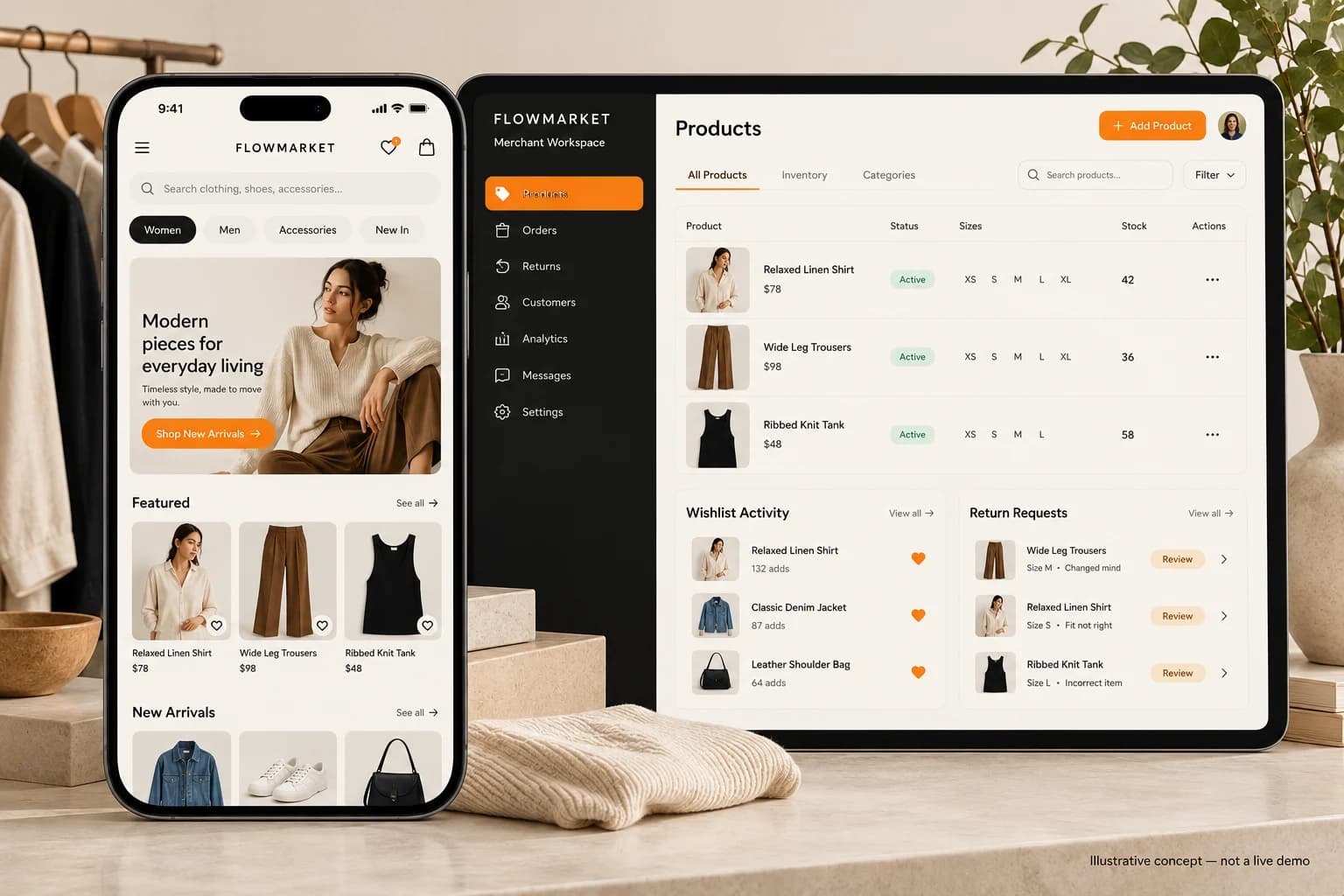
Original fashion-commerce concept. Product cards, sizes and return statuses are illustrative and do not establish inventory, seller rights, duties, checkout or delivery.
What to check in the walkthrough
An independent boutique in Milan or Paris has stock that customers in Dubai or Seoul would buy, but no easy way to reach them, take payment in their currency or ship across borders. A marketplace that handles all of that, and only asks the boutique to confirm and pack, gives it a second shop window without a second team.
In return, the boutique accepts the marketplace’s commission, packing rules and service standards. Keep those rules clear and the statements easy to read, because good boutiques can choose where they sell.
The starting point is a finished luxury marketplace: storefront, customer app, boutique and seller panels and the admin console all run today, and the demo above lets you check them first. Pricing begins at $3,699 one-time for the Professional plan. We rebrand it as your marketplace and hand it over within 6 to 9 days, along with every line of unencrypted source.
Larger boutiques may need a point-of-sale connection, some markets need a duties provider, and top customers may want a concierge. Each is priced separately and added to the code you already own.
Customers pay luxury prices to a marketplace they cannot visit. Accurate stock, honest delivery dates, careful packaging and returns that work are what earn the second order. Spend on those before spending on advertising.
FAQ
Software for a luxury fashion marketplace in the style of Farfetch: boutiques and brands list their stock, customers buy from many sellers in one checkout, and the marketplace handles payment, cross-border shipping, duties and returns. It carries your own brand, not Farfetch’s.
Our Farfetch clone starts from $3,699 one-time on the Professional plan, delivered in 6 to 9 days with the customer storefront and app, boutique and seller panels, admin console and full unencrypted source code. Integrations with a boutique’s point-of-sale system or a duties provider are quoted on scope.
Stock syncs from each boutique’s system on a short interval, and every order must be confirmed by the boutique within a set time. If an item has already gone, the customer is offered an alternative or a refund straight away.
Yes. Duties and import taxes are calculated for the destination country and collected with the order, so the courier delivers without asking the customer for more money.
Yes. You receive the full unencrypted source code and can host it on your own servers, change it or hire another team to extend it.
Primary sources
Dated official documentation, standards, and research that support the factual claims on this page.
EU rules on seller traceability and handling notices about illegal products, including counterfeits, on marketplaces.
Withdrawal periods and pre-contract information for online sales to EU customers.
Card data standards that apply to customer payments.
How to read this page
Scope, cost and timeline figures are planning guidance until confirmed in a written proposal. Diagrams and screens are illustrations, not client deliverables, and source-code rights and handover follow the signed agreement. See the delivery process and the full disclaimer.
Next decision
Define outcomes, constraints, evidence, rights and handover before delivery begins.
Commercial rights, repositories, environments, documentation, acceptance and handover remain contract-defined.
