01V1
Branded passenger app
Booking with fixed or metered fares, scheduled rides, live tracking, masked calls, payment and receipts on iOS, Android and web.
Solutions · White-label taxi
A white label taxi app is ready-made booking and dispatch software that goes out under your company’s name, in your own app store listings, with your fares and your drivers. It suits taxi companies, private hire firms and fleet owners who already have cars and customers and want their own app instead of losing trips and commission to the big ride-hailing platforms. This page covers what that takes, from phone bookings to airport queues.
Professional plan. Enterprise customization is quoted on scope.
Passenger, driver and dispatcher apps
Published under your own app store accounts
Phone bookings and app bookings in one queue
V1
Booking with fixed or metered fares, scheduled rides, live tracking, masked calls, payment and receipts on iOS, Android and web.
Job offers, navigation, cash and card handling, trip history and earnings.
Phone bookings, manual and automatic dispatch, live map and scheduled jobs.
Fares, zones, drivers, vehicles, business accounts, invoices and weekly driver settlement.
Operating loop
Your name, logo, colours and store listings go into the apps. You add your service area, vehicle types, fare tables or meter rules, and invite your existing drivers to install the driver app.
Passengers book in the app with a fixed price or a metered estimate, or call your office and a dispatcher books for them. Scheduled airport runs and account bookings sit in the same queue.
The system offers the job to the nearest available driver by road arrival time, or a dispatcher assigns it by hand. Passengers see the car approaching and can call the driver through a masked number.
The fare is taken by card, cash or charged to a company account. Driver earnings, the company’s share and any account invoices are recorded for weekly settlement.
Roles
Wants a car quickly, a price they can trust and the choice to book in the app or by phone, as they always have.
Often owns or rents the car and works for your company. Needs clear job offers, navigation, cash and card handling and a statement that matches what they were paid.
Takes phone bookings, assigns jobs by hand when needed, handles airport queues and account customers, and watches every car on one map.
Sets fares, commission and driver rules, approves drivers and vehicles, and invoices business accounts each month.
Hard parts
Most taxi companies still take many bookings by phone. If the dispatcher works in a separate system, drivers get two queues and double bookings follow. Put phone, app and website bookings into one dispatch queue from the start.
Licensed taxis and private hire vehicles often have different rules on street hails, meters, fixed fares and driver records. Store driver and vehicle licences with expiry dates, and set fares to match what your licence allows.
Your drivers already have a routine. Give them a driver app that is simple to learn, run it alongside the old system for a short period, and pay them through it reliably from the first week.
Apple rejects apps built from a template unless the business providing the service submits them. The apps go out under your own Apple and Google developer accounts, with your own name, screenshots and descriptions.
Hotels, offices and hospitals often book on account. They need booking rights for several staff, a monthly invoice and trip records they can check against it.
Operator controls
Fixed-price zones, metered rates, airport fees, night rates and minimum fares, with dates showing when each change applies.
Phone bookings, manual assignment, scheduled jobs, airport queues and every car on a live map.
Licences, insurance and vehicle papers with expiry reminders, plus suspensions and reinstatements with reasons.
Business accounts, who may book, monthly invoices and trip records for each account.
Revenue
A share of each fare, or a weekly fee drivers pay to receive your jobs, depending on how your company already works.
Monthly invoiced travel for companies, often your steadiest income.
Small fees for advance bookings, airport pickups or larger vehicles, shown to passengers before they confirm.
Later
Connecting approved meters or in-car card terminals depends on your hardware and licence rules; add it once the apps are in use.
Passing jobs to partner firms when your fleet is busy needs agreements and settlement between companies.
Your drivers can carry parcels between rides, but that brings its own pricing and proof-of-delivery rules.
Next decision
If you are starting a platform rather than moving an existing taxi company onto its own app, the Uber clone covers the full marketplace model.
Open registerA cost and timeline comparison for taxi companies deciding between ready-made software and building their own.
Open registerSee how ride-hailing compares with delivery, home services and other on-demand products.
Open registerOur ride-hailing service sets out how we deliver the apps, dispatch, payments and operator console.
Open registerLive demo
Open each app or panel in a new tab and sign in with the demo login shown. The demos run on shared sample data, carry our demo product names, and show the ready-made product before any customization.
Rider App
+91 9876543210 | User_321Driver App
driver@demo.com | Driver_321Web Site
+91 9876543210 | User_321Operator Panels
admin@demo.com | Admin_$321dispatcher@demo.com | Dispatcher_321fleet@demo.com | Fleet_321Use this original ride-request concept to scope an Uber-style ride marketplace. The sample pickup and destination await a fare estimate and driver confirmation, with dispatcher escalation shown as an option. Ask for a working demo of the proposed rider, driver and operations journey, including interrupted requests and changed trip terms.
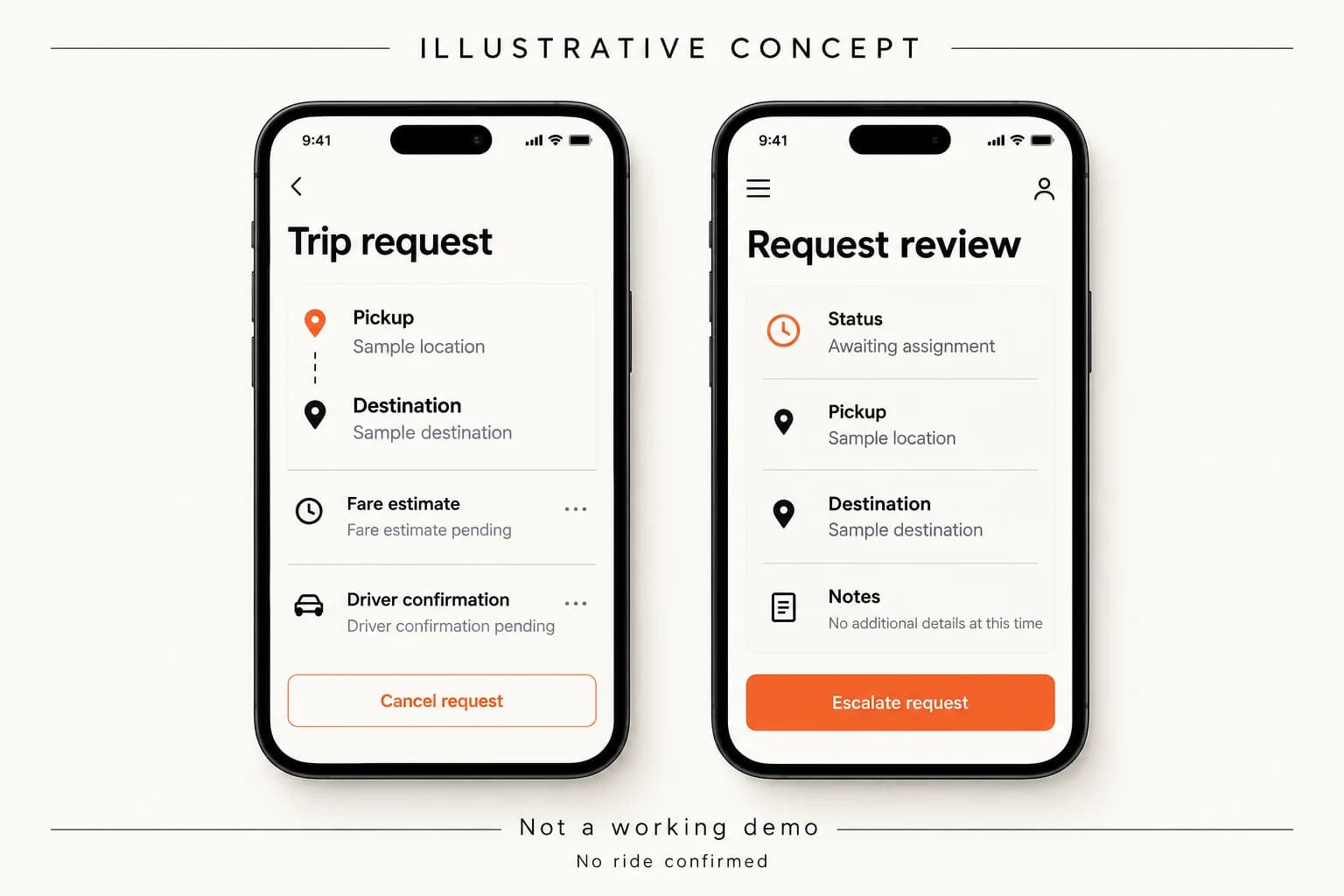
Original App Clone Labs ride-request concept at 1536×1024. Sample trip details, a pending estimate, pending driver confirmation and dispatcher escalation illustrate a procurement discussion. This is concept artwork, not an official Uber interface, a live dispatch screen or proof of driver availability, route accuracy, fare calculation, safety or transport compliance. No confirmed ride is demonstrated.
What to check in the walkthrough
Ride-hailing platforms take a large share of every fare and own the passenger relationship. A taxi company with its own app keeps both, and gives regular customers, hotels and offices an easy way to book the firm they already trust.
The app does not replace the phone line. Many passengers, especially older ones and business accounts, still call. The software has to make the dispatcher faster, not push everyone onto an app overnight.
We start from a ready-made ride-hailing product with passenger, driver, dispatcher and admin apps already working, so you can try the demo before paying. The Professional plan starts from $3,099 one-time and is delivered in 6 to 9 days, branded for your company, with the full unencrypted source code handed over.
When your licence or your customers need more, such as fixed-price zones, account invoicing or a meter integration, we scope it, quote it and build it on the same codebase. You keep the code, the servers and the store accounts.
Many taxi software products are rented per car per month or charge per booking, a cost that grows with your fleet. Owning the source code costs more at the start but removes that fee and lets you change the product as your market demands.
Ask any provider who owns the code, the servers, the store accounts and the passenger data before you sign, and what happens if you stop paying.
FAQ
Ready-made taxi booking and dispatch software that is rebranded and published as your own: your name, logo, fares and drivers, in app store listings under your accounts. Passengers never see the software provider.
Our white label taxi app starts from $3,099 one-time on the Professional plan, delivered in 6 to 9 days with passenger, driver and dispatcher apps and full unencrypted source code. Meter or terminal integrations and custom fare rules are quoted on scope.
Yes. The dispatcher console takes phone bookings and assigns them by hand or automatically, in the same queue as app bookings.
Yes. The apps are published to your own Apple and Google developer accounts, which Apple requires for apps built from a template, so the listing, reviews and passenger data are yours.
Yes. You receive the full unencrypted source code and can host it on your own servers, change it or hire another team to extend it.
Primary sources
Dated official documentation, standards, and research that support the factual claims on this page.
Section 4.2.6 on apps created from commercial templates or app generation services.
Route and arrival-time calculations used for dispatch and fare estimates.
Card data standards that apply to passenger payments.
How to read this page
Scope, cost and timeline figures are planning guidance until confirmed in a written proposal. Diagrams and screens are illustrations, not client deliverables, and source-code rights and handover follow the signed agreement. See the delivery process and the full disclaimer.
Next decision
Define outcomes, constraints, evidence, rights and handover before delivery begins.
Commercial rights, repositories, environments, documentation, acceptance and handover remain contract-defined.
