01V1
Swap interface
Wallet connection, token search, routing, price impact, slippage settings and transaction tracking.
Solutions · Decentralised exchanges
A decentralised exchange lets people trade tokens straight from their own wallets. There is no order book and no account: prices come from pools of tokens that other users supply, and smart contracts settle every trade on chain. A SushiSwap clone gives you that exchange under your brand, with swaps, liquidity pools, routes across networks and recurring buys. The interface is the easy part. The contracts hold real money from the first day and cannot be quietly fixed later. Read on for the trade flow, the contract and liquidity risks, and what belongs in version one.
Try the live demo See product screens and demo accessSwaps routed across pools and networks
Classic and concentrated liquidity pools
Recurring buys and token safety checks
V1
Wallet connection, token search, routing, price impact, slippage settings and transaction tracking.
Create pools, add and remove liquidity, and view positions and fees earned.
Pool, router and factory contracts on one or two networks, audited before launch.
Token lists, fee settings, volume and liquidity dashboards.
Operating loop
No sign-up or deposit. They connect a self-custody wallet, pick the network and the two tokens, and the app finds the best route through the available pools.
The app shows the expected amount, the price impact, the fee and the slippage limit. The trader approves the token if needed, signs the swap and the contracts settle it in one transaction.
Other users deposit pairs of tokens into pools, either across the full price range or a range they choose, and earn a share of the trading fees in return.
For tokens on another network, the app finds a route through bridge and swap providers and tracks each step until the tokens arrive.
Roles
Wants a good price, low fees and a clear warning before trading a token that looks unsafe or has thin liquidity.
Wants to see fees earned, the value of their position and the risk of losing value when prices move, which is often called impermanent loss.
Wants to create a pool for its token, add incentives and appear correctly in the token lists.
Deploys and upgrades contracts, sets fees, manages token lists and the front end, and responds to incidents.
Hard parts
Pool and router contracts hold user funds the moment they go live, and mistakes have cost other exchanges millions. Use proven contract designs, change as little as possible, and have every contract independently audited before deployment.
Decide what the team can change after launch, such as fees or pausing, and protect those powers with a multi-signature wallet and a delay so users can see changes coming.
A new exchange has empty pools and bad prices. Plan where the first liquidity comes from, whether incentives are needed and how long they can be paid for.
Bots watch pending transactions and trade ahead of them. Default slippage limits, private transaction routes and reliable price sources reduce the damage.
Even when contracts run on their own, the company running the website can face sanctions, consumer protection and licensing rules. Take legal advice on token listings, geographic blocking and how the front end is operated.
Operator controls
Fee tiers, protocol fee share and which pools appear by default.
Listed tokens, logos, and warnings for tokens that fail safety checks.
Aggregators, bridges and networks used for swaps and cross-network routes.
Releases, announcements and any regional access rules your lawyers require.
Revenue
A share of each pool’s trading fees sent to the protocol, set when the contracts are deployed.
A small, disclosed fee on swaps made through your interface.
Paid support for projects launching pools, where this is legal and clearly disclosed.
Later
Routes through bridge providers once single-network trading is stable.
Scheduled purchases and orders that execute at a target price, run through keepers or partner protocols.
Only with legal advice, because issuing a token raises securities and tax questions in many countries.
Next decision
See how a DEX compares with centralised exchanges, wallets, NFT marketplaces and launchpads.
Open registerFor leveraged trading on chain, the GMX-style derivatives exchange is the closer starting point.
Open registerIf you also want users to hold tokens in your own branded wallet, start from the self-custody wallet model.
Open registerOur crypto exchange development service covers custom contracts, routing and audits.
Open registerLive demo
Open each app or panel in a new tab and sign in with the demo login shown. The demos run on shared sample data, carry our demo product names, and show the ready-made product before any customization.
Exchange
Use this original on-chain trading concept to scope the trader and protocol-team workflows of a DEX. It is not SushiSwap UI or proof of liquidity, volume, audits or deployed contracts.
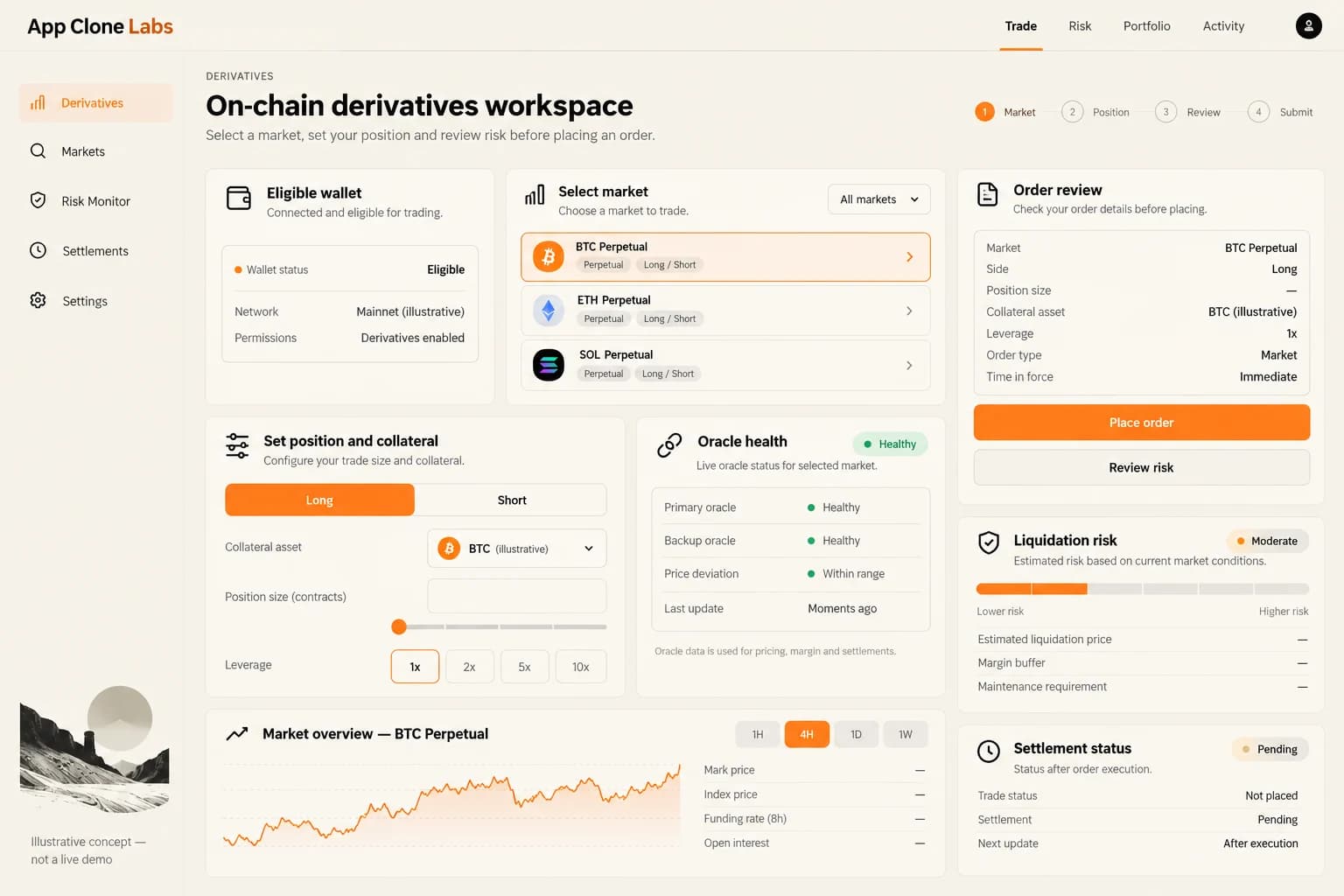
Original on-chain trading concept. Markets, prices and statuses are illustrative and do not establish liquidity, trading volume, audit status or live contracts.
What to check in the walkthrough
Traders go where prices are best, and prices are best where pools are deep. A new DEX with a polished interface and empty pools will lose to an older one with ugly screens and deep liquidity.
Treat liquidity as the launch plan: which pairs matter to your users, who will supply them on day one, and what it costs to keep them there.
We start from a working exchange with swaps, pools and routing already running, so you can trade on the demo before committing. It is rebranded for you, and the contracts and interface come with full unencrypted source.
Network choice, fee settings, routing partners and the audit are planned with you. We prepare the contracts for audit and make the fixes auditors ask for.
Liquidity providers can lose value when prices move, and traders can lose money on unsafe tokens. Show both risks plainly in the interface rather than in a help page nobody reads.
FAQ
A decentralised exchange in the style of SushiSwap, with token swaps, liquidity pools and cross-network routes, delivered with the smart contracts and web interface under your brand.
No. Traders and liquidity providers connect their own wallets. The exchange never holds their funds outside the pool contracts.
Yes. Every contract that will hold user funds should be audited by an independent firm before launch, and again after any change.
Ethereum and other EVM-compatible networks. Most teams launch on one or two networks where their users already are, then add more.
You do. Contracts, interface and admin tools arrive as unencrypted source, and you decide where they are deployed, who audits them and what changes.
Primary sources
Dated official documentation, standards, and research that support the factual claims on this page.
Reference documentation for the pool designs most DEXs build on.
An overview of DeFi, including how DEXs and liquidity pools work.
US Treasury guidance on sanctions obligations for virtual currency businesses.
How to read this page
Scope, cost and timeline figures are planning guidance until confirmed in a written proposal. Diagrams and screens are illustrations, not client deliverables, and source-code rights and handover follow the signed agreement. See the delivery process and the full disclaimer.
Next decision
Define outcomes, constraints, evidence, rights and handover before delivery begins.
Commercial rights, repositories, environments, documentation, acceptance and handover remain contract-defined.
